Chainsaw Safety
Updated 2026-07-28
In this bundle Tools & Machinery
Working in Washington? See the WA DOSH edition → Washington (WA DOSH)
Print-ready PDF
Download this talk as a print-ready PDF, available in 4 languages.
A chainsaw is the only tool most crews use that has no guard at all. Every other cutting tool on a site puts something between the blade and the operator; the chainsaw puts the cutting edge in open air, at the end of a bar, held at arm's length. The controls that replace the guard are a brake, a stance and a set of habits. This Chainsaw Safety Toolbox Talk (Safety Talk / Tailgate Talk) covers those — and the odd position the tool occupies in the regulations.
Here is the distinction that carries this whole talk: kickback is not the chain hitting something — it is the bar being thrown. When the upper quadrant of the bar nose contacts an object, the chain's rotation drives the bar up and back toward the operator in a fraction of a second. It is faster than a reflex, and it is the mechanism behind most severe chainsaw injuries. The chain brake exists specifically to stop the chain during that arc.
The chainsaw text OSHA has — and where it lives#
Search the construction standards for chainsaw requirements and you will not find them. Site clearing is addressed at 1926.604, and the general tool duties apply — 1926.300(a), tools maintained in a safe condition, and 1926.300(c), PPE for employees exposed to flying and abrasive objects — but there is no construction provision setting out how a chainsaw is started, held, fuelled or carried.
That text exists in exactly one place: 29 CFR 1910.266(e)(2), inside the logging operations standard, in the Special Industries subpart of the general industry regulations. It is a comprehensive set of requirements, and by its own scope it is written for logging rather than for construction site clearing.
So the position is the one we have met before on this site: the enforceable construction text is thin, and the detailed text sits in a standard aimed at somebody else. Where a contract, an owner or EM 385-1-1 does not import it directly, the logging provisions are still the clearest published statement of what competent chainsaw practice looks like — and manufacturer instructions plus ANSI B175.1 carry the rest.
Here is what that standard requires, and it is worth reading as a checklist rather than as law:
- Each chain saw placed into initial service after the standard's effective date shall be equipped with a chain brake and shall otherwise meet ANSI B175.1-1991. Saws placed into service before it shall have a protective device that minimizes chain-saw kickback.
- No chain-saw kickback device shall be removed or otherwise disabled.
- Each gasoline-powered chain saw shall have a continuous pressure throttle control system which will stop the chain when pressure on the throttle is released.
- The saw shall be operated and adjusted in accordance with the manufacturer's instructions.
- It shall be fuelled at least 10 feet (3 m) from any open flame or other source of ignition, and started at least 10 feet (3 m) from the fueling area.
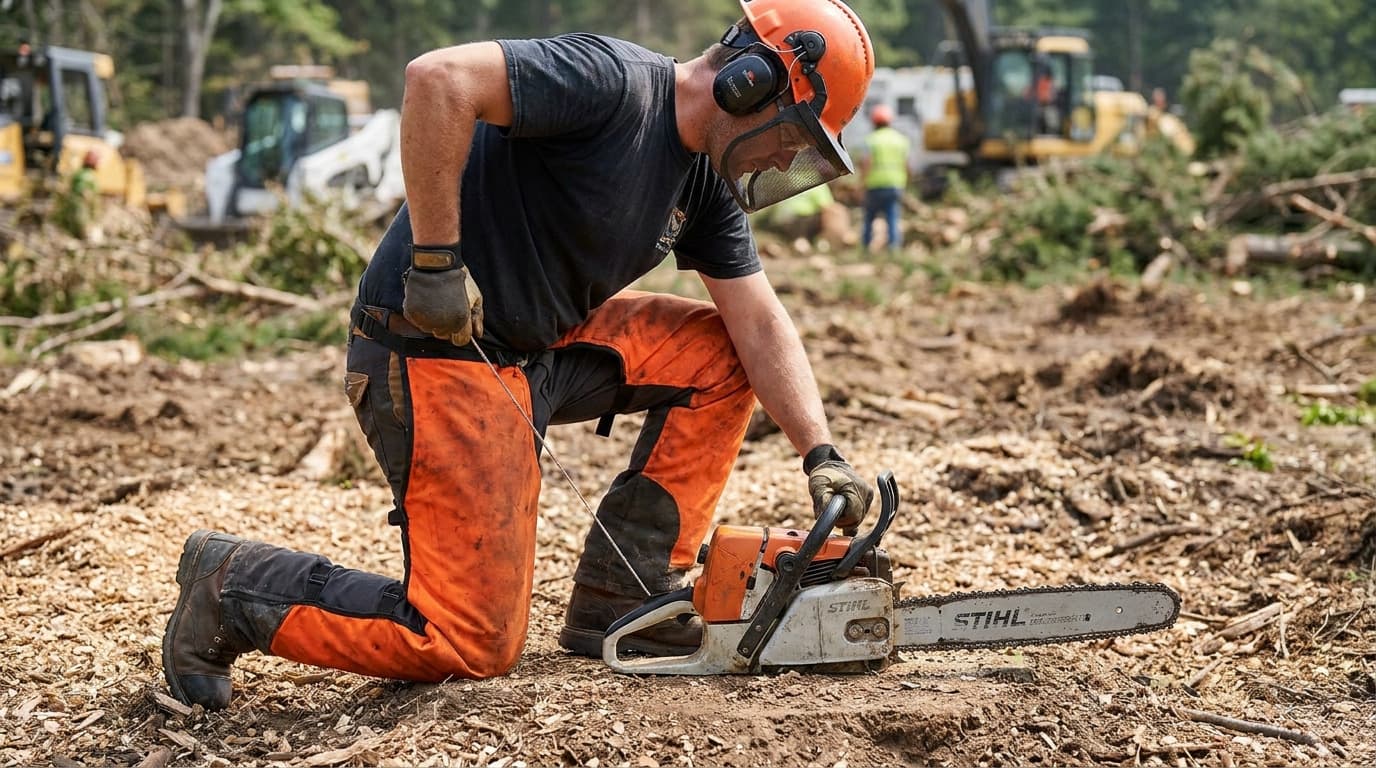
- It shall be started on the ground or where otherwise firmly supported. Drop starting is prohibited.
- It shall be started with the chain brake engaged.
- It shall be held with the thumbs and fingers of both hands encircling the handles during operation, unless the employer demonstrates a greater hazard is posed by keeping both hands on the saw in that particular situation.
- The operator shall be certain of footing before starting to cut, and the saw shall not be used in a position or at a distance that could cause the operator to become off balance, to have insecure footing, or to relinquish a firm grip.
- The saw shall not be used to cut directly overhead.
- The saw shall be shut down or the chain brake engaged whenever it is carried further than 50 feet (15.2 m) — and at less than 50 feet where terrain, underbrush, slippery surfaces or similar conditions may create a hazard.
The four that get skipped#
Drop starting. Starting a saw by holding it in one hand and pulling the cord with the other, letting the saw fall away. It is fast, it is common, and it is expressly prohibited. The saw is started on the ground or firmly supported.
Starting with the brake engaged. A brake takes a second to set and removes the entire hazard of a chain that runs on start-up while the saw is being lifted into position.
Thumbs wrapped. Fingers over the top of the front handle and thumb alongside is the grip that loses the saw in a kickback. Thumbs and fingers encircling is what keeps the bar in your control when it comes back at you.
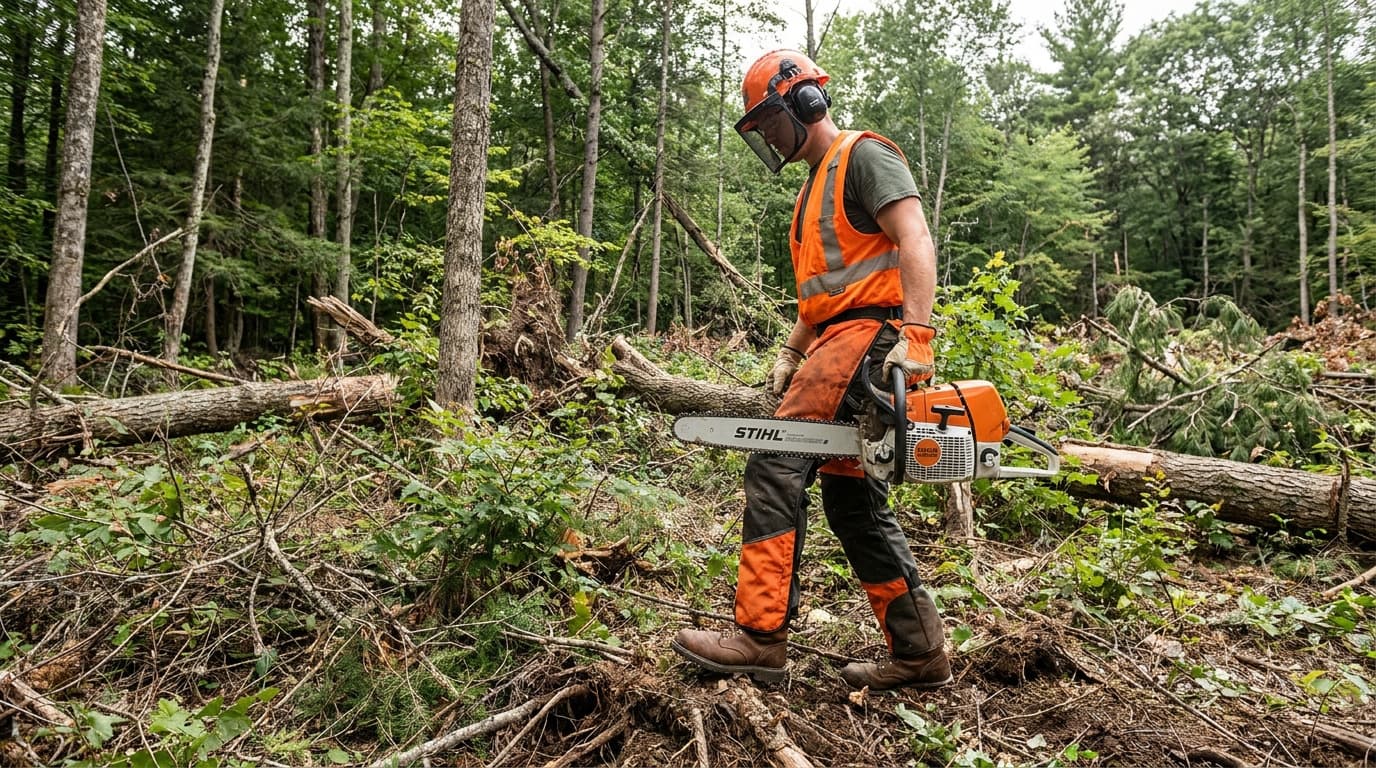
The carry rule. Shut down or brake engaged past 50 feet (15.2 m), and at any distance where the ground is bad. A running saw carried through brush is a moving cutting edge next to a leg.
What can go wrong?#
Kickback. Nose contact in the upper quadrant, bar driven up and back toward the head and shoulder. The chain brake and the kickback device are the designed responses — which is why disabling either is so serious.
Cutting overhead or above shoulder height. The saw is out of control range, the reaction goes toward the head, and there is no stance that recovers it.
Bad footing. Slope, mud, brash, standing on the material being cut. Almost every serious chainsaw injury has a footing component.
Fuel and hot surfaces. Refuelling a hot saw, or starting where the vapour is. The 10-foot separations exist for both ends of that.
Pinched bar and springback. Tension in the timber closing the cut, or a limb under load releasing when cut.
Nobody else knows where the cut is going. Section falls, rolls, or drops on somebody working below.
Fatigue. Chainsaw work is heavy, hot and vibration-loaded, and grip strength is the thing that fails first.
How do we do this properly?#
Check the saw before it starts. Chain brake functioning, chain tension and sharpness correct, all bolts and handles secure, throttle returning and stopping the chain, kickback device present and not disabled.
Fuel it away from ignition and start it away from the fuel — at least 10 feet (3 m) for each — and never refuel a hot saw. Fuel handling and container rules are covered in the fuel storage talk.
Start it on the ground, with the brake on. Never drop start.
Wrap the thumbs. Both hands, thumbs and fingers encircling the handles, every cut.
Plan the footing before the cut. Firm stance, escape route clear, never standing on the piece you are cutting, and never on a ladder.
Never cut above shoulder height or directly overhead.
Set the brake or shut down to move. Past 50 feet (15.2 m) always, and sooner on bad terrain, in brush, or on slippery ground.
Wear the whole set. Cut-resistant leg protection, eye and face protection, hearing protection, helmet where anything can fall, gloves and boots. The PPE duty in 1926.300(c) applies to flying and abrasive objects; the leg protection comes from the tool having no guard.
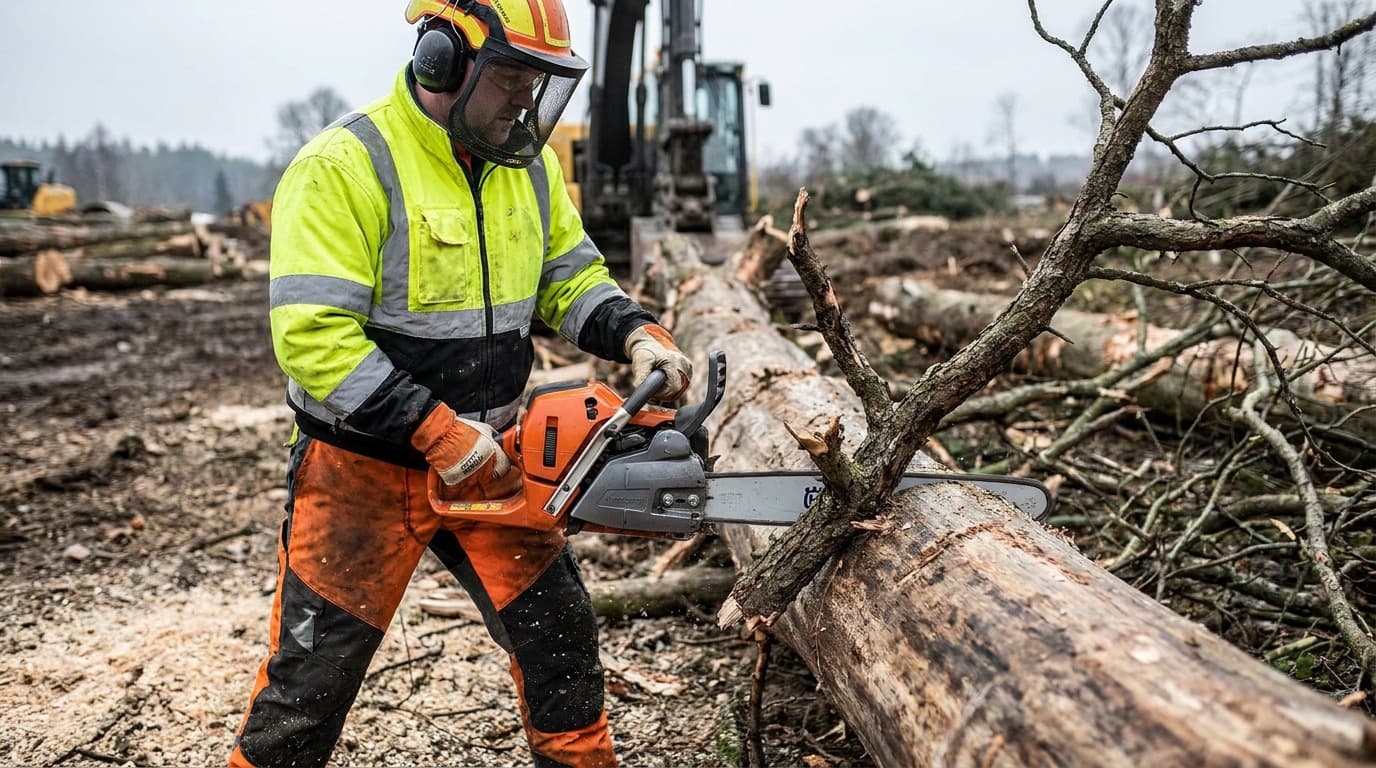
Keep people out of the drop and roll zone, and never work alone where a serious cut cannot be reached quickly.
Before you start#
- Confirm the chain brake works, and that no kickback device has been removed or disabled.
- Confirm the throttle stops the chain when released, and the chain is sharp and correctly tensioned.
- Confirm fuelling happened at least 10 feet (3 m) from ignition sources, and you are starting at least 10 feet (3 m) from the fuel.
- Confirm the saw will be started on the ground or firmly supported, with the brake engaged.
- Confirm your footing, your escape route and that you are not standing on what you are cutting.
- Confirm nothing about this cut is above shoulder height or directly overhead.
- Confirm where the section will fall, roll or spring, and that nobody is in it.
- Confirm leg, eye, face, hearing and head protection is on before the saw starts.
Talk it over#
- Has anyone here had a saw kick back? Where did the bar end up?
- Who drop starts, and what would it take to stop?
- What is under and behind the last cut you made — and who was there?
- Is the chain brake on our saw actually tested, or just assumed to work?
The bottom line#
There is no construction standard telling you how to run a chainsaw. The detailed text sits in 29 CFR 1910.266(e)(2), the logging standard, which is written for a different industry — so on a construction site it is the recognised description of competent practice rather than the citation, alongside manufacturer instructions, ANSI B175.1, and the general duties in 1926.300(a) and 1926.300(c). What that text says is worth borrowing whole: chain brake fitted, kickback device never removed or disabled, throttle that stops the chain on release, fuel 10 feet (3 m) from ignition, start 10 feet (3 m) from the fuel, started on the ground with the brake engaged, drop starting prohibited, thumbs and fingers encircling both handles, certain footing, never cutting directly overhead, and shut down or brake engaged when carried past 50 feet (15.2 m) — or sooner when the ground says so.
Frequently asked questions about chainsaw safety#
Does OSHA have a chainsaw standard for construction?
Not a specific one. Chainsaw requirements are set out in 29 CFR 1910.266(e)(2), which is part of the logging operations standard in the general industry regulations and is written for logging rather than construction. On construction sites the applicable duties are the general ones — 1926.300(a) on maintaining tools in safe condition, 1926.300(c) on PPE, and 1926.604 on site clearing — with the logging text, manufacturer instructions and ANSI B175.1 describing competent practice.
What is a chain brake and is it required?
A device that stops the chain, most importantly during a kickback arc. Under 1910.266(e)(2), each chain saw placed into initial service after the standard's effective date must be equipped with a chain brake and otherwise meet ANSI B175.1-1991; saws placed into service earlier must have a protective device that minimizes kickback. The same paragraph provides that no chain-saw kickback device shall be removed or otherwise disabled.
Why is drop starting prohibited?
Because the saw is unsupported and moving while the chain can start turning, with one hand on the saw and nothing controlling where it goes. 1910.266(e)(2) requires the chain saw to be started on the ground or where otherwise firmly supported, and states plainly that drop starting a chain saw is prohibited.
How far from the fuel should a chainsaw be started?
At least 10 feet (3 m) from the fueling area, and the saw must be fuelled at least 10 feet (3 m) from any open flame or other source of ignition. Two separate 10-foot separations: one for fuelling, one for starting.
How should a chainsaw be held?
With the thumbs and fingers of both hands encircling the handles during operation, unless the employer demonstrates that a greater hazard is posed by keeping both hands on the saw in that particular situation. The wrapped thumb is what keeps the saw under control through a kickback.
When does the chain brake have to be engaged for carrying?
The saw must be shut down or the chain brake engaged whenever it is carried further than 50 feet (15.2 m) — and also at less than 50 feet where conditions such as terrain, underbrush and slippery surfaces may create a hazard for an employee.
Can a chainsaw be used above shoulder height?
1910.266(e)(2) provides that the chain saw shall not be used to cut directly overhead, and that it shall not be used in a position or at a distance that could cause the operator to become off balance, to have insecure footing or to relinquish a firm grip on the saw. Above shoulder height fails all three tests — the reaction from a kickback travels toward the head and there is no stance that recovers it.
Download the chainsaw safety toolbox talk PDF#
Get this chainsaw safety toolbox talk as a print-ready PDF — available in English, Spanish, Portuguese, and Turkish. Print it, hand it to the crew, and collect signatures on the included attendance sheet.
Download the PDF — free account required. New members get 3 free downloads.
Related toolbox talks#
Sources#
- OSHA, 29 CFR 1910.266 — Logging operations: https://www.osha.gov/laws-regs/regulations/standardnumber/1910/1910.266
- OSHA, 29 CFR 1926.300 — General requirements (Subpart I, Tools — Hand and Power): https://www.osha.gov/laws-regs/regulations/standardnumber/1926/1926.300
- OSHA, 29 CFR 1926.604 — Site clearing: https://www.osha.gov/laws-regs/regulations/standardnumber/1926/1926.604
Written by FieldSafetyTalk's safety professional — a CSP, ASP, CHST and OSHA Authorized Outreach Trainer with 14+ years of international construction safety experience across federal, heavy civil, and industrial projects.