Skid Steer Loader Safety
Updated 2026-11-02
In this bundle Vehicle Safety
Print-ready PDF
Download this talk as a print-ready PDF, available in 4 languages.
A skid steer is the smallest machine on most jobsites and the one that kills in the most particular way. It does not usually run people over the way a dump truck does. It pins them: between the lift arm and the frame, between the bucket and the cab, almost always while the person is halfway in or out of it, or reaching into a space the machine was about to close. This Skid Steer Loader Safety Toolbox Talk (Safety Talk / Tailgate Talk) is about why that keeps happening to experienced operators, and about the one rule that stops it: the machine protects you in the seat, and nowhere else.
Where the boundary of this talk sits#
The heavy equipment talk owns the big iron: blind spots, swing radius, the rules in 1926.602 that every earthmoving machine shares. The backing-up talk owns the spotter and the reverse alarm. The struck-by talk owns the people on foot around any machine. The telehandler talk owns the boom. All are linked. This talk owns the skid steer's own geometry: lift arms that pass inches from the operator on both sides, a bucket that can pin a person against the frame, an operator's compartment you climb into across the attachment, a machine short enough to disappear behind a truck and light enough to tip with the arms up, and a set of safety devices — seat bar, interlocks, belt, cab, side screens, lift-arm support — that were designed around one assumption: that you are sitting down. It is written for construction, where 1926.602 brings in the earthmoving rules — with one twist covered below: OSHA reserved the skid steer's specific rules in 1971 and never wrote them.
The anchor#
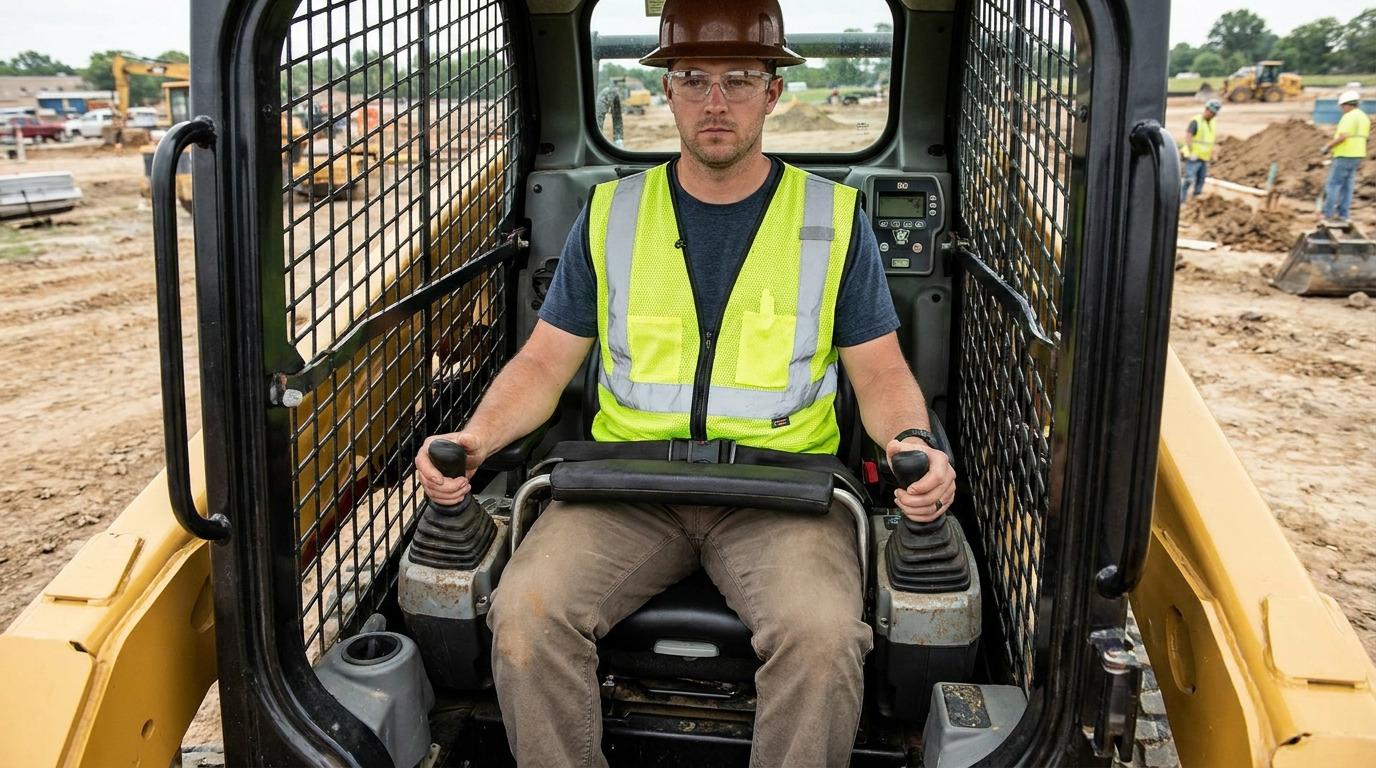
Here is the distinction that carries this whole talk: a skid steer's protection is built around one position — seated, belted, seat bar down, arms and legs inside — the interlocks lock the controls when you leave it, the ROPS and FOPS cover it, the side screens close it, and the lift arms sweep past it on both sides; which is why nearly every skid steer death happens to someone who is not in it — reaching under a raised arm, leaning out past the screen, climbing in or out across the bucket, standing where the operator cannot see — and why the only safe way to be anywhere else on this machine is with the attachment flat on the ground, or the engine off, or the lift-arm support locked in.
What the numbers say#
NIOSH looked at 37 skid steer deaths investigated between 1992 and 1997. Twenty-nine of them — 78 percent — were people pinned between the bucket or lift arm and the frame; six were rollovers. In ten of the deaths the person was working or standing under a raised lift arm or attachment with no support device in place; in eight the operator leaned out of the compartment into the arm's path; in five the person was climbing in or out. OSHA's own records say the same thing a decade later: 100 skid steer accidents from 1997 to 2007, and in one of every five a safety device had been deliberately bypassed — "with all but one resulting in a fatality." Read those two findings together: the machine did what it was built to do, and the person was somewhere it was never built to protect.
The crush zone: lift arms, bucket, and frame#
Look at a skid steer from the side. The lift arms pivot behind the operator's shoulders, run forward along both sides of the cab, and meet in front at the bucket or attachment. When the arms are up, the only way into or out of the seat is through the front, over or around the attachment, directly under the path the arms take when they come down. If a control is bumped, a hydraulic line bleeds down, or someone in the seat does not know you are there, the arms close the space you are standing in.
That is why the two oldest rules on this machine are about the arms, not the engine. First: you enter and exit only when the bucket or attachment is flat on the ground, or when the lift-arm support device is locked in place. Second: nobody works, reaches, or walks under a raised arm or attachment unless the manufacturer's lift-arm support is installed — the pin, the strut, or the bracket the machine came with, not a block of wood, not "I'll just be a second," not the hydraulics holding it where it is. NIOSH put it in a sentence: "Use the lift-arm support device provided by or recommended by the manufacturer" whenever working or moving under a raised arm. The support exists because hydraulics drift and people lean on levers, and both happen on quiet afternoons with nobody meaning any harm.
The devices, and what "bypassed" means#
The machine is built around the seat, and each device is a piece of that design. The seat belt keeps you in the protected zone and, in a rollover, keeps you from being thrown into the arms or out under the cab; NIOSH: "Make sure that the seat belt is secured around the operator whenever the operator is in the seat." The seat bar, the padded bar you pull down across your lap, is part of the interlock, not just an armrest. The control interlock reads the seat switch and the bar together: controls locked unless someone is seated with the bar down, and on most machines the engine or the hydraulics shut off if the operator stands up or lifts the bar to work the controls from outside. The ROPS is the cage that keeps the machine off you in a rollover and the FOPS is the roof that keeps the load off you; the side screens close the openings the arms pass beside. The lift-arm support we have already met. The horn and reverse alarm are the machine's only voice to people it cannot see.
Now read what "bypassed" looked like in OSHA's three cases from the 2009 bulletin: an interlock disabled so the controls worked with nobody in the seat; a lap bar held down by hand so the operator could run the controls standing outside the cab; a seat bar jammed into the interlock; seat belts removed. In NIOSH's cases, a glove stuffed into the seat-belt interlock linkage. None of those were done by people who wanted to die; they were done to save a climb in and out. The rule on the crew is the one OSHA wrote: "Never modify, bypass, disable, or override safety systems." A skid steer whose interlock does not lock, whose bar does not cut the controls, whose belt is missing, or whose alarm is dead is out of service until it is fixed, and the person who finds it that way says so.
Tipping and traveling#
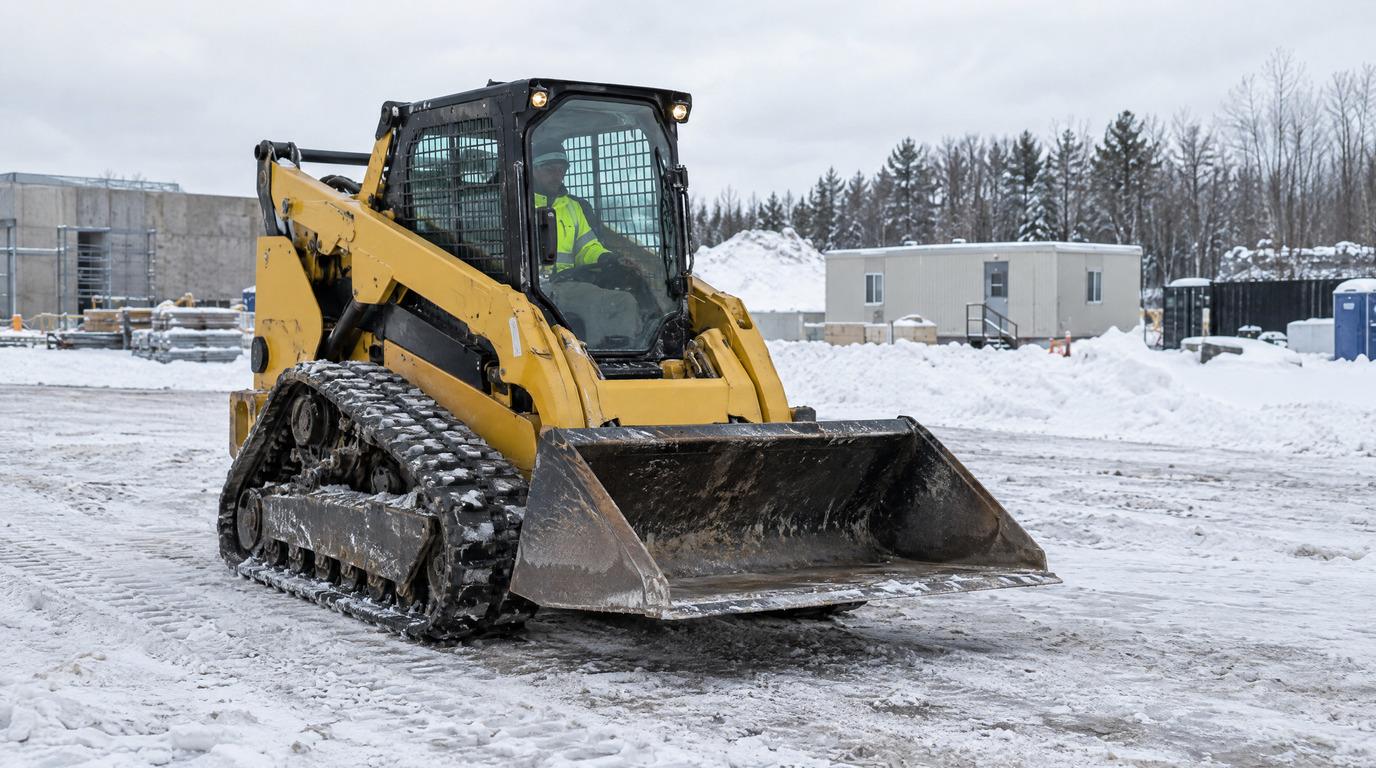
A skid steer is short, its weight is forward when the bucket is loaded, and its center of gravity climbs with the arms. Travel with the bucket or attachment low, carry loads low, and raise the arms only at the pile or the truck, on level ground, with the machine stopped. Go straight up and straight down slopes with the heavy end uphill, the way the manual says; do not cross a slope with the arms up. Turn slowly with a raised load — the machine steers by skidding, and a loaded bucket at height turns a quick pivot into a lean. If it goes over, the belt and the ROPS are what you have, and they only work if the belt is on and the cab is still bolted on. OSHA added rubber-tired skid steer equipment to the ROPS rules in Subpart W for machines manufactured after July 15, 2019 — protective frames to ISO 3471:2008 — and the rule that ROPS removed for any reason are remounted with bolts or welding equal to or better than the original. Twenty years earlier OSHA had already called rollover on skid steer equipment a recognized hazard under the General Duty Clause, with ROPS and seat belts as feasible controls. Either way: the cab stays on, and you stay in it.
The people the operator cannot see#
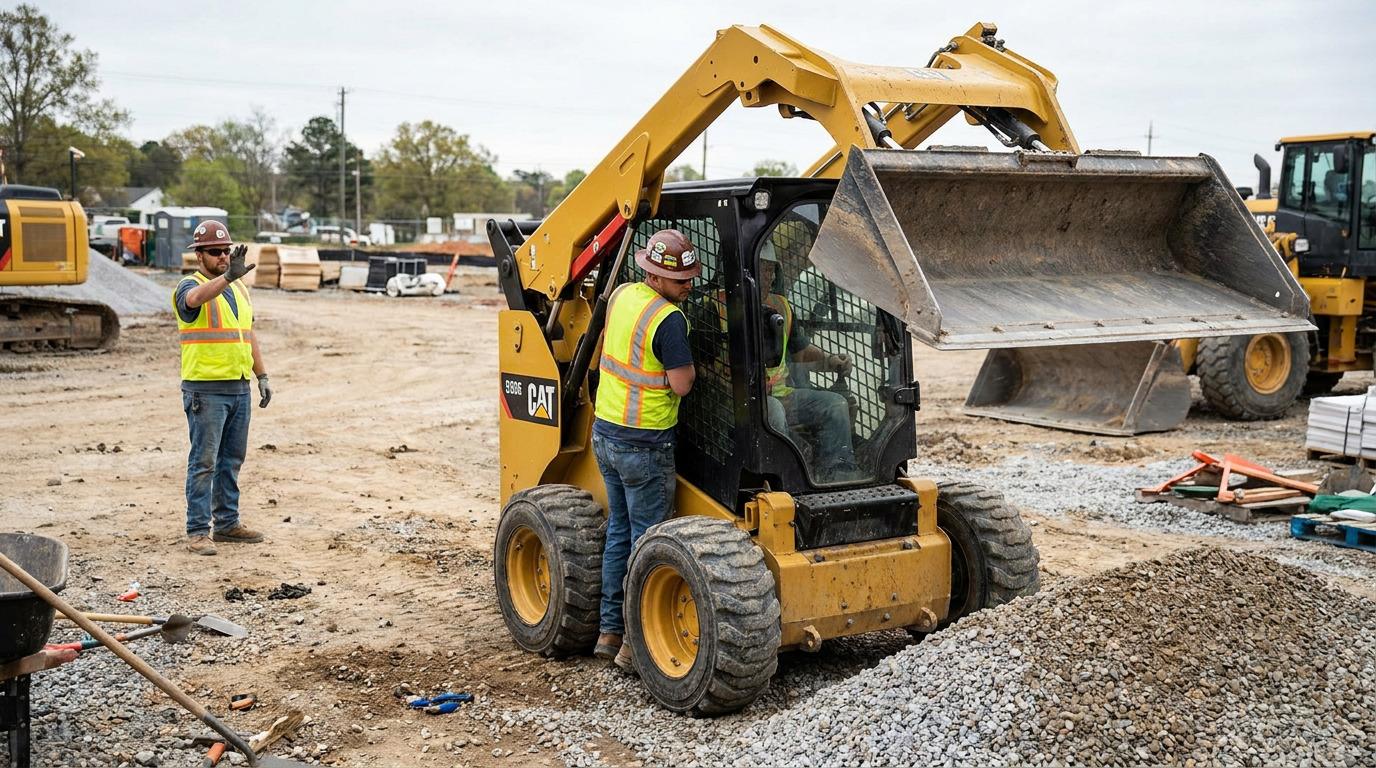
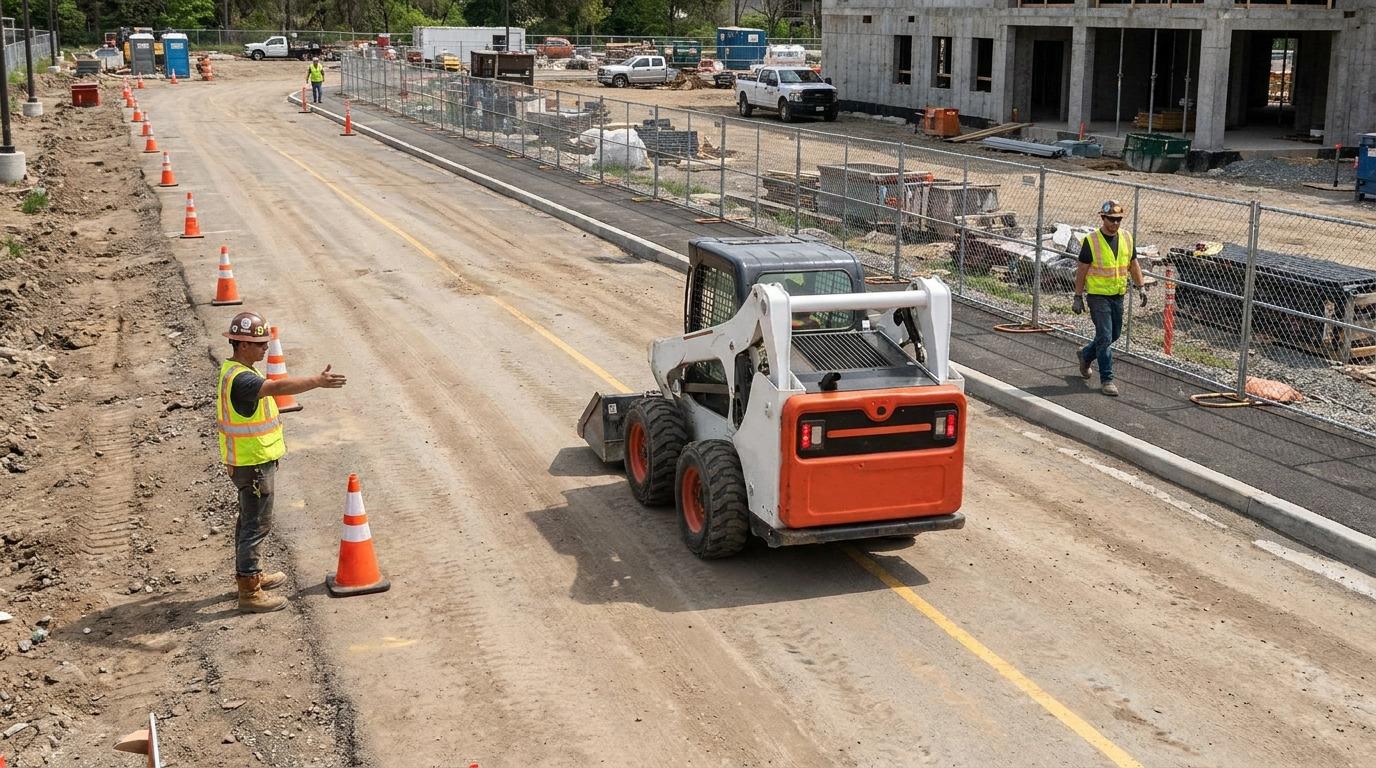
A skid steer operator looks out through a slot between two lift arms, with the bucket in the way low and the arms in the way high, and sees almost nothing directly behind. The machine is bidirectional and its view to the rear is obstructed, which is exactly the machine 1926.602(a)(9) describes: a horn distinguishable from the surrounding noise, and no operation in reverse unless a reverse signal alarm sounds or a signal person says it is clear. Around the machine, the rule is distance and eye contact: nobody walks up to a running skid steer from the side or the rear; get where the operator can see you, signal, and wait for the arms to come down and the bucket to touch the ground before you approach. Nobody rides in the bucket, on the attachment, or on the step — there is no protected position for a second person anywhere on this machine. And attachments change the machine — a breaker, an auger, a trencher, a grapple, a set of forks each has its own reach — so the quick-attach pins are checked locked before the arms lift, and only attachments the manufacturer approves go on.
Who is allowed to run it#
A forklift card does not cover a skid steer. OSHA said so in 2004, in writing, to a skid steer dealer: the powered industrial truck training rule in 1910.178(l) excludes vehicles intended primarily for earthmoving, and a skid steer loader is one. What applies in construction is 1926.21(b)(2) — training in the recognition and avoidance of unsafe conditions for the work and the site — and 1926.20(b)(4), which lets the employer permit only employees "qualified by training or experience" to operate equipment. OSHA added the line every crew should hear: having operated the machine before does not by itself mean the operator knows how to run it safely. Qualified means trained on this machine, its interlocks, its attachments, and its manual, and shown to be able to use them.
Where the duty sits#
1926.602(a)(1) lists the earthmoving equipment the section covers and then says the specific rules for compactors and rubber-tired skid steer equipment are reserved — OSHA never wrote them. So the skid steer is governed by the pieces around that gap: 1926.602(a)(2) for seat belts on the machine and 1926.28(a) for wearing them, which is how OSHA said in 2003 it enforces seat belt use on earthmoving equipment; 1926.602(a)(9) for the horn and reverse alarm; Subpart W, 1926.1000 and 1926.1001(c), for ROPS on skid steer equipment manufactured after July 15, 2019 and for remounting any ROPS that comes off; Section 5(a)(1) of the OSH Act, which OSHA invoked in 1998 for rollover on skid steer equipment and which reaches the crush hazard the manufacturer's interlocks and lift-arm supports are built to control; and 1926.20(b)(4) and 1926.21(b)(2) for who runs it and what they are taught. OSHA's 2009 bulletin and the NIOSH alert are not standards, but they are the two documents everyone reads after a skid steer death, and everything in them is in this talk.
What can go wrong?#
- The operator stands up to see over the bucket, the seat switch opens, and nothing happens — because someone wired around it last winter.
- A laborer reaches under the raised arms to pull a rock out of the quick-attach, and the operator, not seeing him, lowers the bucket.
- The operator climbs out over the bucket with the arms half up to check a hose; the arms drift down while his leg is still across the frame.
- A helper rides in the bucket across the site "for thirty feet" and is thrown out when the front wheels drop into a rut.
- A loaded bucket goes up the slope sideways at full height; the uphill wheels lift and the machine rolls onto its side with the belt unbuckled.
- The reverse alarm has been dead for a month; a carpenter walks behind the machine with an armload of lumber as it backs out of the garage.
How do we manage this properly?#
- Seat, belt, bar, limbs inside — the only operating position; the controls do not move until all four are true.
- Attachment flat on the ground before anyone enters, exits, or approaches — and the engine off if the operator is leaving the seat for more than a moment.
- Lift-arm support locked before anyone goes under a raised arm — the manufacturer's device, every time, no exceptions for "quick."
- Bypassed means out of service — any interlock, seat bar, belt, screen, or alarm that does not work as designed parks the machine and gets reported.
- Loads low, arms up only when stopped and level — straight up and down slopes, heavy end uphill, slow turns with anything raised.
- Distance and eye contact for everyone on foot — nobody approaches until the arms are down and the bucket is on the ground; nobody rides, anywhere.
- Quick-attach pins checked locked — before the arms lift, every attachment change.
- Qualified means trained on this machine — not a forklift card, not "I've run one before."
Before you start#
Walk around the machine: tires, lift arms and pins, hoses, quick-attach, lights, horn, reverse alarm. Climb in across a grounded attachment, sit, buckle, pull the bar down, and test the interlock the way the manual says: controls dead with the bar up, dead with you off the seat. Find the lift-arm support and confirm it is on the machine and fits the arms; if you will be under the arms today, it goes in before you are. Know the attachment, its weight, and what it does to the machine's balance. Look at the ground you will cross and the slopes you will climb. Name the people who will be working on foot near the machine and agree on the signal that brings the arms down.
Talk it over#
- Where on this site do people walk past a running skid steer without the operator seeing them?
- Has anyone here ever reached under a raised bucket to clear something? What was the engine doing?
- When did we last test the seat bar and seat switch instead of assuming they work?
- Who on this crew has actually been trained and evaluated on this skid steer, with these attachments?
- What would you do if you found a glove jammed in the interlock on Monday morning?
The bottom line#
A skid steer protects one position — seated, belted, bar down, limbs inside — and nearly every skid steer death is someone outside it: 78 percent of the people NIOSH counted were pinned between the arms or bucket and the frame, and one in five of the accidents OSHA counted began with a safety device somebody bypassed. So the attachment is on the ground before anyone climbs in, out, or close; the lift-arm support is locked before anyone goes under; the belt is on and the bar is down before the controls move; nobody rides; and a machine with a defeated interlock is a machine nobody runs. OSHA never wrote the skid steer rule, but the machine's own devices wrote it for you.
Frequently asked questions about skid steer safety#
Can I reach in and clear the bucket if the engine is running and I'm quick?
No. Reaching under or between the lift arms with the machine running is how most skid steer deaths happen. Lower the attachment to the ground, shut the engine off, and if the arms must stay up, lock the manufacturer's lift-arm support in place first.
Is the seat bar just an armrest?
No. On a skid steer the seat bar is part of the control interlock: with the bar up or the seat empty, the controls are locked and on most machines the engine or hydraulics shut down. Holding it down by hand from outside, jamming it, or wiring around it defeats the one system built to stop the arms while you are in their path.
I'm certified on a forklift. Can I run the skid steer?
Not on that card. OSHA's 2004 letter says the forklift training rule excludes vehicles intended primarily for earthmoving, which a skid steer is. In construction you need training under 1926.21(b)(2) and the employer must find you qualified under 1926.20(b)(4) — and OSHA says having run one before does not by itself make you qualified.
Does a skid steer need ROPS?
Yes. Rubber-tired skid steer equipment manufactured after July 15, 2019 falls under OSHA's Subpart W, with protective frames to ISO 3471:2008, and any ROPS removed for any reason has to be remounted as well as the original. For older machines OSHA treats rollover on skid steer equipment as a recognized hazard under the General Duty Clause and ROPS and seat belts as feasible controls. In practice: the cab stays on the machine and the belt stays on you.
Can I give someone a lift in the bucket?
No. There is no protected position on a skid steer for anyone but the operator. NIOSH's rule is "never carry riders," and OSHA's bulletin says the same. A person in a bucket is standing in the one place the machine is designed to swing, dump, and lower.
I set the parking brake — can I get out with the arms up to check something?
Only with the lift-arm support locked in. The parking brake stops the wheels, not the arms. Hydraulics drift, controls get bumped, and the way out of the seat passes under the arms' path. Lower the attachment to the ground, or install the support, and then get out.
What if the reverse alarm or horn doesn't work?
The machine does not operate in reverse until it is fixed or a signal person is directing every move — that is 1926.602(a)(9). A skid steer's view to the rear is obstructed by design, and the alarm is the only warning a person behind it gets.
Download the skid steer safety toolbox talk PDF#
Download this Skid Steer Loader Safety Toolbox Talk (Safety Talk / Tailgate Talk) as a printable PDF in English, Spanish, Portuguese, and Turkish for your next tailgate meeting, and read it standing next to the machine with the lift-arm support in your hand.
Related toolbox talks#
- Heavy Equipment Safety
- Backing Up and Spotters
- Struck-By Hazards
- Telehandler (Rough Terrain Forklift) Safety
Sources#
- OSHA, 29 CFR 1926.602 — Material handling equipment ((a)(1) covered earthmoving equipment, with specific rules for compactors and rubber-tired "skid-steer" equipment reserved; (a)(2)(i) seat belts provided on all covered equipment; (a)(9)(i) horn on bidirectional machines; (a)(9)(ii) no reverse operation with an obstructed rear view without a reverse signal alarm or a signal person): https://www.ecfr.gov/current/title-29/subtitle-B/chapter-XVII/part-1926/subpart-O/section-1926.602
- OSHA, 29 CFR 1926.1000 — Rollover protective structures (ROPS), Scope ((a) applies to compactors and rubber-tired skid-steer equipment manufactured after July 15, 2019 and used in construction; (c) ROPS meeting 1926.1001(c); (d) ROPS removed for any reason remounted with equal or better bolts or welding) and 29 CFR 1926.1001(c) (ISO 3471:2008 for equipment manufactured on or after July 15, 2019): https://www.osha.gov/laws-regs/regulations/standardnumber/1926/1926.1000
- OSHA Standard Interpretation, November 5, 2004 — skid-steer loader operator training (1910.178(l) does not apply to vehicles intended primarily for earthmoving; 1926.21(b)(2) training; 1926.20(b)(4) "qualified by training or experience"; prior operation does not by itself establish qualification): https://www.osha.gov/laws-regs/standardinterpretations/2004-11-05
- OSHA Standard Interpretation, December 15, 2003 — seat belt use on earthmoving equipment (1926.602(a)(2)(i) requires belts be provided; failure to use them citable under 1926.28(a)): https://www.osha.gov/laws-regs/standardinterpretations/2003-12-15-1
- OSHA Standard Interpretation, March 16, 1998 — rollover protection for compactors and skid steer equipment (specific rules reserved under 1926.602(a)(1); rollover a recognized hazard under Section 5(a)(1); ROPS and seat belts feasible): https://www.osha.gov/laws-regs/standardinterpretations/1998-03-16-0
- OSHA Safety and Health Information Bulletin, January 12, 2009 — Hazards Associated with Operating Skid-Steer Loaders with Bypassed and/or Improperly Maintained Safety Devices (100 skid-steer loader accidents in IMIS 1997–2007, 20 percent directly caused by deliberately bypassed safety features, all but one fatal; seat belt, seat bar, control interlock, lift-arm support, ROPS/FOPS; employer and operator recommendations; 1926.20(b)(2) and 1926.21(b)(2) in construction): https://www.osha.gov/sites/default/files/publications/shib011209.pdf
- NIOSH Alert, Preventing Injuries and Deaths from Skid-Steer Loaders, DHHS (NIOSH) Publication No. 2011-128, December 2010 (37 FACE fatalities 1992–1997, 29 (78 percent) pinned between the bucket or lift arm and the frame, 6 rollovers; 10 under a raised lift arm or attachment without a support device, 8 leaning out of the compartment, 5 entering or exiting; recommendations on seat belts, interlocks, lift-arm supports, ROPS/FOPS, side screens, riders, entering and exiting): https://Cdc.gov/niosh/docs/2011-128/pdfs/2011-128.pdf
Written by FieldSafetyTalk's safety professional — a CSP, ASP, CHST and OSHA Authorized Outreach Trainer with 14+ years of international construction safety experience across federal, heavy civil, and industrial projects.