Winter Driving Safety
Updated 2026-07-31
In this bundle Jobsite Fundamentals & Compliance
Print-ready PDF
Download this talk as a print-ready PDF, available in 4 languages.
Winter driving gets treated as ordinary driving performed more carefully. It is not. The surface under the tyres changes its physical properties, and almost everything a driver has learned about how the vehicle responds becomes wrong by a margin nobody can estimate accurately from behind the wheel. This Winter Driving Safety Toolbox Talk (Safety Talk / Tailgate Talk) is about what actually changes and what genuinely helps.
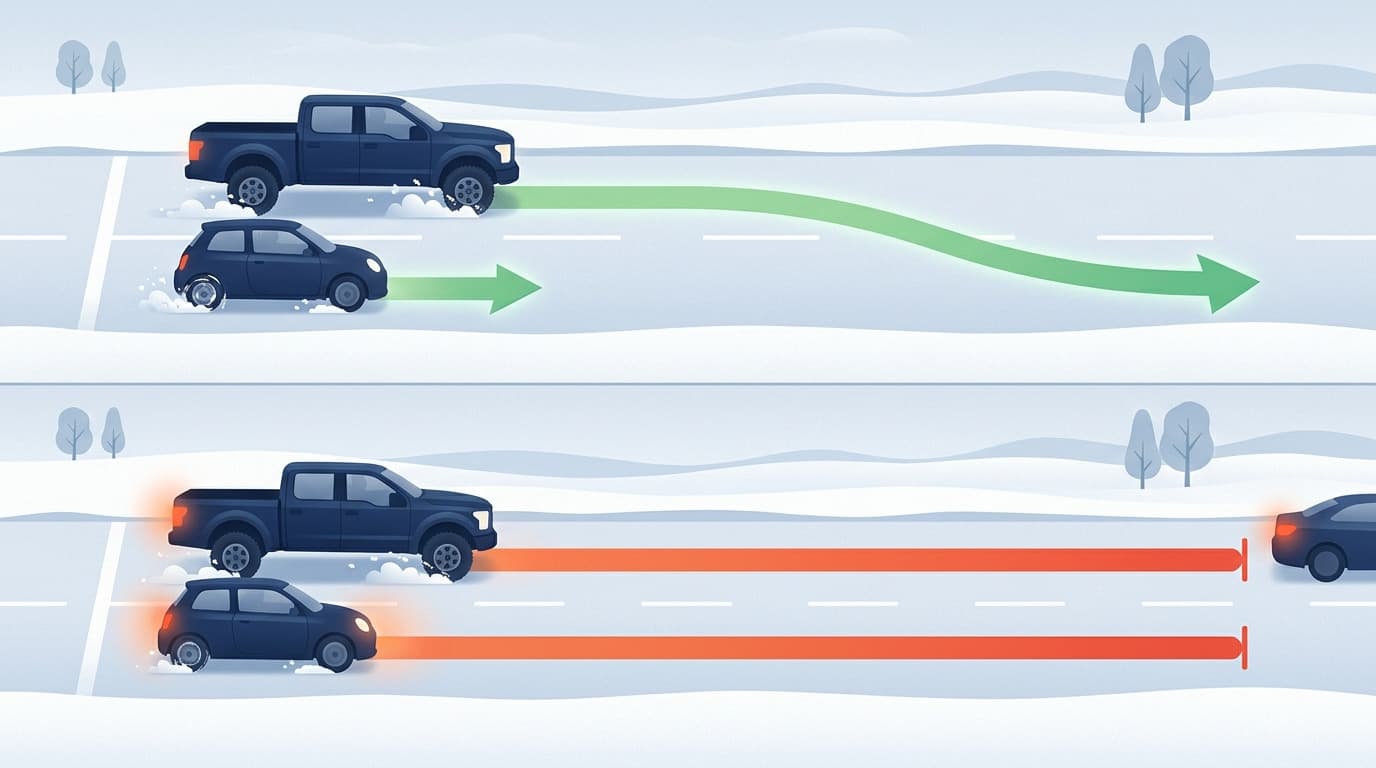
Here is the distinction that carries this whole talk: four-wheel drive helps you go. It does nothing for stopping or steering. Every driven wheel adds traction for acceleration. But braking and cornering are limited by the friction between rubber and road, and that limit is the same whether two wheels are driven or four. A 4WD pickup pulls away from a snowy junction beautifully and then needs exactly the same distance to stop as anything else — while its driver, having just been shown how capable it is, is usually carrying more speed. The confidence is real and the capability is one-directional.
The scale, from the road authority#
Worth stating because winter risk gets underestimated as ordinary and seasonal.
The FHWA reports that 24% of weather-related vehicle crashes occur on snowy, slushy or icy pavement, and a further 15% happen during snowfall or sleet.
Over 1,300 people are killed and more than 116,800 injured each year in vehicle crashes on snowy, slushy or icy pavement. During snowfall or sleet specifically, nearly 900 are killed and nearly 76,000 injured annually.
And the exposure is not regional in the way people assume: over 70% of the nation's roads are in snowy regions — receiving more than five inches of average annual snowfall — with nearly 70% of the population living in them.
What the surface actually does#
Traction falls, and it falls unevenly. Snow, packed slush, black ice and freezing rain all reduce the friction between tyre and pavement, and the reduction is not consistent from one metre of road to the next. That variability is the real problem — the vehicle behaves normally, then suddenly does not.
Speeds drop, and the data shows by how much. FHWA reports that average arterial speeds decline by 30 to 40% on snowy or slushy pavement, with freeway speeds down 3 to 13% in light snow and 5 to 40% in heavy snow.
Read that as instruction rather than description: the traffic around you is already going a third slower, because that is what the surface permits. A driver keeping to the posted limit in those conditions is not maintaining standards — they are the outlier.
Everything takes longer and needs more room. Stopping distances on snow and ice extend dramatically, and the gap you would leave on dry tarmac is nowhere near enough. This is where the space discipline from the defensive driving talk stops being a good habit and becomes the entire control.
Black ice: where it is, not what it looks like#
You cannot see black ice. You can predict it, which is more useful.
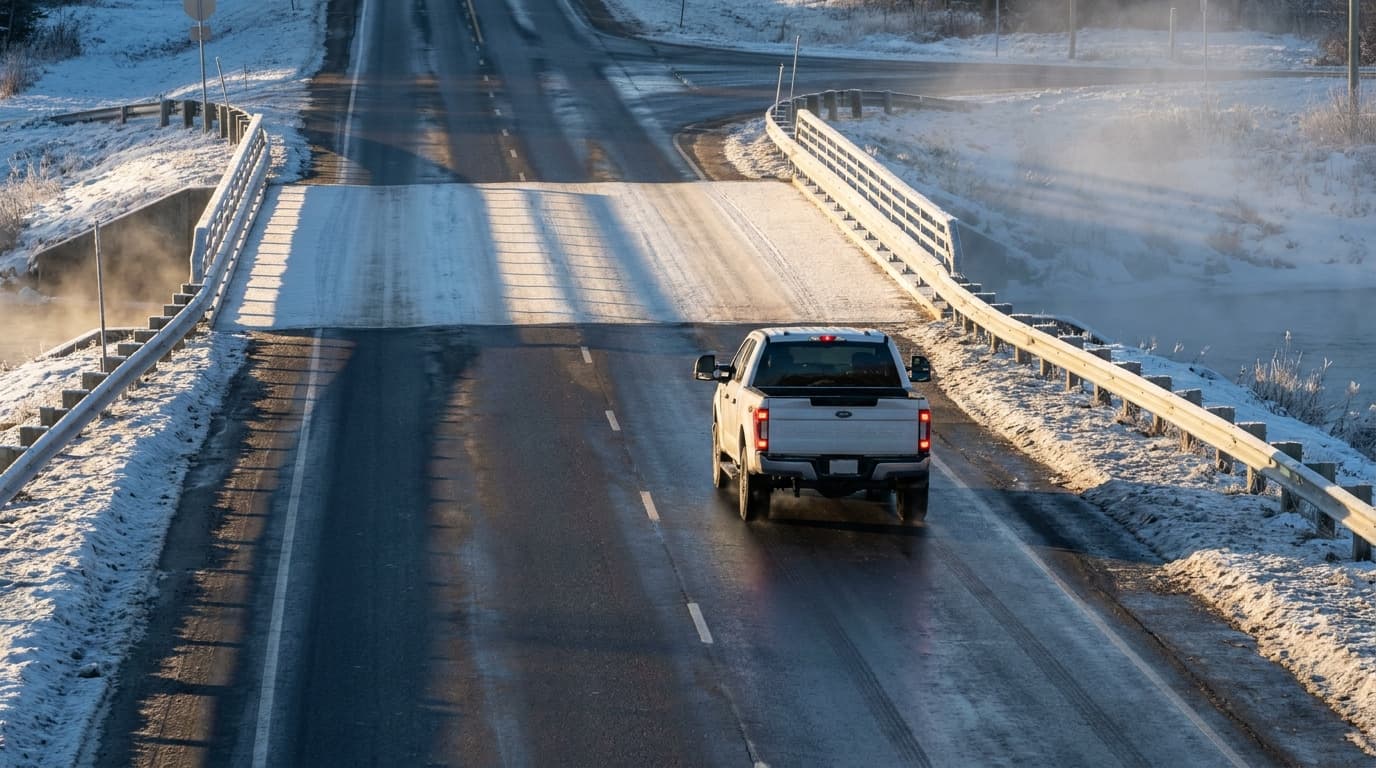
Bridges and overpasses freeze first — they lose heat from above and below, with no ground warmth underneath, so they can be frozen while the approach road is merely wet.
Shaded sections — under trees, beside cuttings, north-facing slopes — stay frozen long after open road has thawed.
Early morning and after dusk, when surface temperature drops below air temperature.
Anywhere water runs across the road — springs, leaking drainage, snowmelt off a bank.
And the freeze-thaw trap: a road that thawed in afternoon sun refreezes as a sheet after dark. The most dangerous surface of the winter is often the one that looked fine at lunchtime.
Slush deserves its own warning, because it looks like the safe option and is not. It hides ice beneath, it drags at the steering, and it refreezes into ruts.
What to change about how you drive#
Everything gradual. Accelerate, brake and steer smoothly — every abrupt input is a request for grip that may not be available. Most winter losses of control are the vehicle being asked for more friction than the surface has.
Massively increase following distance. Whatever gap you use in the dry, multiply it. On ice there is no braking solution — only the space you left.
Brake before the bend, not in it. Combining braking and steering asks the tyres to do two things at once with a fraction of the usual grip.
Look much further ahead. Early information is what makes gradual inputs possible; late information forces sharp ones.
Handle a skid by looking where you want to go, easing off the accelerator, and steering smoothly in that direction — no sudden correction.
Do not use cruise control on any surface that might be slippery.
Give ploughs and gritters room and do not overtake them — the road ahead of them is by definition worse than the road behind.
The vehicle, before you turn the key#
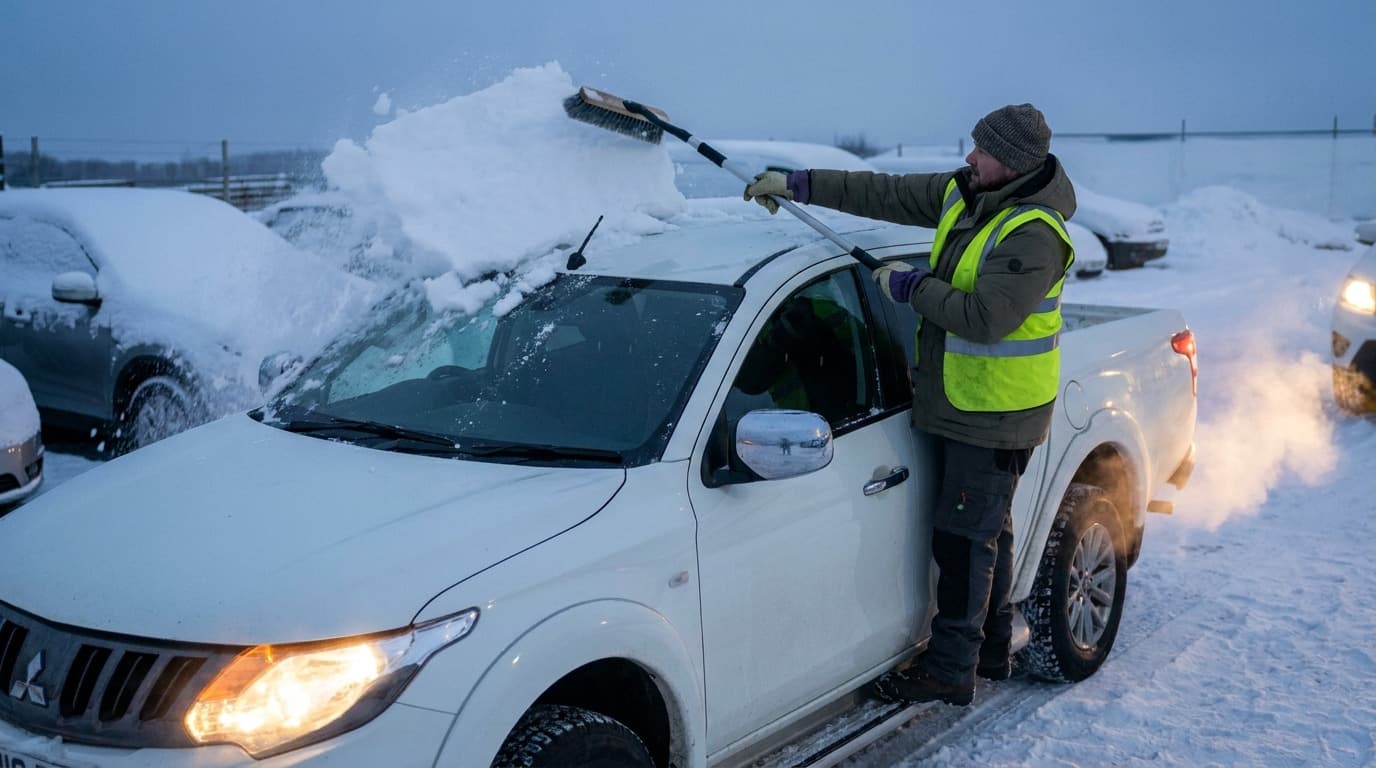
Clear all of it. Windows, mirrors, lights, and the roof — snow slides off a roof onto your own windscreen under braking, or onto the vehicle behind.
Tyres — tread depth and pressure, remembering that cold air reduces pressure. Where conditions or law require chains or winter tyres, that is not optional.
Battery, fluids and wipers, all of which cold degrades.
Fuel kept high — a full tank is thermal mass and it is also survival time if you are stopped.
A winter kit that assumes you will be stationary: blanket, warm layers, torch, water, food, phone power, shovel and traction aid, and a high-visibility vest for standing outside the vehicle.
Where the duty sits#
49 CFR 392.14 is the relevant hard requirement and it names these conditions directly: extreme caution in the operation of a commercial motor vehicle shall be exercised when hazardous conditions, such as those caused by snow, ice, sleet, fog, mist, rain, dust, or smoke, adversely affect visibility or traction; speed shall be reduced when such conditions exist. And it goes further than most standards ever do: if conditions become sufficiently dangerous, the operation of the commercial motor vehicle shall be discontinued and shall not be resumed until the commercial motor vehicle can be safely operated.
Scope matters, and should be stated honestly: Part 392 is an FMCSA rule binding commercial motor vehicles — it does not automatically apply to a crew-cab pickup. But it is the clearest published statement of the standard expected, and it is a reasonable benchmark for any employer.
Alongside it: 1926.601(b)(9) on seat belts, Section 5(a)(1) on recognised hazards — a journey required in conditions known to be dangerous is one — and 1926.21(b)(2) on instruction.
What can go wrong?#
A 4WD driven at 4WD speeds, then braking like everything else.
A bridge deck frozen while the approach was only wet.
Snow left on the roof, arriving on the windscreen at the worst moment.
Cruise control engaged on a road with intermittent ice.
Braking mid-corner on a surface that had grip for one thing only.
Overtaking a gritter onto untreated road.
A journey made because the schedule said so, in conditions that warranted postponement.
No kit in the vehicle, on a route where being stopped for two hours is plausible.
How do we manage this properly?#
Correct the 4WD belief explicitly. It is the single most useful thing this talk can do.
Plan journeys around the weather, and treat postponement as a normal outcome rather than a failure.
Set an expectation about speed: in these conditions the road authority's own data says traffic runs 30 to 40% slower on snow and slush.
Multiply following distances, and say a number so it is checkable.
Brief where the ice will be — the specific bridges, shaded stretches and run-off points on your routes.
Check vehicles for winter, as a scheduled task, not the first cold morning.
Carry the kit, and check it is still complete.
Give explicit permission to stop or turn back. Nobody postpones a journey their supervisor has not authorised them to postpone.
And manage the drive home, which combines darkness, fatigue and the day's coldest surface.
Before you start#
- Confirm the forecast and the surface conditions on your actual route.
- Confirm the vehicle is fully cleared — windows, mirrors, lights and roof.
- Confirm tyres, pressures, fluids, wipers and battery are winter-ready.
- Confirm chains or winter tyres are fitted where required.
- Confirm you know which bridges and shaded sections on this route freeze first.
- Confirm your following distance for today, as a number.
- Confirm cruise control stays off.
- Confirm you have kit for being stationary, and that you may turn back without it costing you.
Talk it over#
- Does four-wheel drive help you stop?
- Where on your route home would you expect black ice first?
- How much gap will you leave tonight compared with a dry day?
- Has anyone here ever been told not to make a journey because of the weather?
The bottom line#
Four-wheel drive helps you go — it does nothing for stopping or steering, because braking and cornering are limited by tyre-to-road friction regardless of how many wheels are driven. The scale is significant: FHWA reports 24% of weather-related crashes occur on snowy, slushy or icy pavement and 15% during snowfall or sleet, with over 1,300 killed and more than 116,800 injured annually on snowy, slushy or icy pavement — and over 70% of the nation's roads, and nearly 70% of its population, are in snowy regions. Treat the FHWA speed data as instruction: arterial speeds fall 30 to 40% on snow and slush, so a driver holding the posted limit is the outlier. Black ice is predicted, not seen — bridges and overpasses freeze first because they lose heat from both sides, along with shaded sections, early morning and after dusk, water crossing the road, and the freeze-thaw refreeze after dark; slush looks safer and is not. Drive gradually, multiply following distance, brake before the bend not in it, look far further ahead, and never use cruise control on a possibly slippery surface. 49 CFR 392.14 requires extreme caution where snow, ice, sleet, fog, mist, rain, dust or smoke affect visibility or traction, speed shall be reduced, and if conditions become sufficiently dangerous, operation shall be discontinued — binding on commercial motor vehicles, and a fair benchmark for everyone else.
Frequently asked questions about winter driving#
Does four-wheel drive make winter driving safe?
No — it helps in one direction only. Extra driven wheels improve acceleration traction, but braking and cornering are limited by the friction between tyre and road, which is identical whether two or four wheels are driven. The practical danger is that a 4WD pulls away confidently and its driver therefore carries more speed into a situation where it stops no better than anything else.
How significant are winter crashes?
Substantial. The FHWA reports that 24% of weather-related vehicle crashes occur on snowy, slushy or icy pavement and 15% during snowfall or sleet, with over 1,300 killed and more than 116,800 injured annually on snowy, slushy or icy pavement, and nearly 900 killed and nearly 76,000 injured during snowfall or sleet. Over 70% of the nation's roads are in snowy regions.
How much should I slow down?
More than feels necessary, and the road authority's own data gives a benchmark: average arterial speeds decline by 30 to 40% on snowy or slushy pavement, with freeway speeds down 3 to 13% in light snow and 5 to 40% in heavy snow. That is what traffic actually does because it is what the surface permits — so a driver maintaining the posted limit in those conditions is the outlier, not the standard.
Where does black ice form first?
Bridges and overpasses, because they lose heat from above and below with no ground warmth underneath — they can be frozen while the approach road is merely wet. Then shaded sections under trees or beside cuttings, early morning and after dusk, and anywhere water runs across the road. Watch the freeze-thaw trap too: a surface that thawed in afternoon sun refreezes as a sheet after dark.
Isn't slush safer than ice?
No, and that assumption is one of the more common winter errors. Slush hides ice beneath it, drags at the steering, and refreezes into ruts. It also coincides with the pavement conditions in which FHWA records the highest share of weather-related crashes. Treat visible slush as a reason to slow down, not as evidence the road has improved.
What does 49 CFR 392.14 require?
Extreme caution in the operation of a commercial motor vehicle where hazardous conditions caused by snow, ice, sleet, fog, mist, rain, dust or smoke adversely affect visibility or traction, and that speed shall be reduced. Unusually, it also requires that if conditions become sufficiently dangerous, operation shall be discontinued and shall not be resumed until the vehicle can be safely operated. Part 392 binds commercial motor vehicles — not automatically a pickup — but it is a reasonable benchmark.
What should be in the vehicle?
Kit that assumes you will be stationary, not just driving: blanket and warm layers, torch, water and food, phone power, shovel and a traction aid, and a high-visibility vest for standing outside the vehicle. Keep fuel high — it is thermal mass and survival time. And clear the whole vehicle before setting off, including the roof, since snow left there arrives on your windscreen under braking.
Download the winter driving toolbox talk PDF#
Get this winter driving safety toolbox talk as a print-ready PDF — available in English, Spanish, Portuguese, and Turkish. Print it, hand it to the crew, and collect signatures on the included attendance sheet.
Download the PDF — free account required. New members get 3 free downloads.
Related toolbox talks#
Sources#
- FHWA, Road Weather Management — Snow and Ice: https://ops.fhwa.dot.gov/weather/weather_events/snow_ice.htm
- FMCSA, 49 CFR 392.14 — Hazardous conditions; extreme caution: https://www.ecfr.gov/current/title-49/subtitle-B/chapter-III/subchapter-B/part-392
- NIOSH, Motor Vehicle Safety at Work: https://www.cdc.gov/niosh/motor-vehicle/about/index.html
Written by FieldSafetyTalk's safety professional — a CSP, ASP, CHST and OSHA Authorized Outreach Trainer with 14+ years of international construction safety experience across federal, heavy civil, and industrial projects.