Rabies & Stray Animals
Updated 2026-08-01
In this bundle Health & Environmental Exposure
Print-ready PDF
Download this talk as a print-ready PDF, available in 4 languages.
Most site hazards give you a second chance. You feel the strain, you see the crack, you smell the fuel, and there is time to act on it. This one does not work that way, and the reason is not that it acts quickly — rabies can take months. The reason is that by the time it announces itself, the treatment no longer works. This Rabies & Stray Animals Toolbox Talk (Safety Talk / Tailgate Talk) is about a decision that has to be made long before anybody feels ill.
Here is the distinction that carries this whole talk: in the United States, most people who die of rabies die because they never realised they had been exposed at all. Not because they refused treatment. Not because treatment failed. Because the contact seemed too small to mention. The virus is essentially always fatal once symptoms begin, and post-exposure treatment is nearly 100% effective if it is given before they do — so the entire control on this hazard is one worker deciding that a scratch, a graze or a startled animal in a roof void is worth reporting.
Two facts that make this unlike anything else#
Once symptoms appear, rabies is almost always fatal. The CDC and the clinical literature are unambiguous: once the virus reaches the central nervous system, treatment is ineffective and care becomes supportive. Most people die within one to two weeks of the late symptoms appearing.
Before symptoms appear, it is almost entirely preventable. Post-exposure prophylaxis — PEP — consists of wound washing, human rabies immune globulin, and a series of four or five rabies vaccines, and the CDC states it is nearly 100% effective if given after exposure and before symptoms.
Those two facts together explain the shape of this talk. There is no test that tells a well person whether they are incubating rabies. There is no wait-and-see. The decision to seek treatment is made entirely on what happened, not on how anybody feels.
The scale in the US shows the system working: fewer than 10 human rabies cases are reported annually, while around 100,000 Americans receive PEP each year after a potential exposure. The deaths are the handful of people who never entered that system.
Why people miss the exposure#
Because they are thinking about dogs, and the animal that actually kills Americans is much smaller.
Canine rabies variants were eliminated from the United States in 2004 through mass pet vaccination. What remains is in wildlife — and the CDC's review of eight decades of data, published in MMWR, found that bats caused 70% of all fatal human rabies infections in the US. The animals most frequently found rabid are bats, skunks, raccoons and foxes, and the virus has been identified in animals in all 49 continental states; only Hawaii is free of it.
A bat is the problem case precisely because it is unimpressive. A bat bite can be small enough to go unnoticed and leave no mark worth showing anybody. And construction puts crews exactly where bats are: roof voids and attics, derelict and part-demolished buildings, bridge soffits and expansion joints, culverts, church towers, disused plant, and anywhere sealed up for a long time and then opened.
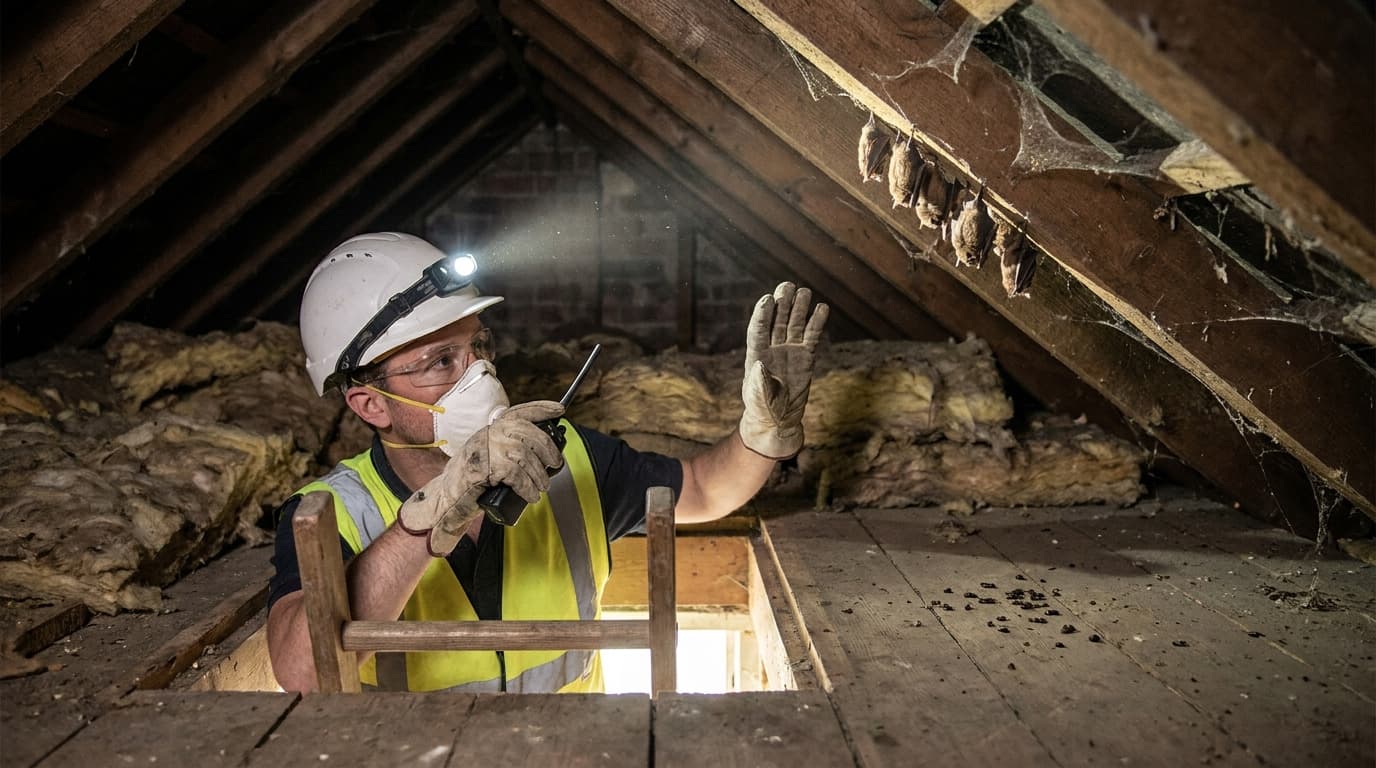
If a bat is found in an occupied space, or somebody wakes in a site cabin with a bat in the room, that is not a story for the pub. That is a medical assessment.
It does not have to be a bite#
This is the second reason exposures get dismissed.
Rabies is transmitted through the saliva of an infected mammal entering the body — through a bite, through a scratch, or through saliva contacting broken skin or a mucous membrane such as eyes, nose or mouth. A cat that scratches, a stray that licks a grazed hand, a startled animal in a crawl space — all of it counts as a potential exposure.
Globally the picture is different again and matters for anyone working internationally: dogs cause about 98% of the roughly 59,000 human rabies deaths each year worldwide. Crews on overseas projects, or working where stray dog populations are unmanaged, are in the dog-bite risk profile rather than the bat one.
The window, and what closes it#
After a bite or scratch, the virus travels along nerves toward the brain. That journey typically takes weeks to months — commonly cited as around three to twelve weeks — and during it a person may have no symptoms at all, or only vague ones: fever, weakness, headache, or an itch or prickling at the wound.
That entire period is the treatment window, and nothing tells you it is running. Once the virus reaches the central nervous system, PEP no longer works.
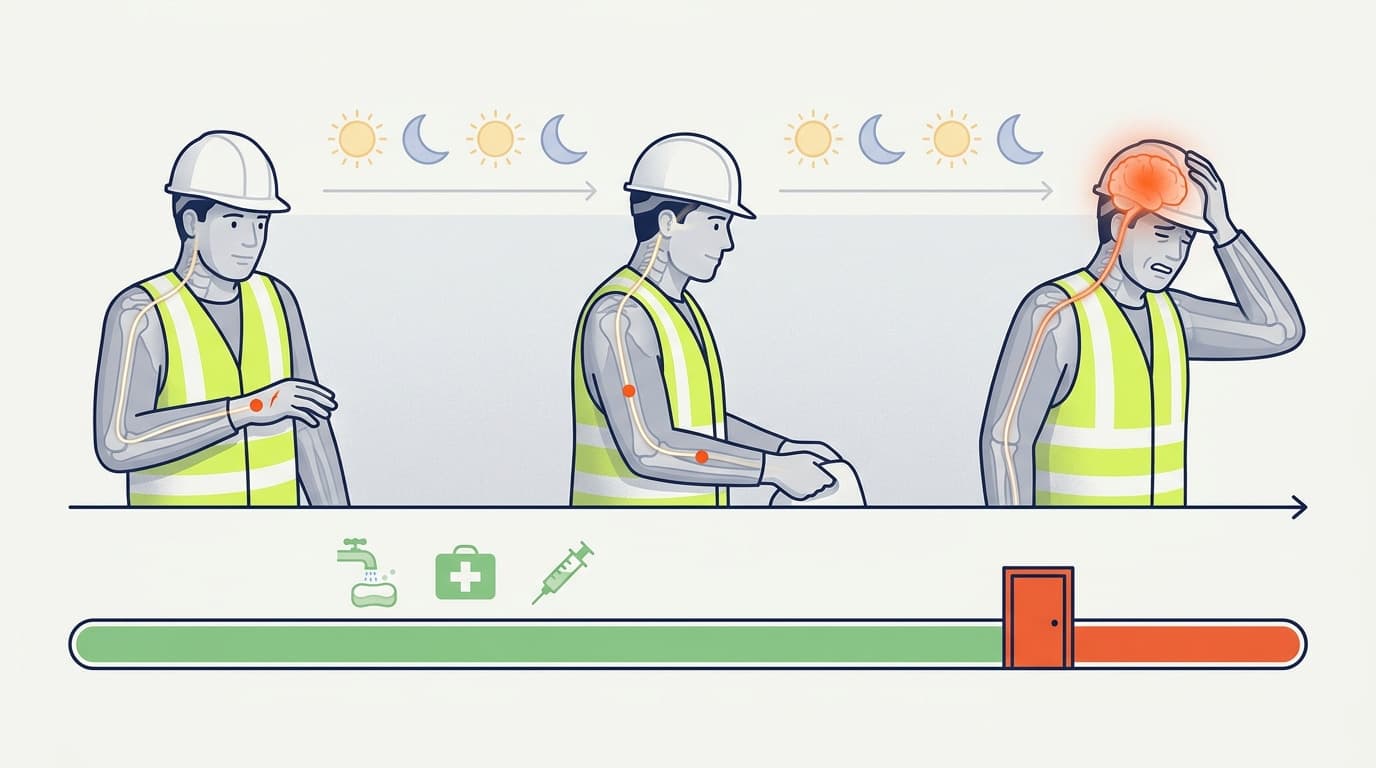
The practical consequence is simple. Do not wait to see whether anything develops. There is nothing to see.
What to do, on the day#
Wash the wound immediately and thoroughly with soap and running water. This is not just cleaning — wound washing is the first component of PEP, and it is the one part the crew can start straight away. Wash for several minutes, longer than feels necessary.
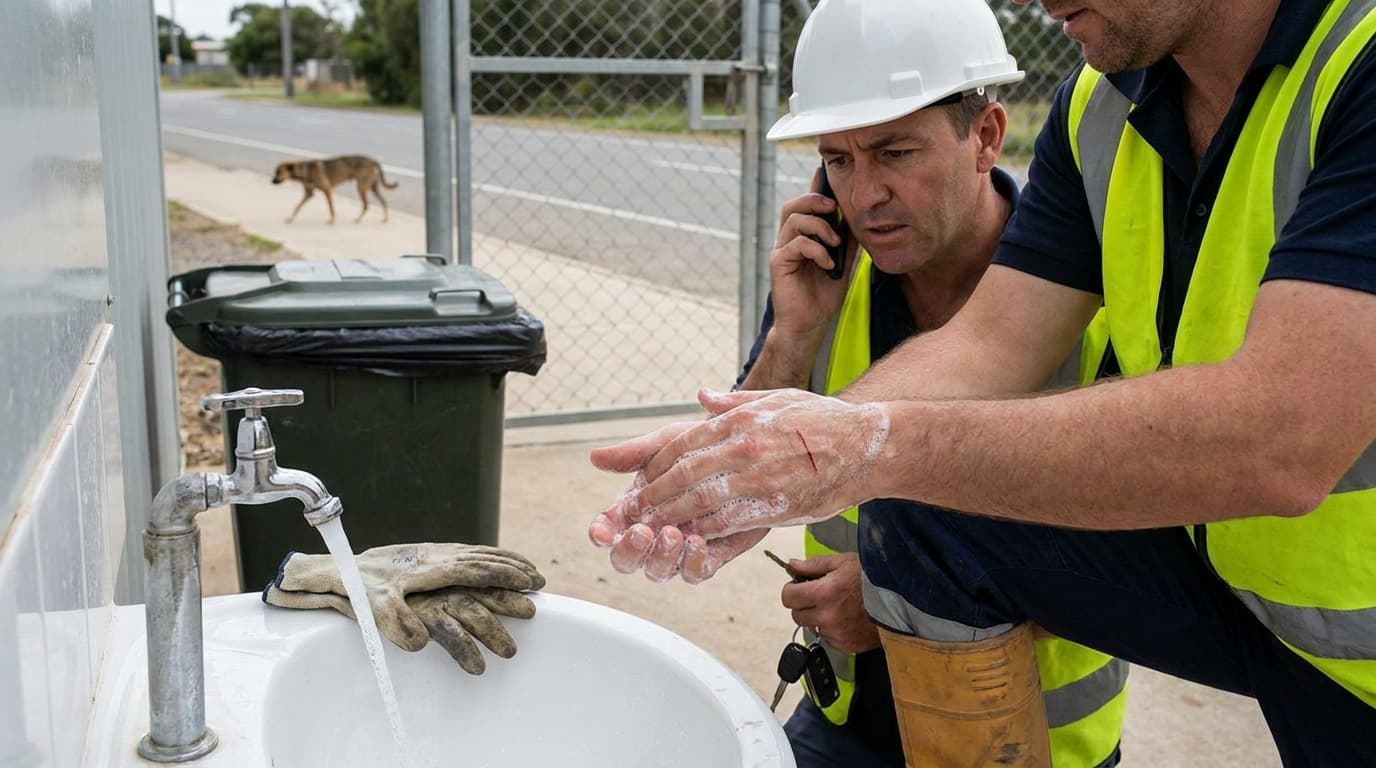
Report it, even if it did not bleed and does not hurt. This is the single behaviour the whole talk exists to produce.
Seek medical assessment the same day. A clinician and the local health department decide whether PEP is needed, based on the animal, the circumstances and local rabies patterns. That decision is not the worker's and not the supervisor's.
Describe the animal and where it happened, as precisely as possible — species, appearance, behaviour, whether it was a pet with a known owner, and the exact location. This is what the health department works from.
Do not try to catch, kill or handle the animal. Report its location; animal control or the health department will deal with it. Handling a suspect animal is how a second exposure happens.
Stray animals more broadly#
Rabies is the one that kills, but it is not the only reason site animals are a problem.
Dog bites and cat bites on site carry a real infection risk in their own right and need proper wound care and medical assessment — and tetanus status becomes a question. How that is treated for recording purposes is covered in the reporting minor injuries talk; note only that tetanus vaccine is treated as first aid, while rabies immune globulin and vaccine are medical treatment.
Feeding strays is where most site incidents begin. A fed animal stays, breeds, becomes territorial, and stops avoiding people. The crew that named the site dog in March is the crew dealing with a bite in August.
Animals nest in the work. Voids, spoil heaps, stored pipe, plant left standing, welfare units and material stacks all become dens. Disturbing them is when people get bitten.
Aggression around machinery. A cornered or startled animal near running plant is a hazard to the operator as well as to itself.
Where the duty sits#
There is no OSHA rabies standard, but there is a construction training provision that fits this hazard exactly, and most crews have never heard of it.
1926.21(b)(4): "In job site areas where harmful plants or animals are present, employees who may be exposed shall be instructed regarding the potential hazards, and how to avoid injury, and the first aid procedures to be used in the event of injury."
Read what that requires. Not just awareness of the hazard — instruction in how to avoid injury and in the first aid procedures. For rabies the first aid procedure is wash, report, and get assessed, so delivering this talk is the compliance step, not a supplement to it.
Around it: 1926.50 covers medical services and first aid, including access to medical attention. 1926.51 covers sanitation and washing facilities. 1926.25 covers waste and housekeeping, which is what keeps sites from becoming attractive to animals in the first place. And Section 5(a)(1) of the OSH Act applies where nothing specific does.
What can go wrong?#
Not reporting a scratch or graze because it was minor and did not hurt.
Dismissing a bat encounter in an attic, void, culvert or derelict building as a story rather than an exposure.
Waiting to see if symptoms develop, when there is nothing to see and the window closes silently.
Assuming it has to be a bite, when a scratch or saliva on broken skin or a mucous membrane counts.
Trying to catch or kill the animal to have it tested, and being exposed a second time.
Feeding site strays, creating a resident, territorial animal population.
Reaching into voids, spoil, stored pipe or standing plant without looking first.
Leaving the decision to the worker or the supervisor, when it belongs to a clinician and the health department.
How do we manage this properly?#
Tell the crew the rule in one sentence: any bite, scratch or animal saliva contact gets washed, reported and assessed the same day. No judgement calls in the field.
Wash immediately with soap and running water, for several minutes, before anything else.
Treat bats as a category of their own. Any bat in an occupied space, or any contact with one, goes for medical assessment — the bite may not be visible.
Survey before disturbing voids, roof spaces, culverts, spoil, stored materials and long-standing plant.
Ban feeding of strays and say why, rather than just posting a sign.
Keep the site unattractive: waste contained, food waste removed, welfare units clean — this is where 1926.25 does the real work.
Report animal sightings and dens so they can be dealt with by animal control, not by the crew.
Know your route to medical care and who to call, before somebody needs it.
Record the animal's description and location at the time, while it is fresh.
Before you start#
- Confirm whether any animals or dens have been seen in this work area.
- Confirm whether the structure has been sealed or disused, and could hold bats.
- Confirm everyone knows a scratch counts, not just a bite.
- Confirm there is soap and running water available for immediate washing.
- Confirm the route to medical assessment and who authorises it.
- Confirm nobody is feeding animals on this site.
- Confirm waste and food waste are contained and being removed.
- Confirm nobody intends to catch or handle an animal themselves.
Talk it over#
- Has anyone seen an animal, or signs of one, in the area we are working in today?
- If you were scratched by a stray at four this afternoon, what would you actually do?
- Has anyone here worked in a roof void or culvert on this job?
- Who has been feeding the dog that hangs around the gate?
The bottom line#
In the United States, most people who die of rabies die because they never realised they had been exposed at all — not because they refused treatment or because treatment failed. Two facts drive everything: once symptoms appear rabies is almost always fatal and treatment becomes supportive; but before symptoms, post-exposure prophylaxis — wound washing, human rabies immune globulin and a series of four or five vaccines — is nearly 100% effective. There is no test for a well person and no wait-and-see, so the decision is made on what happened, not on how anybody feels. The US picture shows the system working — fewer than 10 human cases a year against around 100,000 people receiving PEP — and the deaths are those who never entered it. People miss exposures because they are thinking about dogs: canine rabies variants were eliminated from the US in 2004, and the CDC's eight-decade MMWR review found bats caused 70% of all fatal human rabies infections in the US, with bats, skunks, raccoons and foxes the animals most often found rabid and the virus present in all 49 continental states. A bat bite can be small enough to go unnoticed, and construction puts crews in roof voids, attics, derelict buildings, bridge soffits, culverts and long-sealed structures. It also does not have to be a bite: transmission is by saliva entering through a bite, a scratch, or contact with broken skin or a mucous membrane. Internationally the profile flips — dogs cause about 98% of roughly 59,000 rabies deaths worldwide each year. The incubation window is weeks to months, commonly three to twelve weeks, during which there may be no symptoms — and once the virus reaches the central nervous system PEP no longer works. So: wash immediately and thoroughly with soap and running water, report even if it did not bleed, get medical assessment the same day, describe the animal and location, and never try to catch or kill it. On duties, there is no OSHA rabies standard, but 1926.21(b)(4) requires that where "harmful plants or animals are present, employees who may be exposed shall be instructed regarding the potential hazards, and how to avoid injury, and the first aid procedures to be used in the event of injury" — so this talk is the compliance step. 1926.50 covers medical services and first aid, 1926.51 washing facilities, 1926.25 waste and housekeeping, and 5(a)(1) behind them.
Frequently asked questions about rabies and stray animals#
Why can't we just wait and see if symptoms develop?
Because by then it is too late, and there is nothing to see in the meantime. Once the virus reaches the central nervous system, post-exposure prophylaxis no longer works and rabies is almost always fatal. Before that, there is no test that tells a well person whether they are incubating it, and the incubation period runs weeks to months. That is why the decision to seek treatment is made on the exposure event itself, not on symptoms.
Does it have to be a bite?
No, and this is why exposures get dismissed. Rabies is transmitted by the saliva of an infected mammal entering the body — through a bite, through a scratch, or through saliva contacting broken skin or a mucous membrane such as the eyes, nose or mouth. A stray that licks a grazed hand, or a cat that scratches, is a potential exposure. Wash it, report it, and get it assessed.
Aren't stray dogs the main risk?
Not in the United States. Canine rabies variants were eliminated from the US in 2004 through mass pet vaccination, and the CDC's MMWR review of 1938–2018 found that bats caused 70% of all fatal human rabies infections there. Globally it is the reverse — dogs cause about 98% of roughly 59,000 human rabies deaths each year — so crews working internationally, or where stray dog populations are unmanaged, are in a different risk profile.
Why are bats treated differently?
Because the exposure can be invisible. A bat bite can be small enough to go unnoticed and leave nothing worth showing anybody, so the usual test — "was there a wound?" — fails. Construction meets bats in roof voids and attics, derelict and part-demolished buildings, bridge soffits, culverts and structures sealed up for years then opened. A bat found in an occupied space, or any contact with one, is a reason for medical assessment.
What is the first thing to do after a bite or scratch?
Wash the wound immediately and thoroughly with soap and running water, for several minutes — longer than feels necessary. This is not just cleaning; wound washing is the first component of post-exposure prophylaxis and it is the part the crew can begin straight away. Then report it, get medical assessment the same day, and record a description of the animal and the exact location while it is fresh.
Should we catch the animal so it can be tested?
No. Report its location and let animal control or the health department deal with it. Attempting to catch, kill or handle a suspect animal is a straightforward way to produce a second exposure, and it is not needed for the decision — a clinician and the health department assess the risk from the species, the circumstances and local rabies patterns. Your job is an accurate description, not a captured animal.
Is there an OSHA standard for this?
There is no OSHA rabies standard, but there is a construction provision that fits exactly. 1926.21(b)(4) requires that "in job site areas where harmful plants or animals are present, employees who may be exposed shall be instructed regarding the potential hazards, and how to avoid injury, and the first aid procedures to be used in the event of injury." That is instruction in avoidance and first aid, not just awareness. Alongside it sit 1926.50 medical services and first aid, 1926.51 washing facilities, 1926.25 waste and housekeeping, and Section 5(a)(1).
Download the rabies and stray animals toolbox talk PDF#
Get this rabies and stray animals toolbox talk as a print-ready PDF — available in English, Spanish, Portuguese, and Turkish. Print it, hand it to the crew, and collect signatures on the included attendance sheet.
Download the PDF — free account required. New members get 3 free downloads.
Related toolbox talks#
Sources#
- CDC, About Rabies: https://www.cdc.gov/rabies/about/index.html
- CDC, Clinical Overview of Rabies: https://www.cdc.gov/rabies/hcp/clinical-overview/index.html
- OSHA, 29 CFR 1926.21 — Safety training and education: https://www.osha.gov/laws-regs/regulations/standardnumber/1926/1926.21
This talk is general awareness guidance for training purposes. It is not medical advice and nothing in it is a diagnosis. Whether post-exposure prophylaxis is needed is a decision for a qualified medical professional and the local health department, based on the animal, the circumstances and local rabies patterns. Anyone bitten or scratched by an animal, or who has had contact with a bat, should wash the wound immediately and seek medical assessment the same day.
Written by FieldSafetyTalk's safety professional — a CSP, ASP, CHST and OSHA Authorized Outreach Trainer with 14+ years of international construction safety experience across federal, heavy civil, and industrial projects.