Radiation Safety
Updated 2026-08-06
In this bundle Health & Environmental Exposure
Print-ready PDF
Download this talk as a print-ready PDF, available in 4 languages.
Almost every hazard on a jobsite reaches you through a sense. You see the edge, hear the alarm, feel the heat, smell the gas, flinch from the flash. Even the ones that hide give you something — a sound, a shimmer, an odor — that a trained person can catch. Ionizing radiation gives you nothing. You cannot see it, hear it, feel it, smell it, or taste it; it passes through you silently, does its damage at the level of individual cells, and leaves no sensation behind at all. There is no flash to blink at and no heat to pull back from. That single fact — that your body has no way to know it is happening — is what makes radiation a fundamentally different kind of hazard, and it is why the protections against it look nothing like the protections against anything else. This Radiation Safety Toolbox Talk (Safety Talk / Tailgate Talk) is about protecting yourself from something you will never sense.
Here is the distinction that carries this whole talk: ionizing radiation is the one jobsite hazard your body cannot sense at all — nothing to see, feel, or flinch from — so unlike almost every other hazard, you cannot rely on noticing it, and your entire protection is three things you arrange in advance: time, distance, and shielding. With a hot surface, your reflex protects you the instant you touch it. With radiation there is no instant and no reflex; the exposure accumulates while you feel completely normal, and you only learn about it afterward from an instrument. So protection cannot be reactive the way it is with most hazards. It has to be set up before you are ever near the source, through three controls that work whether or not you can sense the danger — less time in the field, more distance from the source, and shielding between you and it — plus the one device that gives you the sense you were born without: a dosimeter that measures what you cannot feel.
Where the boundary of this talk sits#
This talk has a natural twin. The laser safety talk covers non-ionizing radiation — light energy your eye can actually respond to, where the blink reflex is part of your protection. This talk covers the opposite: ionizing radiation, energy strong enough to strip electrons from atoms and damage cells, which your body cannot sense or respond to at all. The welding talk owns the arc's hazards, including its intense non-ionizing ultraviolet and infrared. The hazard communication talk owns chemical labeling and the right to know. This talk owns ionizing radiation specifically: why you cannot sense it, the time-distance-shielding controls that protect you from it, and the industrial radiography that is the most common way a construction worker meets it. Where the hazard is a laser or a welding arc, those talks own it; this one owns the radiation you will never feel.
Where a construction worker actually meets it#
Most construction workers never handle a radioactive source, and it helps to be precise about where the exposure really comes from. By far the most common is industrial radiography — non-destructive testing that uses a sealed gamma source, often iridium-192 or cobalt-60, or a high-powered X-ray machine, to shoot through a weld or a casting and image the inside on film, the same way a hospital X-rays a bone. It is how critical welds on pipe, pressure vessels, and structural steel get inspected without cutting them open. The radiographer operating the source is licensed and specially trained, but the hazard on a shared site is not usually to them — it is to everyone else working nearby who wanders into the area while a shot is being taken. That is the exposure this talk is really about: not operating the source, but being near one that someone else is using, often without realizing a shot is in progress.
Time, distance, and shielding#
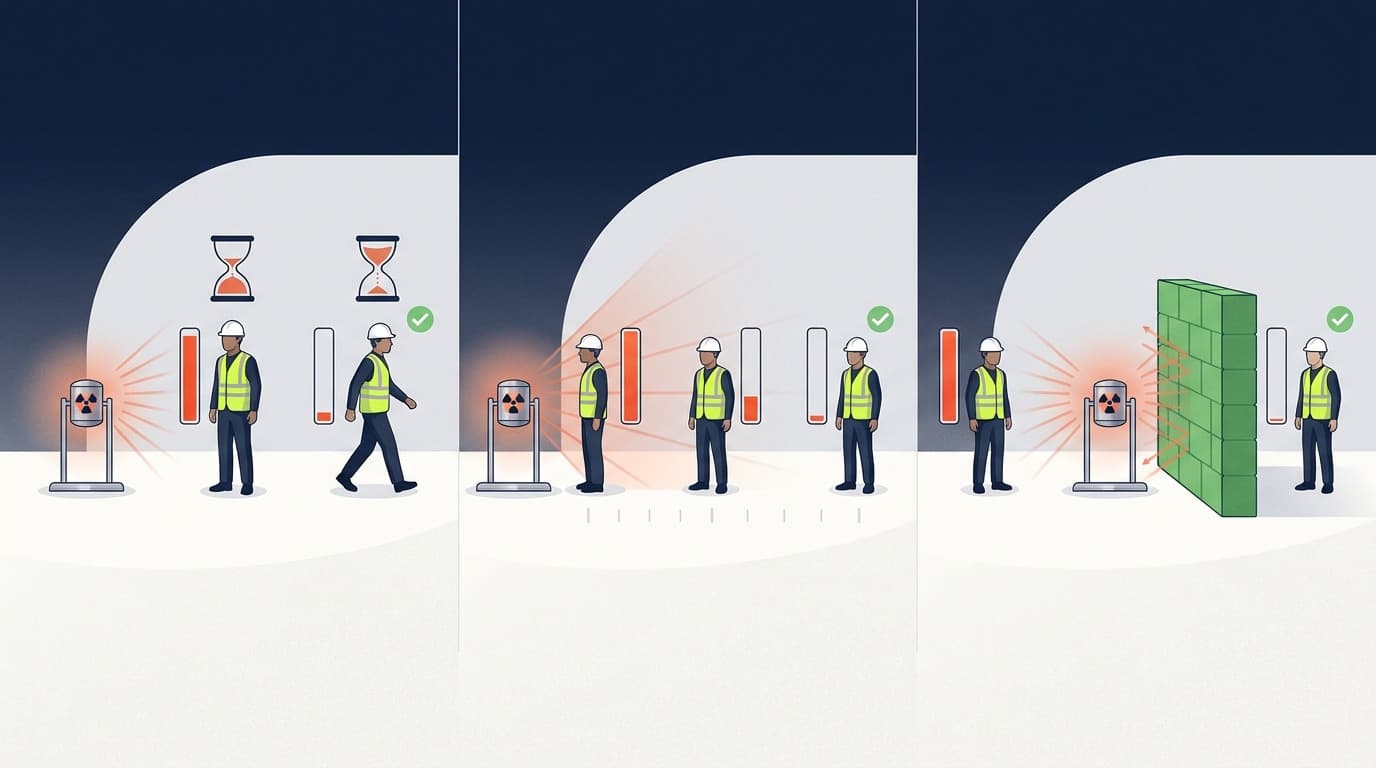
Because you cannot sense radiation, protection comes down to three controls you set deliberately, and they are worth understanding because each one is a lever you can actually pull. Time is the simplest: dose accumulates the whole time you are in the field, so half the time means half the dose — you do not linger near a source, and radiography is scheduled to keep people out during shots. Distance is the most powerful, because radiation from a point source falls off with the square of the distance: double your distance and the dose drops to a quarter; step back ten times as far and it drops to a hundredth. A few extra steps back is often worth more than anything else you can do, which is why the controlled area around a radiography shot is a boundary you never cross. Shielding is what you use when time and distance are not enough — dense material, usually lead or concrete, between you and the source absorbs the radiation, which is why the source lives in a shielded container and why barriers go up around a shot. Every real protection is one of these three, and they work precisely because they do not depend on you feeling anything.
The dosimeter is the sense you don't have#
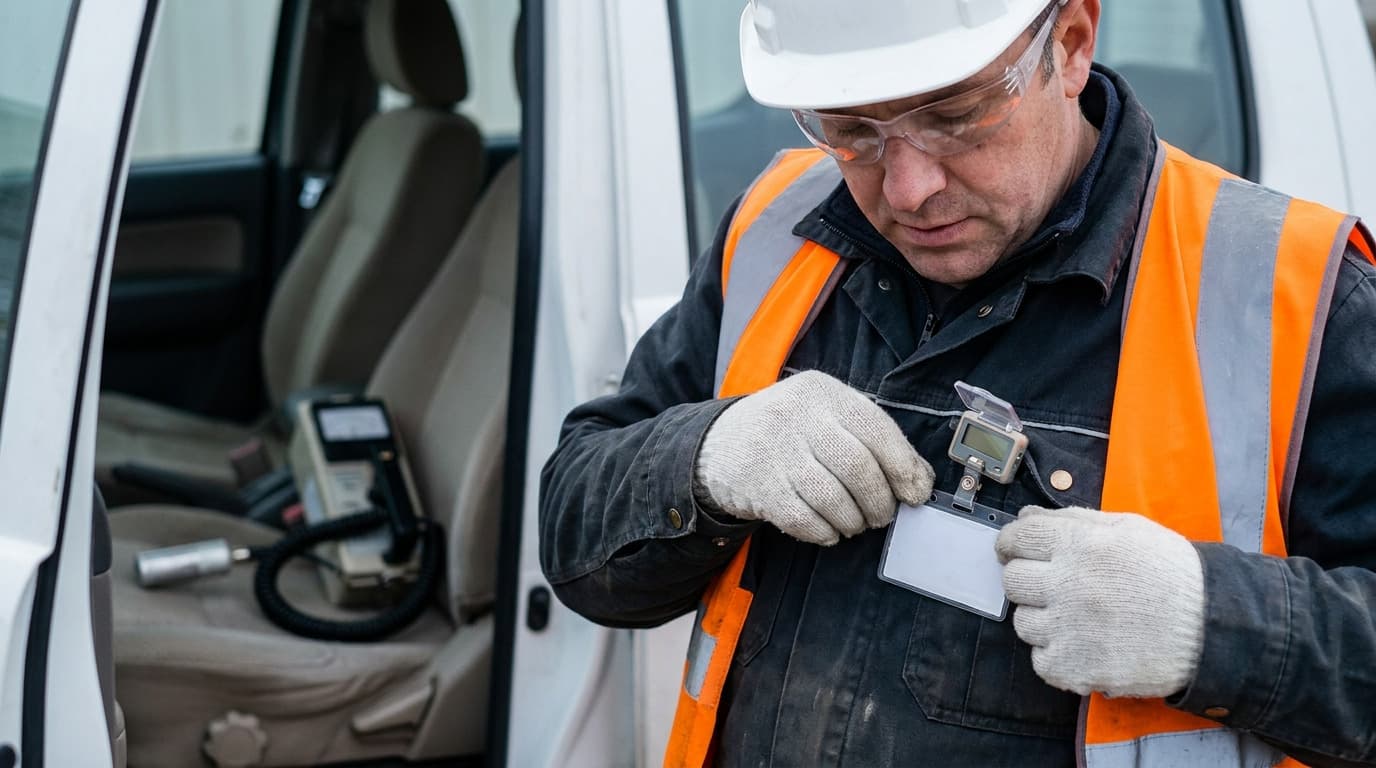
Since your body cannot tell you your exposure, a device has to. A dosimeter — a badge or electronic monitor worn by workers who may enter a radiation area — measures the dose you actually receive and makes the invisible countable. This is not paperwork; it is the sense organ evolution never gave you, and it is the only way anyone knows whether the controls are working. OSHA requires dose monitoring for workers likely to receive a meaningful fraction of the occupational limit, and the readings are what confirm you stayed safe or warn you that you did not. Alongside the dosimeter is the governing mindset of all radiation work, ALARA — keeping exposure As Low As Reasonably Achievable, not merely under the legal limit. ALARA matters precisely because there is no threshold you can feel and no dose so small it is guaranteed harmless, so the goal is never "under the limit," it is "as little as we can reasonably manage." Wear the badge if you are issued one, and treat every reading as real information about something you cannot perceive.
The signs and boundaries that stand in for your senses#
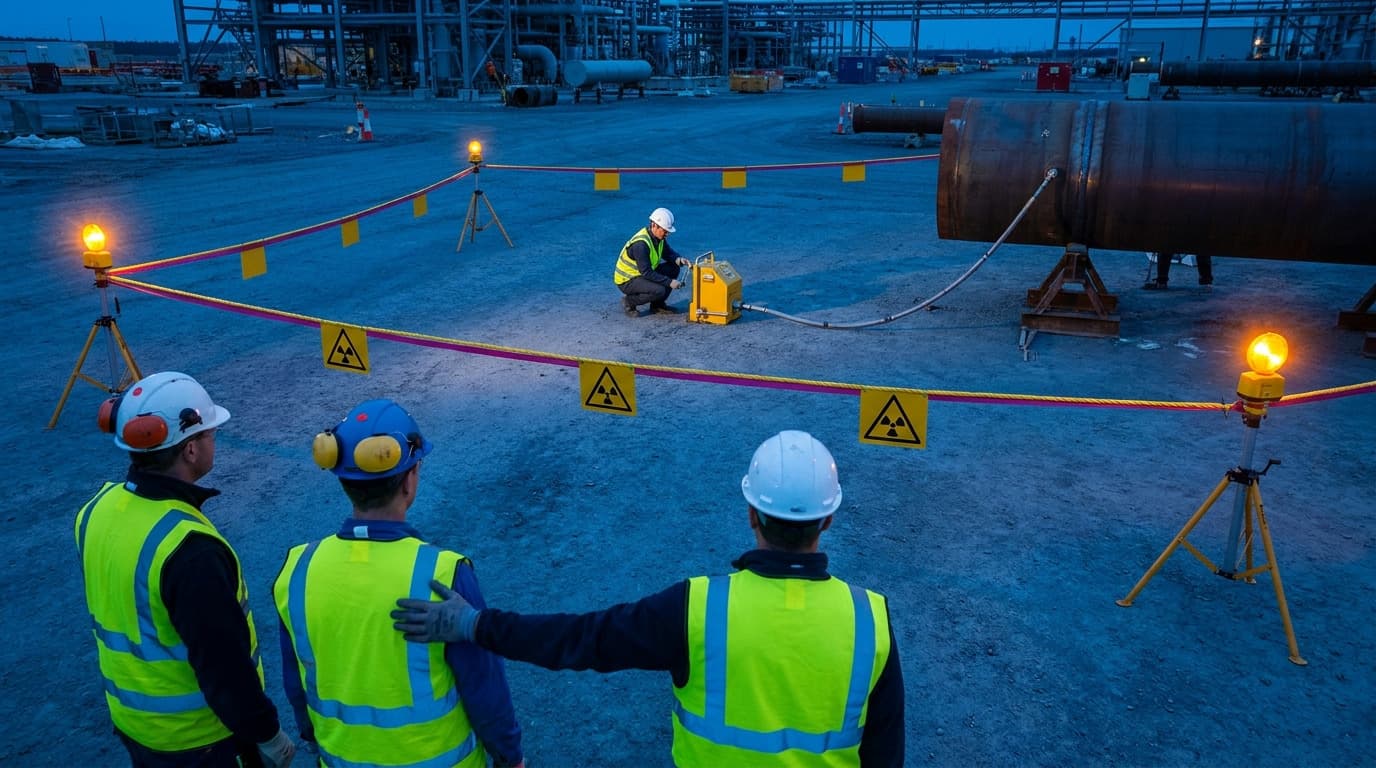
Because workers cannot sense the hazard, the site marks it for them, and those markings carry the weight your senses would otherwise carry. A radiation area must be conspicuously posted with the magenta-and-yellow radiation symbol and the words Caution Radiation Area, and higher-exposure areas carry stronger wording. During a radiography shot, the radiographer sets up a controlled area with boundaries, signs, and often audible or visible alarms, and that boundary is not advisory — it marks the line past which the invisible dose becomes significant. The single most important rule for everyone who is not the radiographer is simple: when you see radiation postings or a radiography crew setting up barriers, stop and stay out until they tell you it is clear. Those signs and boundaries are doing the job your eyes and ears cannot do for this hazard, so treating them as seriously as you would treat seeing the danger yourself is the whole game.
Where the duty sits#
The construction requirements live in 1926.53, which brings the Nuclear Regulatory Commission's radiation-protection standards in 10 CFR part 20 into construction work, and requires that any activity using radioactive materials or X-rays be performed by competent persons specially trained in the safe operation of the equipment — and, for licensed material, only by licensed persons or those under a licensee's direction. The detailed provisions of 1926.53 are identical to the general-industry ionizing radiation standard, 1910.1096, which sets dose monitoring, posting, and exposure limits. One honest note on the numbers: OSHA's dose limits date to a 1971 version of the standard, and the NRC's current 10 CFR part 20 limits are more protective; employers may follow the more protective current limits, and responsible radiation programs do. The General Duty Clause, Section 5(a)(1) and training under 1926.21(b)(2) round out the duty for everyone who might be near a source. Where an NRC or Agreement-State license, or a radiation safety officer's procedures, set specific requirements, those govern.
What can go wrong?#
- A worker walks into a controlled area during a radiography shot without knowing one is in progress.
- Someone crosses a radiation boundary because there is nothing to see or feel warning them off.
- A worker issued a dosimeter doesn't wear it, so their real exposure is never known.
- People linger near a source instead of leaving, accumulating dose the whole time.
- A radiography crew's barriers and signs are ignored as if they were optional.
- A sealed source is damaged or left unshielded and no one senses the exposure.
- Work is scheduled next to an active radiography operation without coordination.
- ALARA is treated as "under the limit is fine" instead of "as low as we can get."
How do we manage this properly?#
- Treat radiation postings and radiography barriers as a hard stop — stay out until cleared.
- Cut time near any source; never linger where radiation work is happening.
- Put distance between you and a source — a few steps back cuts dose dramatically.
- Respect shielding — don't defeat shielded containers or move barriers.
- Wear your dosimeter if issued one, and treat the readings as real.
- Follow ALARA — aim for as little exposure as reasonably achievable, not just under the limit.
- Coordinate work near radiography so shots happen with people clear.
- Leave source handling to the licensed, trained radiographer — never touch a source.
Before you start#
- Confirm whether any radiography or radiation work is scheduled near your area today.
- Confirm you know what the radiation symbol and Caution Radiation Area posting look like.
- Confirm the boundaries of any controlled area and that you'll stay outside them.
- Confirm you're wearing your dosimeter if you've been issued one.
- Confirm how the radiography crew signals that a shot is in progress and when it's clear.
- Confirm you know who the radiation safety officer or radiographer is if you have questions.
- Confirm no work puts you near an active source without coordination.
- Confirm you understand you never handle or approach a source yourself.
Talk it over#
- Does anyone know if radiography is happening on this site this week, and where?
- Would you recognize a Caution Radiation Area posting or a controlled-area boundary?
- If you were issued a dosimeter, are you wearing it — and do you know why it matters?
- What's our plan when a radiography crew needs to take a shot near where we're working?
The bottom line#
Ionizing radiation is the one jobsite hazard your body cannot sense at all — nothing to see, feel, or flinch from — so unlike almost every other hazard, you cannot rely on noticing it, and your entire protection is three things you arrange in advance: time, distance, and shielding. Its opposite is the laser: non-ionizing light your eye can respond to, where your blink reflex is part of the defense. Here there is no reflex and no sensation, so protection is external and deliberate — less time in the field (dose adds up the whole time), more distance from the source (dose falls with the square of distance, so a few steps back is powerful), and shielding when those aren't enough. The dosimeter is the sense organ you were never given — wear it, and treat its readings as the only real measure of what you cannot feel — and ALARA, as low as reasonably achievable, is the mindset because no dose you can feel means no dose is automatically safe. On most sites the exposure is not operating a source but being near industrial radiography, so the postings and controlled-area boundaries do the job your senses cannot: when you see them, stop and stay out until cleared. This all sits in 1926.53, which pulls the NRC's 10 CFR part 20 into construction and requires trained, competent, licensed people to run the sources. The question to carry is the one your body will never ask for you: is radiation work happening near me right now — and am I outside the boundary, wearing my badge, and keeping my time, distance, and shielding, even though I can't feel a thing?
Frequently asked questions about radiation safety#
Why is radiation different from other jobsite hazards?
Because you cannot sense it. Nearly every other hazard reaches you through sight, sound, heat, smell, or touch, and your reflexes give you a chance to react — you flinch from a flash, pull back from heat, cough at a fume. Ionizing radiation gives you none of that: it passes through you silently, damages cells directly, and produces no sensation at all, so you can be overexposed while feeling completely normal and only learn of it later from an instrument. That is why protection against radiation cannot be reactive the way it is for most hazards. It has to be arranged in advance through time, distance, and shielding, and measured by a dosimeter, because the one thing you cannot do with radiation is notice it and respond in the moment.
How does a construction worker actually get exposed?
Almost always by being near industrial radiography, not by handling anything radioactive. Industrial radiography is non-destructive testing that uses a sealed gamma source — commonly iridium-192 or cobalt-60 — or a high-powered X-ray machine to image the inside of welds, pipe, and structural steel, the way a hospital X-rays a bone. The radiographer running the source is licensed and specially trained, and the real risk on a shared site is to everyone else: workers who wander into the area while a shot is being taken, often without realizing it is happening. So for most people this talk is not about operating a source at all — it is about recognizing when radiography is in progress nearby and staying outside the boundary the crew has set.
What do time, distance, and shielding actually mean?
They are the three ways to reduce your dose, and each is a lever you can pull. Time: dose accumulates the entire time you are near a source, so spending half as long there means half the dose — you never linger. Distance: radiation from a point source falls off with the square of the distance, so doubling your distance cuts the dose to a quarter, and stepping back ten times as far cuts it to a hundredth; a few extra steps are often the most powerful thing you can do. Shielding: dense material like lead or concrete between you and the source absorbs radiation, which is why sources live in shielded containers and barriers go up around a shot. Every genuine radiation protection is one of these three, and they work precisely because none of them depends on your being able to feel the hazard.
What is a dosimeter and do I need to wear it?
A dosimeter is a small badge or electronic monitor that measures the radiation dose you actually receive, and if you are issued one, yes — wear it, every time you may enter a radiation area. It exists because your body has no way to sense radiation, so the dosimeter is effectively the sense organ you do not have: it makes the invisible countable and is the only way anyone knows whether the controls are keeping you safe. OSHA requires dose monitoring for workers likely to receive a meaningful fraction of the occupational limit. Treat the badge as real safety equipment, not paperwork, because its readings are the actual measure of an exposure you cannot perceive in any other way, and they are what confirm the protections are working.
What does ALARA mean?
ALARA stands for As Low As Reasonably Achievable, and it is the governing principle of all radiation work. It means the goal is never simply to stay under the legal dose limit — it is to keep exposure as far below that limit as can reasonably be managed. ALARA exists because ionizing radiation has no threshold you can feel and no dose so small it is guaranteed to be harmless, so "under the limit" is not the same as "safe." In practice it means using time, distance, and shielding to push your dose down even when you are already compliant, and treating every unnecessary exposure as worth avoiding. It is the mindset behind why radiography is scheduled to keep people clear and why boundaries are set generously rather than just barely.
What should I do if I see a radiation posting or a radiography crew?
Stop and stay out until they tell you it is clear. A radiation area is posted with the magenta-and-yellow radiation symbol and the words Caution Radiation Area, and during a shot the radiography crew sets up a controlled area with boundaries, signs, and often alarms. Because you cannot sense the hazard yourself, those markings are doing the job your eyes and ears would normally do — the boundary marks the line past which the invisible dose becomes significant. Crossing it because you feel fine is exactly the mistake the sign exists to prevent, since you will always feel fine. The single most important rule for anyone who is not the radiographer is to treat those postings and boundaries as seriously as you would treat seeing the danger with your own eyes, and to wait until the crew confirms the shot is done.
Download the radiation safety toolbox talk PDF#
Get this radiation safety toolbox talk as a print-ready PDF — available in English, Spanish, Portuguese, and Turkish. Print it, hand it to the crew, and collect signatures on the included attendance sheet.
Download the PDF — free account required. New members get 3 free downloads.
Related toolbox talks#
Sources#
- OSHA, Ionizing radiation — 29 CFR 1926.53 (construction work involving sources of ionizing radiation applies the NRC's Standards for Protection Against Radiation, 10 CFR part 20; activities using radioactive materials or X-rays performed by competent persons specially trained, and for licensed material only by licensed persons or those under a licensee's direction; provisions identical to 1910.1096): https://www.osha.gov/laws-regs/regulations/standardnumber/1926/1926.53
- OSHA, Ionizing radiation — 29 CFR 1910.1096 (general-industry standard incorporated by 1926.53: dose monitoring, posting of radiation areas with the caution symbol, and occupational exposure limits): https://www.osha.gov/laws-regs/regulations/standardnumber/1910/1910.1096
- OSHA, Ionizing Radiation — Standards and Control and Prevention (OSHA's limits derive from the 1971 version of the standard; employers may follow the more protective current NRC 10 CFR part 20 limits; dose monitoring required above defined fractions of the occupational limit; industrial radiography identified as a primary source of occupational exposure): https://www.osha.gov/ionizing-radiation/standards
This talk is general awareness guidance for training purposes. It does not replace your employer's radiation safety program, the OSHA ionizing radiation standards, the NRC or Agreement-State licensing requirements, a radiation safety officer's procedures, or a competent person's duties, and it is not legal advice. Where an NRC or state license, a manufacturer's instruction, or a radiation safety officer sets a specific requirement, that requirement governs.
Written by FieldSafetyTalk's safety professional — a CSP, ASP, CHST and OSHA Authorized Outreach Trainer with 14+ years of international construction safety experience across federal, heavy civil, and industrial projects.