Carbon Fiber and Fiberglass
Updated 2026-08-06
In this bundle Health & Environmental Exposure
Print-ready PDF
Download this talk as a print-ready PDF, available in 4 languages.
Carbon fiber and fiberglass are everywhere on modern sites — panels, ducting, insulation, rebar, wraps, tanks, and a hundred fabricated parts. They are light, strong, and mostly ignored as a hazard, because in the form you usually handle them they do very little. A cured composite panel or an intact roll of glass cloth sits there inertly. The trouble starts the moment a tool touches it. This carbon fiber and fiberglass talk is about why these materials are safe to hold and dangerous to machine, and about a difference between the two that most crews never hear.
Here is the distinction that carries this whole talk: the hazard of these materials is not what they are made of — it is what you do to them. Intact fiber and cured composite are largely inert; the hazard is created by cutting, grinding, sanding, drilling, and shredding, which turns a stable solid into airborne fiber and fine dust. And there is a second, sharper point inside that: a fiber that is too big to breathe becomes breathable the moment you grind it. As manufactured, continuous glass filaments are non-respirable — too large to reach deep into the lung. But machining breaks them down, and the process can release respirable-sized particles, some of them sharp glass shards. The particle's size, not its chemistry, decides whether it reaches your lungs — and the tool is what changes the size.
Where the boundary of this talk sits#
The dust and silica talk owns crystalline silica — a different material with a different, well-defined lung disease and its own OSHA standard. The respiratory protection talk owns respirator selection, fit and use. The skin hazards talk owns dermatitis and skin injury generally, and the hazard communication talk owns the SDS and label system. The PPE talk owns personal protective equipment across the board. This talk owns carbon fiber and fiberglass specifically as materials — how their dust and fibers harm you, why the harm is mechanical rather than chemical, the respirable-fiber question, and the two extra hazards carbon fiber carries that fiberglass does not. Where a respirator, an SDS, or a silica exposure is the question, those talks own it; this one owns what a cutting wheel does to a composite.
Mechanical, not chemical — and why that still matters#
The first thing to understand about fiberglass and carbon fiber dust is that it hurts you the way a splinter or sandpaper does, not the way a solvent does. The safety data sheets are consistent: contact causes mechanical irritation to skin, eyes, and the upper respiratory tract — itching, scratchiness in the throat, transient dermatitis — from the physical abrasion of tiny fibers, not from any chemical reaction. In fact, under the global classification system, mechanical abrasion is not even counted as a chemical health hazard, and fibrous glass is not classified as a carcinogen by OSHA or NTP (IARC's "possibly" rating rests on artificial animal-implant studies, not on the human production-worker data, which found no significant disease increase).
But "mechanical, not chemical" does not mean harmless, and it is a mistake to relax because there is no toxic label. Mechanical irritation is still irritation: fibers in the eye scratch the cornea, fibers on sweaty skin drive itching and rash, and fibers in the throat and airways produce a persistent scratchy cough. The harm is real; it is just a different kind of harm, and it responds to a different control. You do not neutralize a splinter with a chemical — you keep it out. The whole strategy for these materials is barrier and containment: keep the fiber off your skin, out of your eyes, and out of the air you breathe.
The respirable line: what grinding changes#
The most important safety fact about these fibers is about size. A fiber only reaches the deep lung if it is small enough — roughly, long and thin enough to stay airborne and slip past the body's upper defenses. The fiberglass industry's own voluntary exposure guideline is written around exactly this geometry: 1 fiber per cubic centimeter for fibers longer than 5 micrometers and thinner than 3 micrometers in diameter — the respirable shape.
As manufactured, most continuous glass and carbon filaments are too thick to be respirable — they cause surface irritation but do not lodge deep in the lung. The danger is that machining changes the geometry. Grinding, crushing, shredding and high-speed cutting fracture the fibers lengthwise and crosswise, and can release much finer, respirable particles — including sharp glass shards — that the intact material never would. This is why the same roll of cloth is nearly harmless to carry and genuinely hazardous to cut on a saw: the operation manufactures the respirable hazard on the spot. The control follows directly — cut, grind and sand with local exhaust ventilation or tool-mounted dust collection, wet methods where suitable, so the fine dust is captured at the point it is created rather than breathed.
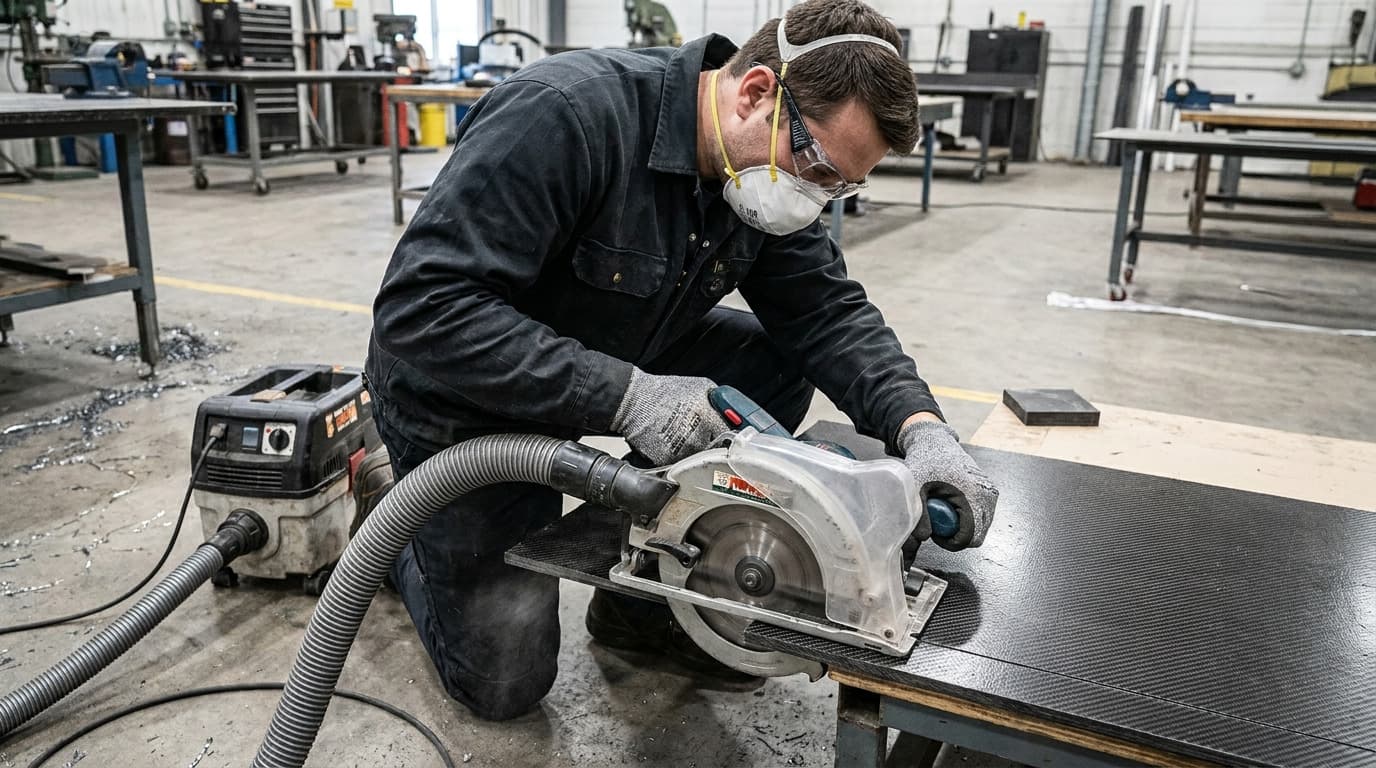
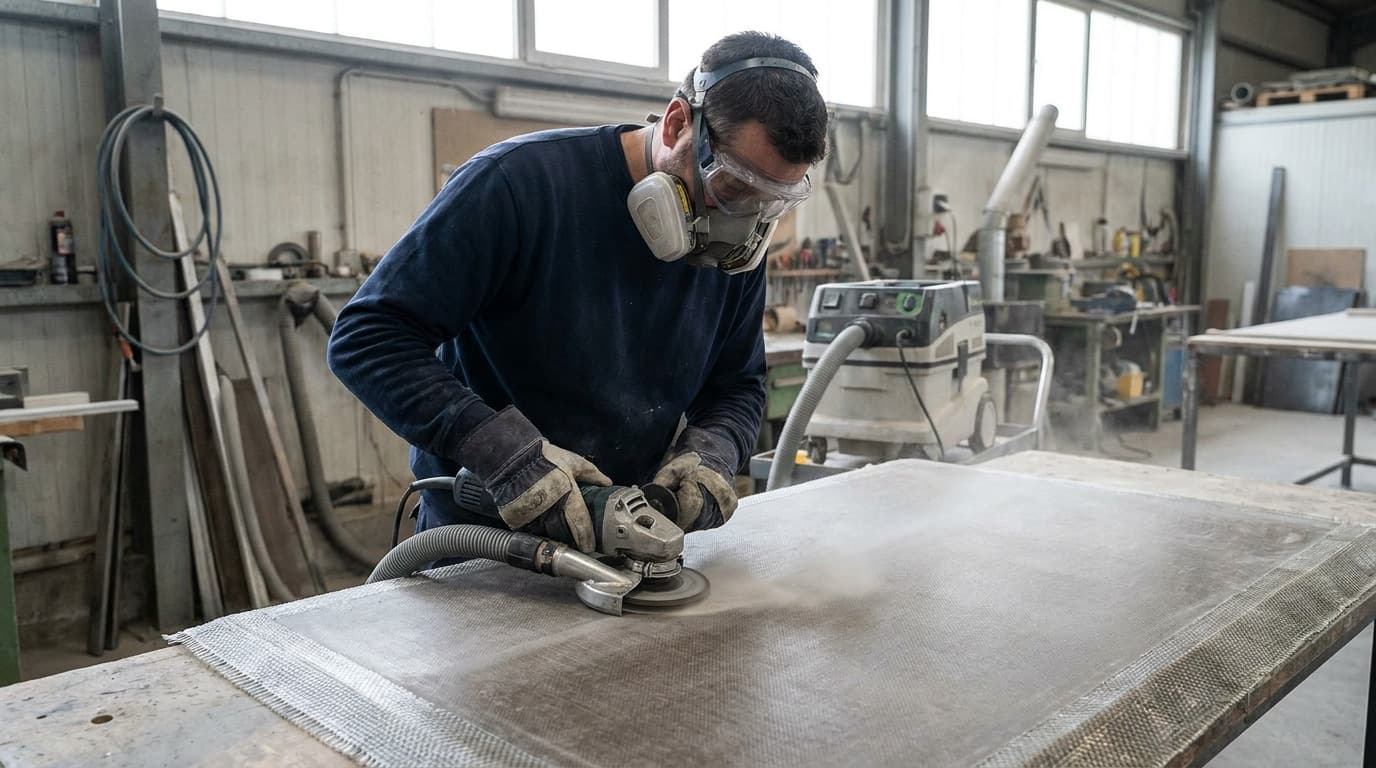
OSHA regulates this dust not with a fiber-specific limit but as Particulates Not Otherwise Regulated — nuisance dust — under 1910.1000 (and 1926.55 in construction), with the familiar limits of 5 mg/m³ for the respirable fraction and 15 mg/m³ for total dust. That is not a license to reach those numbers; it is the ceiling, and good practice keeps airborne dust far below it. Where ventilation cannot hold the level down, a NIOSH-approved respirator is required — which is the respiratory protection talk's ground, invoked here because the fine dust is exactly what makes it necessary.
Carbon fiber's two extra hazards#
Everything so far applies to both materials. But carbon fiber carries two hazards that fiberglass does not, and they are easy to miss because they have nothing to do with breathing.
The first is that carbon fiber dust is electrically conductive. Fine carbon dust that settles on electrical equipment, panels, connectors and motors can bridge contacts and cause short circuits, arcing, equipment damage, and fire. A cloud of it around energized equipment is a genuine electrical hazard, not just a housekeeping problem. This is why carbon fiber machining is kept away from open electrical gear, and why dust is collected rather than allowed to drift and settle.
The second is that carbon fiber dust can form an explosive mixture with air. Accumulated fine carbon dust is a combustible dust — given a dust cloud at the right concentration and an ignition source, it can deflagrate. Combustible dust is governed by NFPA 660, the standard that took effect in December 2024 consolidating the older combustible-dust standards (the earlier NFPA 652 and 654 are retired — do not rely on them). The practical consequence on a site is housekeeping as a safety control, not a chore: do not let carbon dust accumulate, control ignition sources near it, and use collection systems rated for combustible dust. Fiberglass does not carry these two hazards — glass is neither conductive nor combustible in this way — which is exactly why the two materials, so similar to handle, are not the same to grind.
Skin, eyes, and the itch that spreads it#
Because the harm is mechanical, the protective measures are physical barriers, and a few field habits make a large difference.
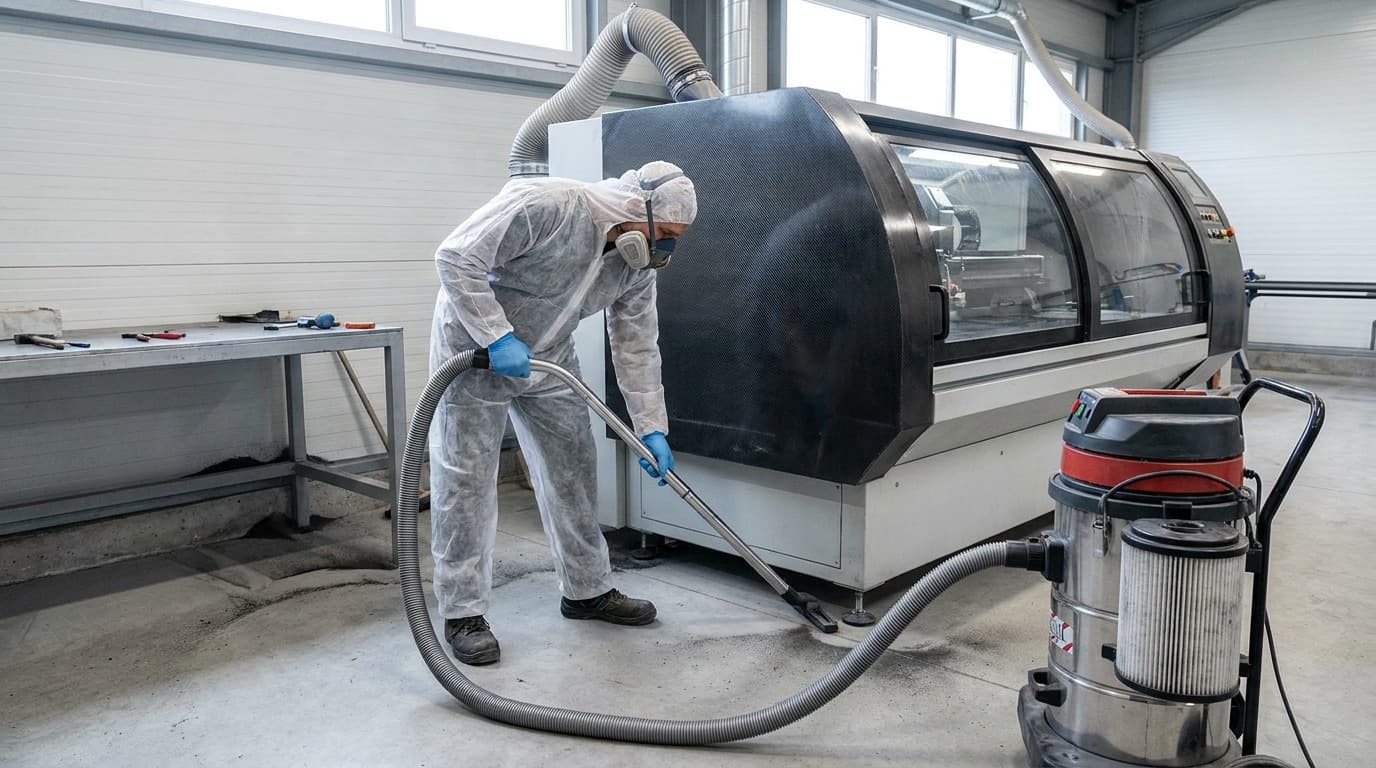
For skin: fibers embed in sweaty skin and in clothing, and the worst thing you can do is scratch — scratching drives fibers deeper and spreads them. Long sleeves, gloves, and washing exposed skin with cool water (warm water opens pores and traps fibers) keep the fiber off and out. Work clothes should be washed separately from other laundry so fibers do not transfer. For eyes: sealed or side-shield safety glasses, because a fiber on the cornea is a mechanical scratch that a chemical wash will not fix — flush, do not rub. For the airway: the ventilation and respirator controls above, because the upper-airway scratchiness is the warning sign that dust is being breathed. And a general point: do not use compressed air to blow off dust or clothing — it launches the fibers straight into the breathing zone and, for carbon, into the air around electrical gear. Vacuum with appropriate filtration, or wet-wipe.
Where the duty sits#
Carbon fiber and fiberglass dust sit under OSHA's air-contaminant and hazard-communication rules, plus the combustible-dust standard for carbon.
The airborne dust is limited as Particulates Not Otherwise Regulated under 1910.1000 / 1926.55 — 5 mg/m³ respirable, 15 mg/m³ total — with the employer's duty to keep exposures below those limits through engineering controls first. The Hazard Communication Standard, 1910.1200 (1926.59 in construction), requires the manufacturer's SDS to be available and workers trained on it — the SDS is where a specific product's sizing, coatings, and any decomposition products are disclosed. Respirator use falls under the respiratory protection standard and its talk. For carbon fiber's combustible dust, NFPA 660 is the current consensus standard (superseding the retired NFPA 652/654), and the conductive-dust hazard is managed under the site's electrical safety program.
On federal contract work, EM 385-1-1 carries its own air-contaminant, ventilation, respiratory-protection and combustible-dust requirements, generally at least as strict as the OSHA baseline; where the manufacturer's SDS or the contract sets a tighter limit, that limit governs. And across all of it, the product's own SDS is the authority on that specific material — sizings and coatings vary, and a coated or specialty product can carry hazards the plain fiber does not.
What can go wrong?#
- A composite panel is cut or ground dry, with no dust collection, and fine respirable dust fills the breathing zone.
- A worker treats fiberglass as harmless because it has no toxic label, and works in it without a barrier.
- Grinding turns a non-respirable fiber into respirable shards that reach deep into the lung.
- A worker scratches itching skin, driving fibers deeper and spreading them.
- Compressed air is used to blow dust off clothing, launching fibers into the air.
- Carbon fiber dust settles on energized electrical equipment and causes a short or arc.
- Carbon dust is allowed to accumulate until it becomes a combustible-dust hazard.
- Work clothes carrying fibers are washed with the family laundry, spreading the irritation home.
How do we manage this properly?#
- Treat the operation, not the material, as the hazard — the danger is created by cutting, grinding, sanding, and drilling.
- Capture dust at the source with local exhaust or tool-mounted collection, and use wet methods where suitable.
- Assume machining can make a respirable, sharp dust even from a fiber that was too big to breathe intact.
- Keep airborne dust well below the PNOR limits (5 mg/m³ respirable, 15 mg/m³ total); use a NIOSH-approved respirator where ventilation cannot.
- Wear skin and eye barriers — long sleeves, gloves, sealed eyewear — and never rub or scratch; flush eyes, wash skin with cool water, launder work clothes separately.
- Never use compressed air to clean dust off skin, clothing, or surfaces; vacuum with filtration or wet-wipe.
- For carbon fiber, keep dust away from energized electrical equipment and do not let it accumulate — treat housekeeping as a combustible-dust control under NFPA 660.
- Read the product's SDS for sizings, coatings and decomposition products specific to that material.
Before you start#
- Confirm whether the job involves cutting, grinding, sanding or drilling — the operations that create the hazard.
- Confirm dust collection or local exhaust is set up, and wet methods are used where suitable.
- Confirm skin and eye barriers are worn, and a NIOSH-approved respirator is available if ventilation is inadequate.
- Confirm the material's SDS has been checked for sizings, coatings or decomposition products.
- For carbon fiber, confirm dust is kept clear of energized electrical equipment.
- For carbon fiber, confirm housekeeping and collection are set up to prevent combustible-dust accumulation.
- Confirm compressed air will not be used to blow off dust.
- On federal work, confirm the EM 385-1-1 air-contaminant and ventilation requirements are met.
Talk it over#
- On today's task, what operation is actually creating the dust — and is it being captured at the source?
- Fiberglass has no toxic label. Does that make it safe to work in without a barrier? Why or why not?
- If we are machining carbon fiber, where is the energized electrical equipment, and where is the dust going?
- Have you ever had fiberglass itch that got worse after you scratched or showered in hot water? What actually helps?
The bottom line#
The hazard of carbon fiber and fiberglass is not what they are made of — it is what you do to them. Intact fiber and cured composite are largely inert; cutting, grinding, sanding, drilling and shredding create the hazard by turning a stable solid into airborne fiber and fine dust. The harm is mechanical, not chemical — abrasion of skin, eyes, and airways, not toxicity — which is why fibrous glass is not classified as a carcinogen by OSHA or NTP, but also why "no toxic label" is not "harmless." The sharpest point is size: as manufactured, continuous filaments are non-respirable, but machining changes the geometry and can release respirable, sharp particles that reach deep into the lung, so the control is capturing dust at the source with local exhaust or tool-mounted collection and staying well below the PNOR limits (5 mg/m³ respirable, 15 mg/m³ total, under 1910.1000 / 1926.55), with a NIOSH-approved respirator where ventilation cannot hold it down. Carbon fiber carries two hazards fiberglass does not: its dust is electrically conductive (short circuits and arcing on energized equipment) and it is a combustible dust governed by NFPA 660 (the retired NFPA 652/654 no longer apply), making housekeeping a safety control rather than a chore. Protect skin and eyes with physical barriers, never rub or scratch, wash with cool water, launder work clothes separately, and never blow dust off with compressed air. Read the product's SDS for sizings and coatings that add hazards the plain fiber lacks. The test for any composite job is one question: is a tool about to turn this inert panel into breathable dust — and if so, is the dust being caught before it reaches anyone's lungs?
Frequently asked questions about carbon fiber and fiberglass#
Is fiberglass toxic?
Not in the chemical sense. Fiberglass harms by mechanical irritation — the physical abrasion of fine fibers against skin, eyes, and the airway — not by chemical toxicity, and fibrous glass is not classified as a carcinogen by OSHA or NTP. But mechanical irritation is still real harm: scratched eyes, skin rash, and a scratchy cough. "No toxic label" does not mean you can work in it without a barrier.
Why is machining more dangerous than handling?
Because handling intact material exposes you to large, non-respirable fibers that mostly cause surface irritation, while cutting, grinding, and sanding fracture the fibers into much finer, respirable particles — including sharp shards — that can reach deep into the lung. The operation manufactures the respirable hazard on the spot. That is why dust must be captured at the source when you machine these materials.
What does "respirable" mean for these fibers?
It refers to particle size small enough to be breathed deep into the lung — roughly, fibers longer than 5 micrometers and thinner than 3 micrometers, the geometry the fiberglass industry's voluntary 1 f/cc guideline is built around. As-manufactured continuous filaments are generally too thick to be respirable; grinding and crushing are what can produce respirable-sized particles.
What is the exposure limit for the dust?
OSHA regulates it as Particulates Not Otherwise Regulated — nuisance dust — at 5 mg/m³ for the respirable fraction and 15 mg/m³ for total dust, under 1910.1000 (1926.55 in construction). There is no fiber-specific PEL. Those numbers are a ceiling, not a target; engineering controls should keep airborne dust well below them, with a respirator where they cannot.
What makes carbon fiber different from fiberglass?
Two things, both unrelated to breathing. Carbon fiber dust is electrically conductive, so it can settle on energized equipment and cause short circuits, arcing, and fire. And accumulated carbon dust is a combustible dust that can form an explosive mixture with air, governed by NFPA 660. Fiberglass carries neither of these — glass is not conductive or combustible in this way — so grinding carbon fiber needs controls that grinding fiberglass does not.
How do I deal with fiberglass itch?
Keep the fiber off in the first place with long sleeves and gloves, and never scratch — scratching drives fibers deeper and spreads them. Wash exposed skin with cool water, not hot, because warm water opens pores and traps fibers. Launder work clothes separately from other laundry. If a fiber is in your eye, flush it, do not rub, and get medical attention if irritation persists.
Can I use compressed air to clean off the dust?
No. Compressed air launches the fibers straight into your breathing zone, and for carbon fiber it spreads conductive, combustible dust into the air and onto electrical equipment. Use a vacuum with appropriate filtration or a wet wipe instead. Blowing dust off with air is one of the fastest ways to turn a settled hazard back into an airborne one.
Download the carbon fiber and fiberglass toolbox talk PDF#
Get this carbon fiber and fiberglass toolbox talk as a print-ready PDF — available in English, Spanish, Portuguese, and Turkish. Print it, hand it to the crew, and collect signatures on the included attendance sheet.
Download the PDF — free account required. New members get 3 free downloads.
Related toolbox talks#
Sources#
- OSHA, 29 CFR 1910.1000 — Air contaminants (Particulates Not Otherwise Regulated): https://www.osha.gov/laws-regs/regulations/standardnumber/1910/1910.1000
- OSHA, 29 CFR 1910.1200 — Hazard Communication: https://www.osha.gov/laws-regs/regulations/standardnumber/1910/1910.1200
- NFPA, NFPA 660 — Combustible Dusts and Particulate Solids (effective 2024; consolidates the retired NFPA 652/654): https://www.nfpa.org/codes-and-standards/nfpa-660-standard-development/660
This talk is general awareness guidance for training purposes. It does not replace your employer's exposure-control and hazard-communication program, the product's Safety Data Sheet, the OSHA air- contaminant or respiratory-protection standards, NFPA 660, or a competent or qualified person's duties, and it is not legal advice. Where the SDS or a contract sets a specific limit, that limit governs.