Confined Space Rescue
Updated 2026-08-06
In this bundle Fire, Hot Work & Emergency
Print-ready PDF
Download this talk as a print-ready PDF, available in 4 languages.
Almost every confined space rescue starts the same way: a worker inside goes down — overcome by an atmosphere nobody could see or smell — and someone outside sees them collapse and goes in after them. It is the most human response imaginable, and it is the one that fills the body count. The single most important fact about confined space rescue is that the rescuers are the ones who die. This Confined Space Rescue Toolbox Talk (Safety Talk / Tailgate Talk) is about the rescue half of confined space work — not the permit and the entry, which have their own talk, but what happens when something goes wrong inside and the instinct to save a coworker becomes the thing that kills two more people.
Here is the distinction that carries this whole talk: more than 60% of confined space deaths are the would-be rescuers, not the original entrant — so the rescue plan is not a backup, it's the thing that decides whether one emergency becomes several. That figure comes from NIOSH's 1986 Alert, which studied confined space fatalities and concluded that a well-designed and properly executed rescue plan is a must precisely because most of the dead are rescuers. Later studies have put the ratio lower, but every one of them agrees on the core: a large share of the people who die in confined spaces went in to save someone else. The reason is not carelessness or cowardice — it is that the untrained rescuer runs into the exact same invisible hazard that dropped the first person, with no more protection than the person already lying on the floor. The rescue plan exists to break that chain before it starts.
Where the boundary of this talk sits#
The confined space talk owns entry — recognizing a permit space, testing and monitoring the atmosphere, the permit, the attendant's duties before anything goes wrong. The respiratory protection talk owns the air supply. The fall rescue talk owns a worker suspended in a harness after a fall. This talk owns the rescue itself: what happens when an entrant is down inside a confined space, why the rescue is planned before entry rather than improvised at the emergency, and why the default is to get them out without anyone else going in. Where the question is getting in safely, that is the entry talk; this one owns getting a downed worker out without adding to the casualties.
The same atmosphere that dropped the entrant drops the rescuer#
This is the mechanism, and understanding it is the whole point. The atmospheres that kill in confined spaces — oxygen deficiency, hydrogen sulfide, carbon monoxide, and others — are usually invisible and often odorless, or they deaden the sense of smell so fast that the warning disappears. A worker can go from standing to unconscious in a breath or two, with no time to climb out and no ability to call for help. So when a coworker looks in and sees them collapsed, nothing about the space looks dangerous — the air that is lethal looks exactly like normal air. The rescuer rushes in, breathes the same atmosphere, and goes down in the same spot, often within feet of the first victim. This is how single fatalities become double and triple ones: not because the second person was reckless, but because the hazard is invisible and the instinct to help is overwhelming. The only thing that beats that instinct is a plan decided in advance, when nobody is lying on the floor.
Non-entry rescue is the default: get them out without going in#
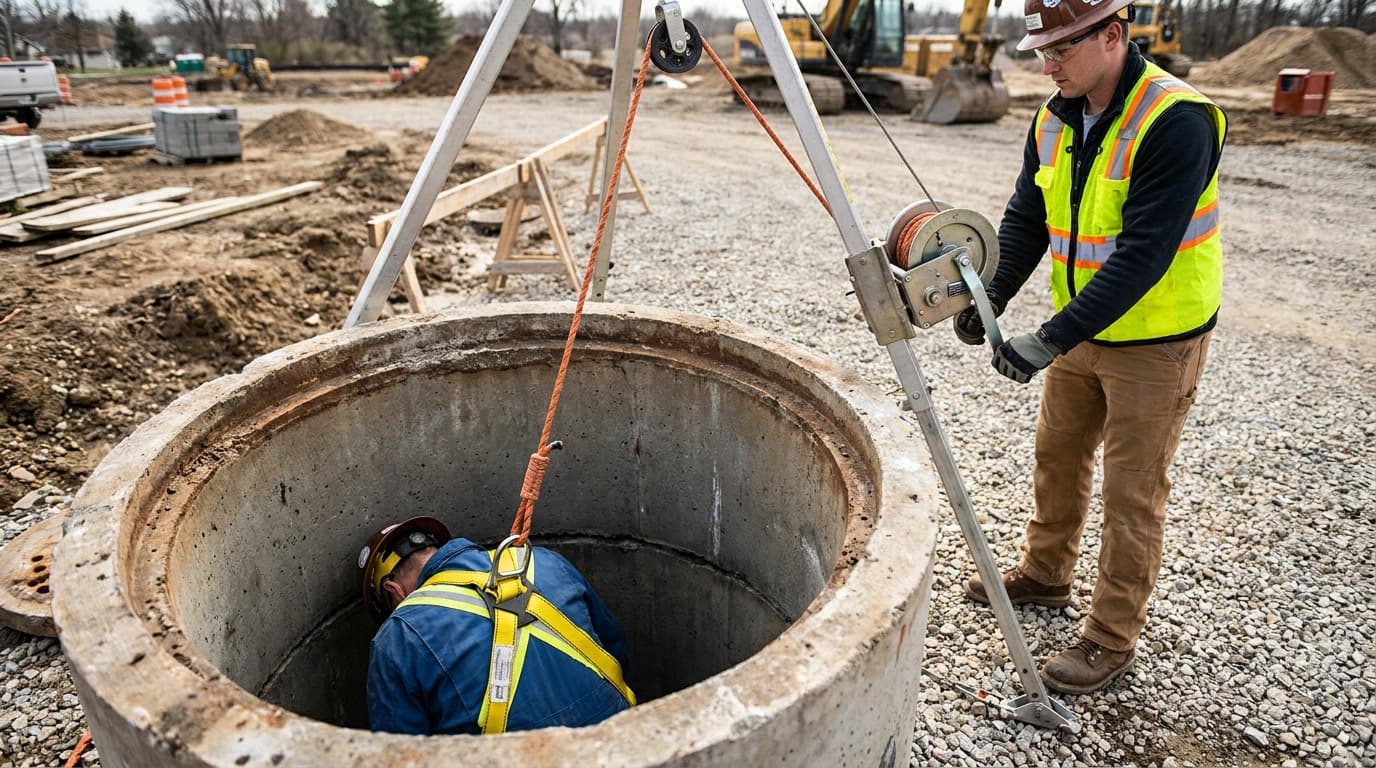
Because the rescuer is the one most likely to die, OSHA's rescue rules are built around a simple priority: get the entrant out without sending anyone in after them. This is non-entry rescue, and it is the default — required unless the retrieval equipment would actually increase the overall risk of entry or would not contribute to the rescue. The way it works is set up before the entrant ever goes in: the authorized entrant wears a chest or full-body harness with a retrieval line attached at the center of the back near shoulder level, above the head, or at another point that gives a small enough profile to pull them out cleanly. The other end of that line is attached to a mechanical device or a fixed point outside the space, arranged so that rescue can begin the instant the attendant realizes it is needed. For a vertical space more than five feet deep, a mechanical device — a winch-type retrieval system — must be available, because a person cannot be hauled straight up by hand. The entire design lets someone outside pull the entrant out without ever breathing the atmosphere that dropped them.
When non-entry rescue won't work, you need a trained team — not volunteers#
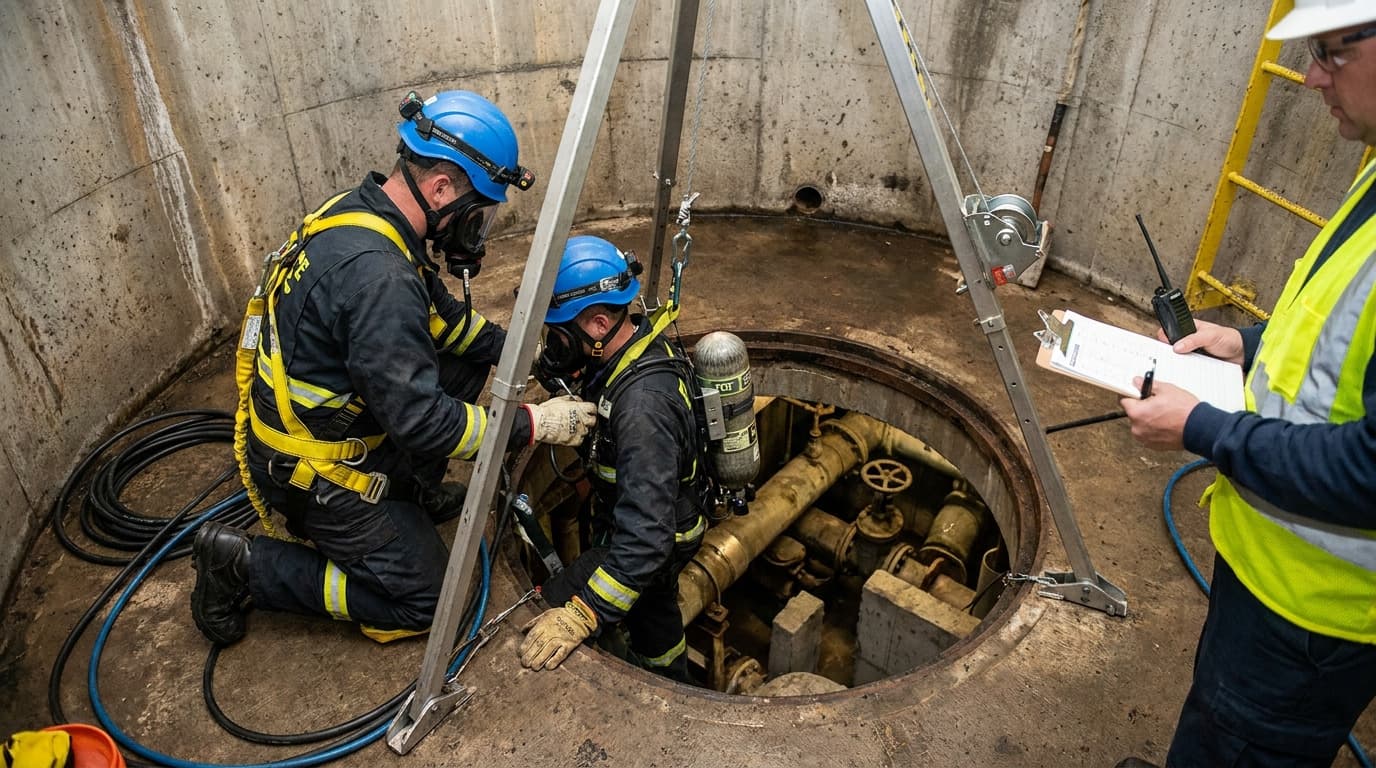
Non-entry rescue has limits. A retrieval line can become entangled, or the internal configuration of the space — turns, obstructions, horizontal runs — can make a straight pull impossible, and the standard says equipment unsuitable for retrieval must not be used. When non-entry rescue cannot work, the answer is still not the coworker standing outside. The employer must designate an entry rescue service — a trained, equipped team that can enter safely with its own air supply and its own protection — and must confirm before entry that this emergency assistance would actually be available if non-entry rescue fails. The distinction that matters on the ground is this: entry rescue is a job for people with breathing apparatus and training, not for whoever happens to be nearby. The attendant's role in an emergency is to summon that rescue, not to become part of it. The moment the attendant enters, there is no one left outside, and the space has claimed its second victim.
The attendant never becomes the rescuer#
This is worth stating on its own because it is the exact point where plans fail. The attendant — the person stationed outside the space whose job is to monitor the entrant and the conditions — is the entrant's lifeline, and that role only works from outside. If the attendant enters to help, the entrant loses their monitor, no one is left to summon or direct the rescue service, and the attendant is now a second person exposed to the atmosphere. Every confined space rescue plan depends on the attendant holding position and calling the trained rescue, even while watching a coworker in trouble. That is an extraordinarily hard thing to ask of a person, which is exactly why it has to be trained and agreed before entry — in the moment, instinct will pull the other way. The attendant staying out is not the attendant doing less; it is the attendant doing the one thing that keeps the rescue from becoming a recovery of two.
Where the duty sits#
The rescue requirements live in 1926.1211, the confined space standard's rescue and emergency services provisions: non-entry rescue required unless it would increase risk or not contribute; retrieval systems with a harness and a line rigged to an external mechanical device or fixed point; a mechanical retrieval device for vertical spaces more than five feet deep; a designated entry rescue service when non-entry is not selected; and confirmation before entry that emergency help is available. The evidence base for why this matters so much is NIOSH Alert 86-110, which found that most confined space fatalities are would-be rescuers and that a rescue plan is therefore essential. The broader duties to train workers and protect against recognized hazards run through 1926.21(b)(2) and the General Duty Clause, Section 5(a)(1). Where a site's permit program or rescue procedure sets specific requirements, those govern — and the manufacturer's instructions govern the retrieval equipment.
What can go wrong?#
- An entrant is overcome by the atmosphere and a coworker rushes in and is overcome too.
- No retrieval system was rigged before entry, so non-entry rescue is impossible.
- The attendant enters to help and becomes the second victim.
- The space is a vertical space over five feet deep with no mechanical retrieval device available.
- No trained entry rescue service was designated, so the only "rescuers" are untrained coworkers.
- The plan was to call 911 and hope — with no confirmation help could arrive in time.
- The retrieval line is entangled or the space's configuration makes a straight pull impossible.
- The rescue is improvised in the moment instead of planned before entry.
How do we manage this properly?#
- Understand that the rescuer is the one most likely to die — the plan exists to prevent that.
- Rig non-entry rescue before entry: harness, retrieval line, external anchor or mechanical device.
- For a vertical space over five feet deep, have a mechanical retrieval device ready.
- Designate a trained entry rescue service when non-entry rescue can't work — not coworkers.
- Confirm before entry that emergency help would actually be available in time.
- The attendant never enters — their job is to summon rescue and hold position.
- Never send an untrained volunteer into the same atmosphere that dropped the entrant.
- Decide the rescue in advance, when no one is on the floor and instinct isn't driving.
Before you start#
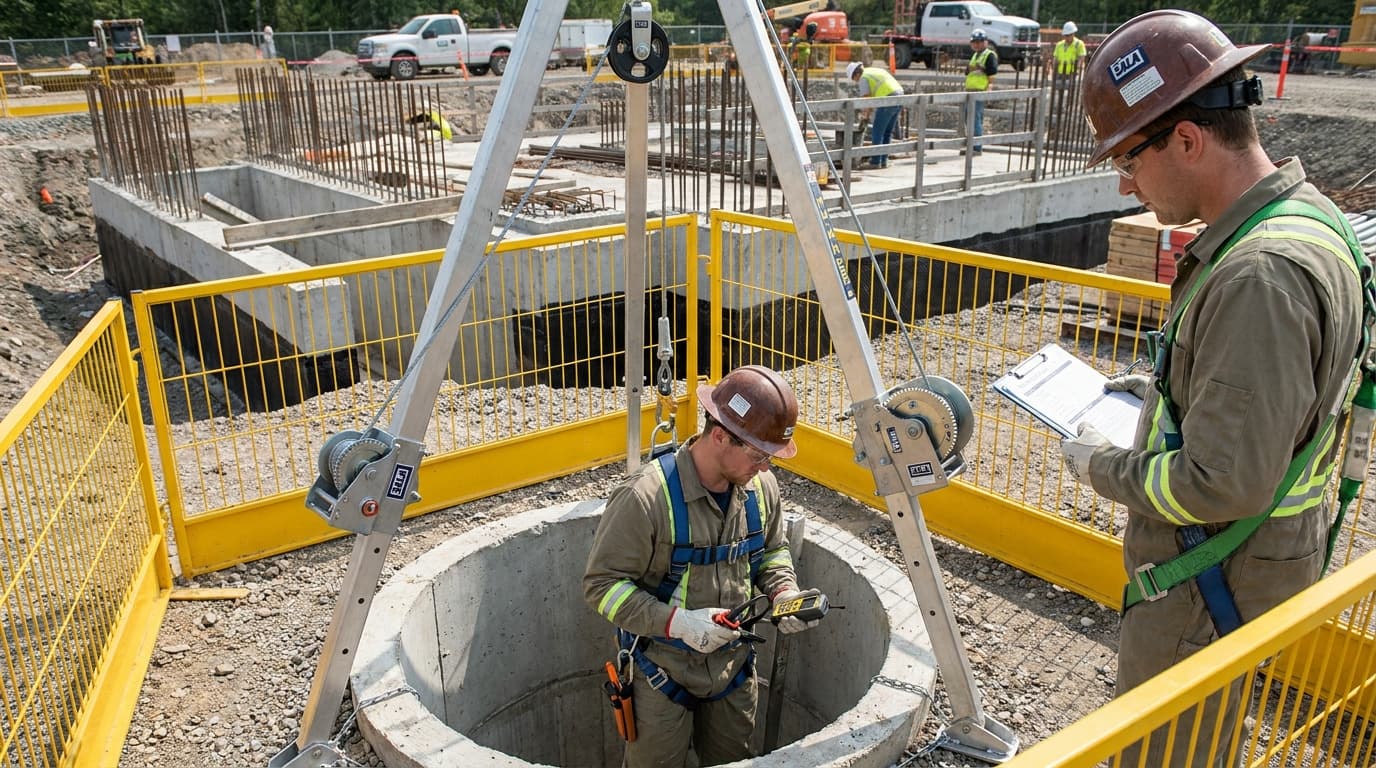
- Confirm a rescue plan exists for this specific space before anyone enters.
- Confirm the entrant is in a harness with the retrieval line rigged.
- Confirm the retrieval line's external end is on a mechanical device or fixed point.
- Confirm a mechanical retrieval device is present for a vertical space over five feet deep.
- Confirm a trained entry rescue service is designated and reachable.
- Confirm emergency assistance would actually arrive in time — not just "call 911."
- Confirm the attendant knows they never enter, only summon rescue.
- Confirm the whole crew knows an unplanned rescue is how the toll multiplies.
Talk it over#
- If someone went down in this space right now, what would actually happen?
- Is the retrieval system rigged, or would a rescue mean someone going in?
- Who is our trained entry rescue service, and how fast can they be here?
- Could you hold position as the attendant while a coworker was down — and why must you?
The bottom line#
More than 60% of confined space deaths are the would-be rescuers, not the original entrant — so the rescue plan is not a backup, it's the thing that decides whether one emergency becomes several. That figure is from NIOSH's 1986 Alert; later studies put it lower, but all agree a large share of the dead went in to save someone. The mechanism is simple and merciless: the same invisible atmosphere that dropped the entrant drops the rescuer, because lethal air looks exactly like normal air and the instinct to help is overwhelming. That is why OSHA's default is non-entry rescue under 1926.1211 — a harness and retrieval line rigged before entry, anchored to an external mechanical device or fixed point, with a mechanical device required for vertical spaces over five feet deep — so a downed entrant can be pulled out without anyone breathing that atmosphere. When non-entry rescue can't work, the answer is a trained, designated entry rescue service with its own air, not the coworker standing outside, and the employer must confirm before entry that this help would actually be available. Above all, the attendant never enters — the moment they do, the space has its second victim. The evidence is NIOSH 86-110, the rule is 1926.1211, and the test is one question: if someone went down in this space right now, would we pull them out — or would we send a second person in after them?
Frequently asked questions about confined space rescue#
Why are so many of the deaths rescuers?
Because the hazard is invisible and the instinct to help is overwhelming. The atmospheres that kill in confined spaces — oxygen deficiency, hydrogen sulfide, carbon monoxide — usually can't be seen or smelled, so when a coworker looks in and sees someone collapsed, the space looks perfectly normal. They rush in, breathe the same air, and go down in the same place. NIOSH's 1986 Alert found that more than 60% of confined space fatalities were would-be rescuers; later studies put the ratio lower, but all confirm that a large share of the dead entered to save someone. It is not recklessness — it is an invisible hazard meeting a human instinct, which is exactly why the rescue has to be planned, not improvised.
What is non-entry rescue and why is it the default?
Non-entry rescue means pulling a downed entrant out from outside the space, without anyone else going in. It is OSHA's default under 1926.1211 — required unless the retrieval equipment would increase the overall risk or would not contribute to the rescue. It works because it is set up before entry: the entrant wears a chest or full-body harness with a retrieval line attached near shoulder level or above the head, and the other end is rigged to a mechanical device or fixed point outside. For a vertical space more than five feet deep, a mechanical retrieval device must be available, since a person cannot be hauled straight up by hand. The whole point is to get the entrant out without a rescuer ever breathing the atmosphere that dropped them.
What if non-entry rescue won't work for our space?
Then you need a designated, trained entry rescue service — not volunteers. Non-entry rescue has real limits: a retrieval line can entangle, and a space with turns, obstructions, or horizontal runs can make a straight pull impossible, in which case unsuitable retrieval equipment must not be used. When that is the case, the employer must designate an entry rescue service that can enter safely with its own breathing apparatus and training, and must confirm before entry that this help would actually be available if non-entry rescue fails. What it can never be is the coworker standing nearby — entry into an atmosphere that has already dropped someone is a job for trained, equipped rescuers only.
Can the attendant go in to help?
No — and this is the single most important rule in confined space rescue. The attendant is stationed outside to monitor the entrant and conditions and to summon rescue, and that role only works from outside. If the attendant enters, the entrant loses their monitor, no one is left to call or direct the rescue service, and the attendant becomes a second person exposed to the same atmosphere. Every rescue plan depends on the attendant holding position and calling the trained rescue even while watching a coworker in trouble. It is a hard thing to ask, which is why it has to be trained and agreed before entry — because in the moment, instinct pulls the other way.
Is calling 911 a rescue plan?
Not by itself. A rescue plan has to confirm, before entry, that emergency assistance would actually be available in time — and for a confined space emergency, "in time" can be minutes. A local emergency service may not have confined space rescue training or equipment, and may not be able to arrive and set up before an unprotected entrant is beyond help. The standard requires the employer to evaluate and arrange a rescue capability in advance, whether that is non-entry rescue rigged and ready or a designated entry rescue service confirmed to be reachable. Relying on a 911 call with no confirmation is planning to arrive too late.
How is this different from the confined space entry talk?
The entry talk owns getting in safely — recognizing a permit space, testing and continuously monitoring the atmosphere, the permit, and the attendant's duties during normal work. This talk owns what happens when something goes wrong inside: the rescue. The two are connected — good entry practice prevents most rescues — but they are separate skills. You can do entry perfectly and still lose people if there is no rescue plan, and the rescue is where the majority of confined space deaths actually happen. That is why the rescue gets its own talk: it is planned before entry, it has its own equipment and its own trained team, and its whole purpose is to make sure a downed entrant does not take rescuers down with them.
Download the confined space rescue toolbox talk PDF#
Get this confined space rescue toolbox talk as a print-ready PDF — available in English, Spanish, Portuguese, and Turkish. Print it, hand it to the crew, and collect signatures on the included attendance sheet.
Download the PDF — free account required. New members get 3 free downloads.
Related toolbox talks#
Sources#
- NIOSH, Alert 86-110 — Preventing Occupational Fatalities in Confined Spaces (more than 60% of confined space fatalities occur among would-be rescuers; a well-designed and properly executed rescue plan is a must): https://www.cdc.gov/niosh/docs/86-110/
- OSHA, Rescue and emergency services — 29 CFR 1926.1211 (non-entry rescue required unless it would increase risk or not contribute; retrieval line rigged to an external mechanical device or fixed point; mechanical device required for vertical spaces more than 5 feet deep; designated entry rescue service when non-entry is not selected): https://www.osha.gov/laws-regs/regulations/standardnumber/1926/1926.1211
- OSHA, Training requirements — 29 CFR 1926.21(b)(2) (employer must instruct each employee in the recognition and avoidance of unsafe conditions, the general duty under which rescue preparedness sits): https://www.osha.gov/laws-regs/regulations/standardnumber/1926/1926.21
This talk is general awareness guidance for training purposes. It does not replace your employer's confined space entry program or rescue procedures, the OSHA confined space standard, the OSH Act General Duty Clause, the retrieval equipment manufacturer's instructions, or a competent person's duties, and it is not legal advice. Where a site rescue plan or permit program sets a specific requirement, that requirement governs.
Written by FieldSafetyTalk's safety professional — a CSP, ASP, CHST and OSHA Authorized Outreach Trainer with 14+ years of international construction safety experience across federal, heavy civil, and industrial projects.