Rigging Inspections
Updated 2026-07-28
In this bundle Rigging & Lifting
Print-ready PDF
Download this talk as a print-ready PDF, available in 4 languages.
Rigging fails quietly. A sling does not announce that it has lost capacity; it simply holds for the hundredth lift and not the hundred-and-first. Everything about the way the standard is written accepts that — which is why it does not ask you to judge whether a sling is strong enough, but to look for specific damage on a specific schedule and take the sling out of service the moment you find it. This rigging inspections talk is about that schedule.
Here is the distinction that carries this whole talk: there are two separate inspection regimes, not one. A daily inspection before use, by a competent person, of the sling and everything attached to it. And a thorough periodic inspection on a defined interval, of which a record must be kept. Sites routinely do the first and skip the second, then discover the gap when someone asks for the record.
The daily inspection — 1926.251(a)(6)#
Each day before being used, the sling and all fastenings and attachments shall be inspected for damage or defects by a competent person designated by the employer. Additional inspections shall be performed during sling use, where service conditions warrant.
Three things in one sentence. It is daily, it is before use, and it is by a competent person designated by the employer — not by whoever picks the sling up. It also covers all fastenings and attachments, which means the shackles, hooks, links and any accessory in the assembly, not just the sling body.
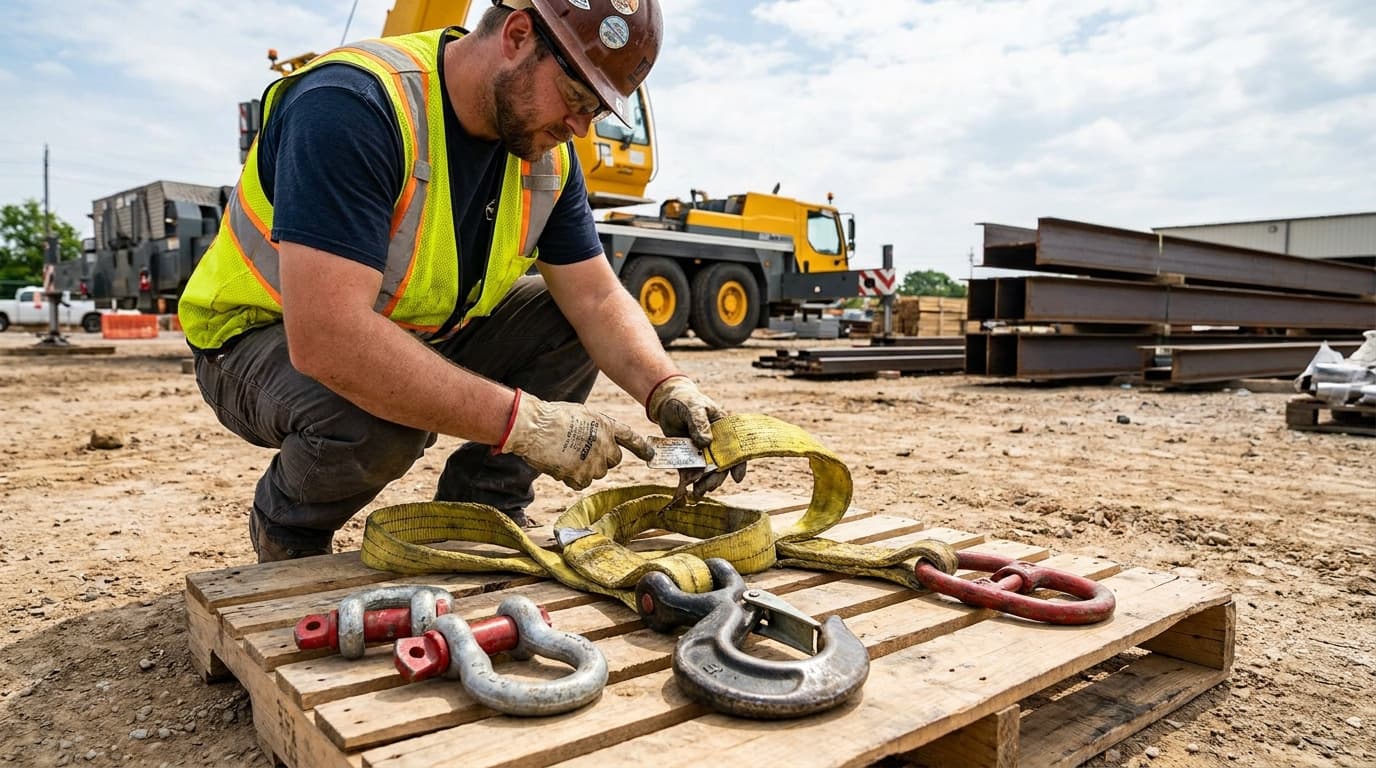
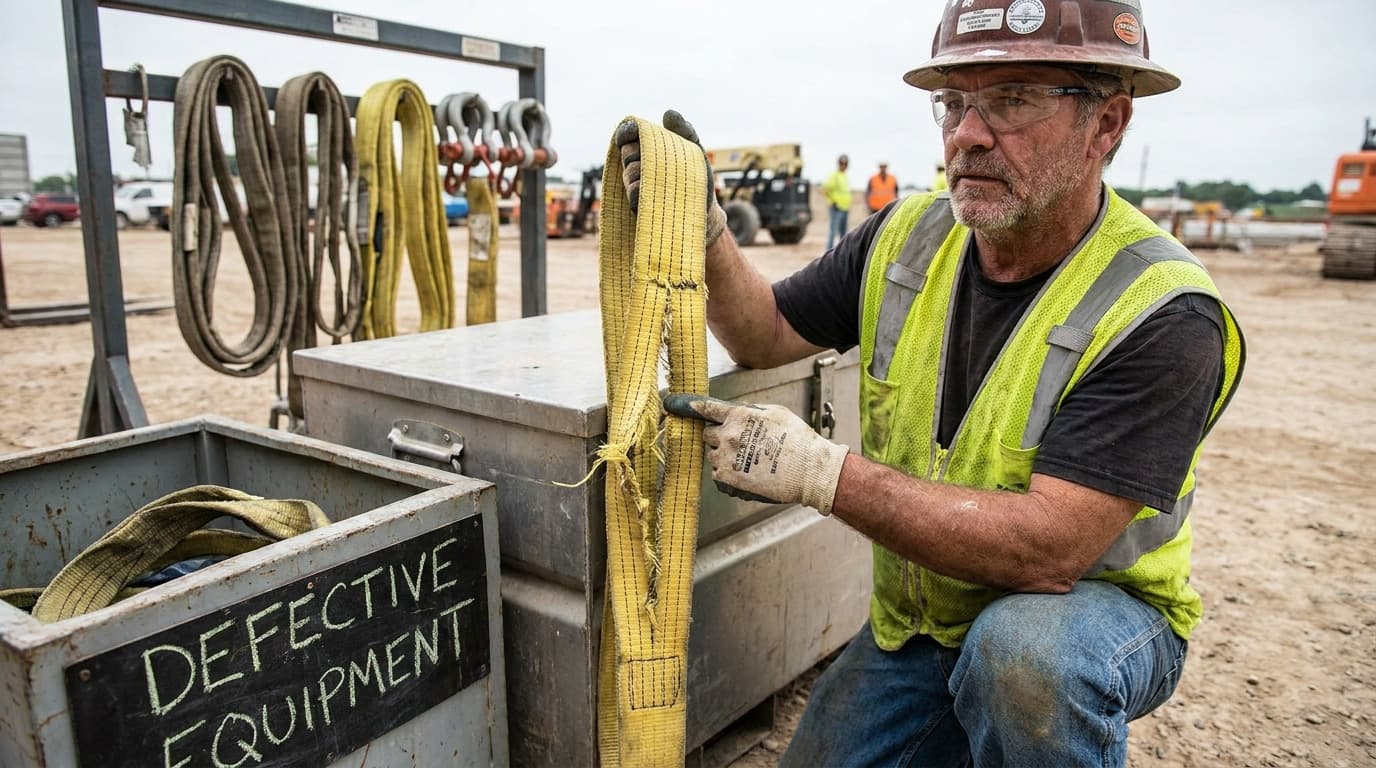
Behind it sits the general rule at (a)(1): rigging equipment for material handling shall be inspected prior to use on each shift and as necessary during its use to ensure that it is safe — and defective rigging equipment shall be removed from service. Not set aside. Not used for the last lift. Removed.
Two more general duties that get overlooked:
(a)(2) — rigging equipment shall not be loaded in excess of its recommended safe working load, as prescribed in Tables H-1 through H-20.
(a)(3) — rigging equipment, when not in use, shall be removed from the immediate work area so as not to present a hazard to employees. A pile of slings by the load is itself a trip and snag hazard.
The periodic inspection — 1926.251(b)(6), and the record#
This is the requirement most sites cannot evidence.
For alloy steel chain slings, a thorough periodic inspection must be made on a regular basis, determined by:
- (A) frequency of sling use
- (B) severity of service conditions
- (C) nature of lifts being made
- (D) experience gained on the service life of slings used in similar circumstances
And then the ceiling: "Such inspections shall in no event be at intervals greater than once every 12 months."
Read that structure carefully, because it is not a twelve-month rule. The interval is supposed to be set by the four factors — a chain sling in daily use lifting abrasive material in a marine environment should be on a far shorter cycle than one used monthly indoors. Twelve months is the maximum, not the schedule. A site that inspects everything annually and calls it compliant has applied the ceiling and ignored the rule.
Then the part that surprises people, at (b)(6)(ii):
The employer shall make and maintain a record of the most recent month in which each alloy steel chain sling was thoroughly inspected, and shall make such record available for examination.
A record of the month. Not the date, not the findings, not the inspector — the month, per sling, kept and produced on request. It is a modest requirement and an unusually specific one, and the fact that it is written per sling is why chain slings need individual identification in the first place.
Marking, capacity and the proof test#
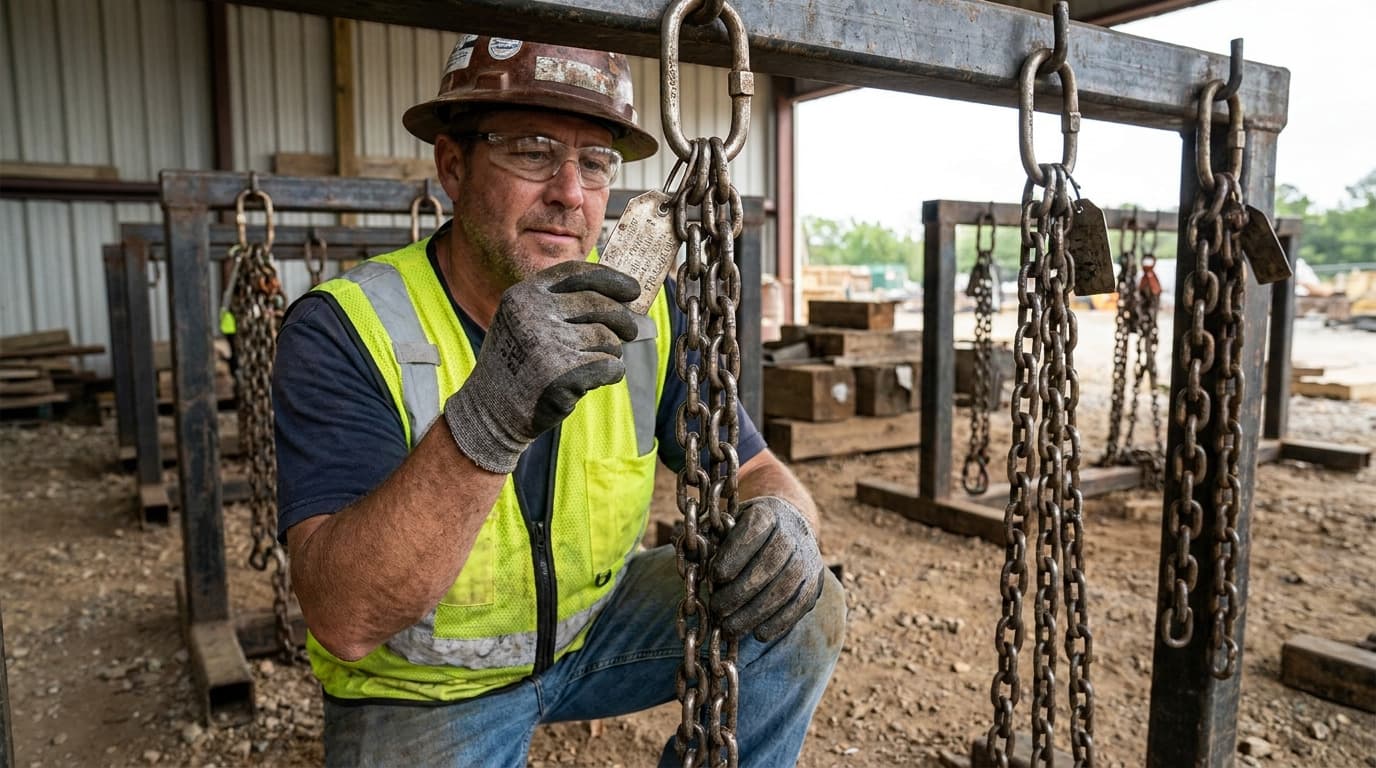
Alloy steel chain slings must carry permanently affixed durable identification stating size, grade, rated capacity and sling manufacturer — which is what makes the per-sling inspection record possible.
Wire rope slings must not be used with loads in excess of the rated capacities indicated on the sling by permanently affixed and legible identification markings prescribed by the manufacturer. And protruding ends of strands in splices on slings and bridles shall be covered or blunted — a small provision that prevents a lot of hand injuries.
And the one that catches fabricated lifting gear — (a)(4):
Special custom design grabs, hooks, clamps, or other lifting accessories, for such units as modular panels, prefabricated structures and similar materials, shall be marked to indicate the safe working loads and shall be proof-tested prior to use to 125 percent of their rated load.
That covers the purpose-made lifting beam, the panel clamp, the site-fabricated spreader and the bespoke grab that arrives with a module. Marked, and proof-tested to 125% before use. Anything fabricated on site without that is not lifting gear; it is an assumption.
One boundary worth knowing: the numeric removal criteria most riggers can recite — counts of broken wires per rope lay — come from the general industry sling standard and the ASME B30.9 consensus standard rather than from 1926.251 itself. They are the recognised practice and worth applying, but if you are citing construction text, cite the inspection and removal-from-service duties above.
What to look for#
Chain — stretch, gouges, nicks, cracked or deformed links, wear at bearing points, heat damage, and any link that will not articulate freely.
Wire rope — broken wires, kinking, crushing, birdcaging, corrosion, heat damage, and damaged or distorted end fittings.
Synthetic web and round slings — cuts, snags, punctures, abrasion, broken or worn stitching, acid or caustic burns, melting, charring, and a missing or illegible tag.
Hooks — deformation, opened throat, twist, cracks, and a missing or non-functioning latch.
Shackles — the wrong pin, a bolt substituted for a pin, elongation, distortion and thread damage.
Everything — an illegible or missing tag. A sling with no identification has no rated capacity, and no rated capacity means it cannot be used.
What can go wrong?#
The tag has gone, so nobody knows the capacity and somebody estimates.
A defective sling is set aside rather than removed, and returns to the rack by the end of the week.
The annual inspection is the only inspection, with the four factors never applied.
No record exists per sling, because slings are not individually identified.
A bolt in place of a shackle pin, or the wrong pin entirely.
Site-fabricated lifting gear with no proof test and no marked safe working load.
Slings stored on the ground in mud, grit or standing water, or left in the work area when not in use.
Sharp edges with no protection, cutting a web sling on the first lift.
How do we manage this properly?#
Name the competent person who does the daily inspection, and make sure they are actually available before the first lift.
Inspect the assembly, not the sling — fastenings, attachments, hooks, shackles and the tag.
Remove defective gear from service immediately, physically and irreversibly. Cut it if that is what it takes.
Set the periodic interval from the four factors, and treat 12 months as the ceiling.
Identify every chain sling individually so the required record of the most recent month can exist.
Keep the record and be able to produce it, because the standard requires it to be available for examination.
Proof-test and mark custom lifting accessories to 125% of rated load before first use.
Protect edges and store gear off the ground, and clear rigging from the work area when not in use.
Before you start#
- Confirm who the designated competent person is and that today's inspection has happened.
- Confirm every sling has a legible tag with a rated capacity.
- Confirm the fastenings and attachments were inspected, not just the sling.
- Confirm the load does not exceed the safe working load for the configuration and angle.
- Confirm nothing defective is still on the rack or in the basket.
- Confirm any custom lifting accessory is marked and was proof-tested to 125%.
- Confirm edge protection where the sling bears on anything sharp.
- Confirm the chain sling periodic inspection record exists and is current.
Talk it over#
- Pick up the nearest sling — can you read its tag?
- When was the last thorough periodic inspection here, and who holds the record?
- What happens on this site to a sling somebody finds damaged?
- Has anyone lifted with gear that had no marked capacity?
The bottom line#
1926.251 sets two inspection regimes. Under (a)(6), each day before being used, the sling and all fastenings and attachments must be inspected for damage or defects by a competent person designated by the employer, with additional inspections during use where service conditions warrant — and under (a)(1) rigging is inspected prior to use on each shift, with defective rigging removed from service. Under (b)(6)(i), alloy steel chain slings additionally need a thorough periodic inspection whose interval is set by frequency of use, severity of service, nature of lifts and experience — and which shall in no event be at intervals greater than once every 12 months. Twelve months is the ceiling, not the schedule. Then (b)(6)(ii): the employer must make and maintain a record of the most recent month in which each chain sling was thoroughly inspected, available for examination. And (a)(4) requires custom grabs, hooks, clamps and other lifting accessories to be marked with safe working loads and proof-tested prior to use to 125 percent of rated load.
Frequently asked questions about rigging inspections#
How often must slings be inspected?
Daily, at minimum. 1926.251(a)(6) requires that each day before being used, the sling and all fastenings and attachments be inspected for damage or defects by a competent person designated by the employer, with additional inspections during use where service conditions warrant. (a)(1) also requires rigging equipment to be inspected prior to use on each shift.
What is the 12-month rule for chain slings?
It is a ceiling rather than a schedule. 1926.251(b)(6)(i) requires a thorough periodic inspection of alloy steel chain slings on a regular basis determined by frequency of use, severity of service conditions, nature of lifts, and experience gained on similar slings — and states that such inspections shall in no event be at intervals greater than once every 12 months. Heavy or severe service demands a shorter interval.
What record has to be kept?
A modest but specific one. 1926.251(b)(6)(ii) requires the employer to make and maintain a record of the most recent month in which each alloy steel chain sling was thoroughly inspected, and to make that record available for examination. It is per sling and it records the month — which is why chain slings need individual identification.
What has to happen to a damaged sling?
It must be removed from service. 1926.251(a)(1) provides that defective rigging equipment shall be removed from service — not set aside, not used for one more lift. In practice, destroying or cutting the sling is the only reliable way to ensure it does not reappear on the rack.
Do site-made lifting attachments need testing?
Yes. 1926.251(a)(4) requires special custom design grabs, hooks, clamps or other lifting accessories for units such as modular panels and prefabricated structures to be marked to indicate the safe working loads and proof-tested prior to use to 125 percent of their rated load. Fabricated gear without that is not rated lifting equipment.
Can a sling be used if the tag is missing?
No. Wire rope slings must not be used with loads in excess of the rated capacities indicated on the sling by permanently affixed and legible identification markings, and chain slings must carry permanently affixed durable identification stating size, grade, rated capacity and manufacturer. Without a legible tag there is no established rated capacity, so there is no safe load to work to.
Where do the broken-wire removal criteria come from?
Mostly from outside the construction standard. The numeric criteria riggers commonly quote — counts of broken wires per rope lay — sit in the general industry sling standard and in ASME B30.9 rather than in 1926.251. They are recognised practice and worth applying; the construction citations are the inspection and removal-from-service duties.
Download the rigging inspections toolbox talk PDF#
Get this rigging inspections toolbox talk as a print-ready PDF — available in English, Spanish, Portuguese, and Turkish. Print it, hand it to the crew, and collect signatures on the included attendance sheet.
Download the PDF — free account required. New members get 3 free downloads.
Related toolbox talks#
Sources#
- OSHA, 29 CFR 1926.251 — Rigging equipment for material handling: https://www.osha.gov/laws-regs/regulations/standardnumber/1926/1926.251
- OSHA, 29 CFR 1926.252 — Disposal of waste materials: https://www.osha.gov/laws-regs/regulations/standardnumber/1926/1926.252