Eye & Face Protection
Updated 2026-07-28
In this bundle Jobsite Fundamentals & Compliance
Print-ready PDF
Download this talk as a print-ready PDF, available in 4 languages.
Eye injuries are the ones people describe afterwards as having come from nowhere. Not the task they were braced for — the one beside them, or the moment they lifted their glasses to see better, or the second between finishing and walking away. The protection is cheap, available and usually present on site. The failures are almost entirely about the gap between having it and wearing it, correctly, at the moment it mattered. This Eye & Face Protection Toolbox Talk (Safety Talk / Tailgate Talk) covers both halves.
Here is the distinction that carries this whole talk: safety glasses are a baseline, not a solution. They handle flying particles from the front. They do not handle splash, they do not handle dust that arrives around the edges, and they are not face protection. Most serious eye injuries on construction sites happen to people who were, technically, wearing eye protection — just not the right kind for what arrived.
What the standard accepts — and it is more flexible than most people think#
1926.102(b)(1) requires that protective eye and face protection devices comply with any of the following consensus standards:
- ANSI/ISEA Z87.1-2010, Occupational and Educational Personal Eye and Face Protection Devices
- ANSI Z87.1-2003, Occupational and Educational Personal Eye and Face Protection Devices
- ANSI Z87.1-1989 (R-1998), Practice for Occupational and Educational Eye and Face Protection
All three are incorporated by reference in 1926.6, and any of them satisfies the standard. OSHA does not require the newest edition.
And (b)(2) goes further: devices the employer demonstrates are at least as effective as those constructed in accordance with one of those consensus standards will be deemed to be in compliance. That is a genuine performance route — but note the burden. The employer must demonstrate it, which means evidence, not opinion.
The practical takeaways: look for the Z87 marking, and understand that eyewear marked to a later edition such as Z87.1-2020 is what current suppliers provide even though the standard names earlier ones. What is not acceptable is eyewear with no marking at all — because then nothing has been demonstrated about it.
Two general requirements matter as much as the marking. Protection must be provided when machines or operations present potential eye or face injury from physical, chemical or radiation agents — and devices must fit snugly and not unduly interfere with the movements of the wearer. Protection that does not fit gets adjusted, lifted or removed, and that is a selection failure rather than a discipline problem.
Matching the protection to what arrives#
Flying particles from the front — safety glasses with side protection. This is the baseline for general construction work.
Dust, fine particles and anything that gets around the edges — sealed goggles. Safety glasses have gaps at the top, bottom and sides by design, and cutting, grinding and sweeping put material through them.
Liquid splash, chemicals, molten material — goggles for the eyes, plus a face shield for the face. A face shield alone is secondary protection: it protects the face, but eye protection must be worn under it.
Impact and heavy grinding — glasses or goggles under a full-length face shield. A shield that stops short leaves the lower face exposed.
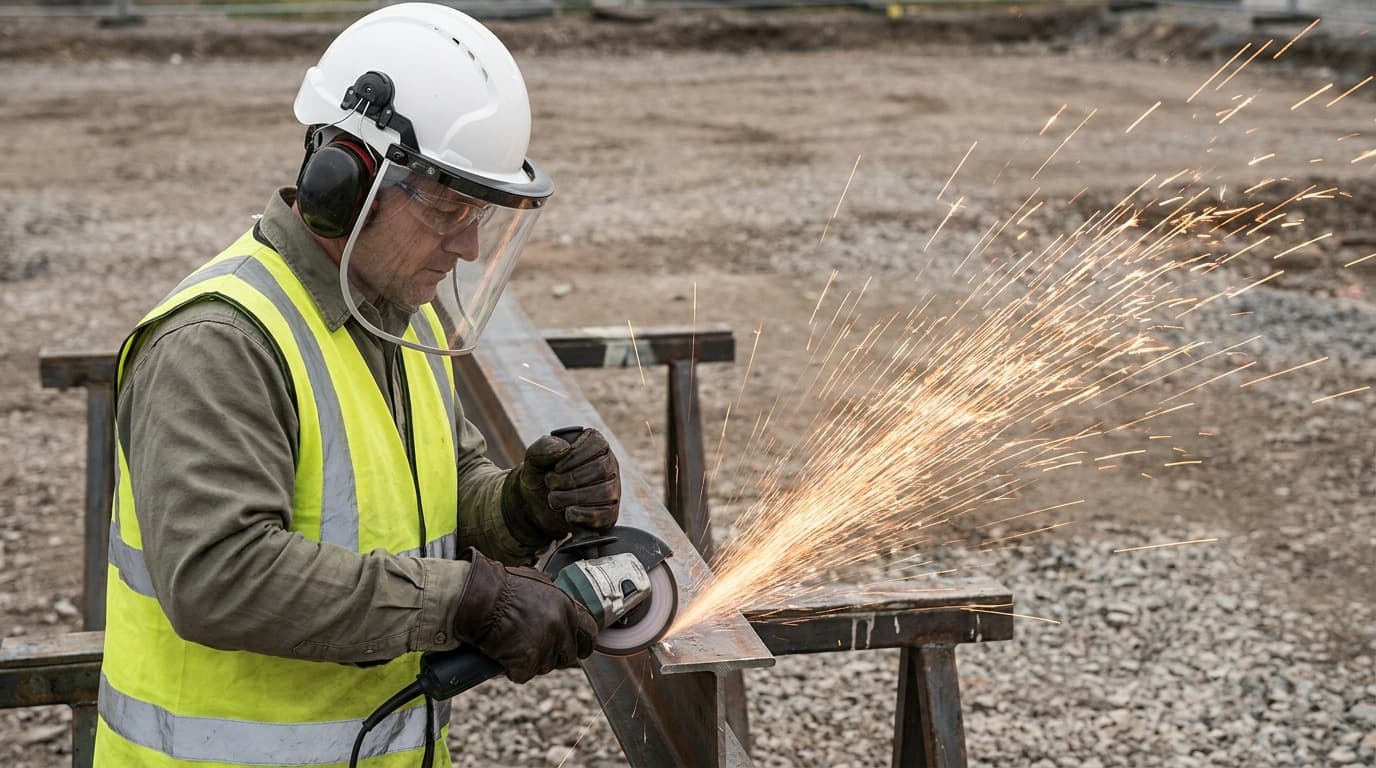
Radiant energy — welding filters, covered below.
Prescription glasses are not safety eyewear unless they are Z87-marked. The options are prescription safety eyewear, or safety glasses designed to be worn over prescription lenses — not ordinary spectacles with a shield hoped over them.
Radiant energy: Table E-1 is a floor#
1926.102(c)(1) provides that Table E-1 shall be used as a guide for selecting the proper shade numbers of filter lenses or plates used in welding, and — the part that matters — shades more dense than those listed may be used to suit the individual's needs.
Read that carefully. The table sets a minimum, not a specification. Going darker is expressly permitted; going lighter is not. The correct shade depends on the process and the amperage, and the practical rule is to start at the minimum recommended shade and increase it if glare or discomfort persists. Too light fails to protect. Too dark reduces visibility and creates a different kind of error.
Note also that construction's table is Table E-1 in 1926.102, while general industry's shade tables sit in 1910.133 — a small difference that causes confusion when people quote table numbers at each other.
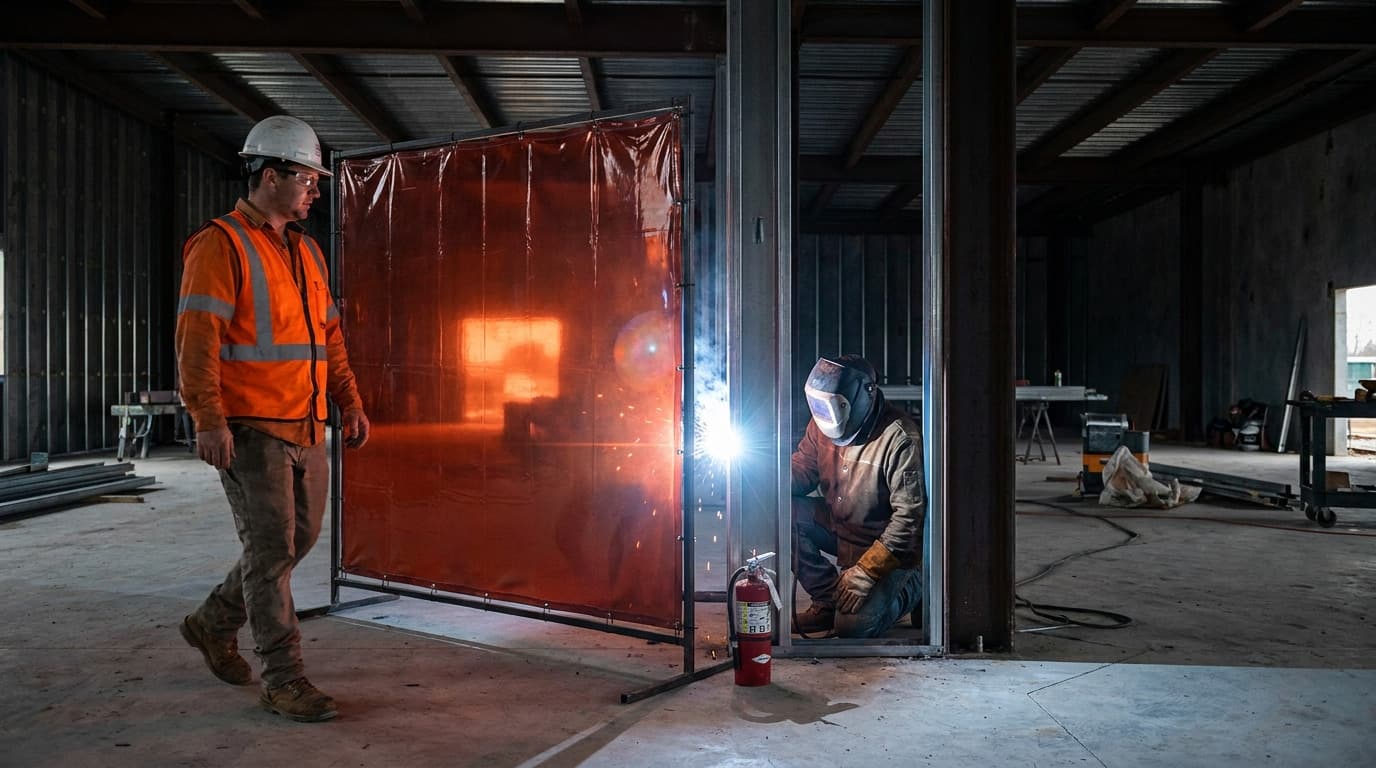
And the flash risk is not confined to the welder. Arc eye is a photokeratitis — a burn to the surface of the eye — and it commonly affects the person nearby who looked up, hours later, at home. Screening the arc protects people who never held a torch.
Lasers: generic eyewear does not exist#
1926.102(c)(2)(i) requires that employees whose occupation or assignment requires exposure to laser beams be furnished suitable laser safety goggles which will protect for the specific wavelength of the laser and be of optical density (O.D.) adequate for the energy involved.
Two variables, both specific: wavelength and optical density. There is no such thing as general-purpose laser eyewear — goggles that protect against one wavelength may be transparent to another. With laser levels and alignment equipment now routine on construction sites, this is worth knowing rather than assuming.
What can go wrong?#
Glasses lifted "for a second" to see a mark, a cut or a fit.
Safety glasses used where goggles were needed — dust, splash or fine particles arriving around the edges.
A face shield worn alone, with no eye protection under it.
Ordinary prescription spectacles treated as safety eyewear.
Unmarked eyewear bought on price, with nothing demonstrated about its performance.
Scratched, pitted or fogged lenses that make people take them off to see.
Poor fit — too loose, too tight, or incompatible with a respirator or hard hat, so it gets adjusted or abandoned.
Bystanders unprotected — the person holding the light, the labourer sweeping behind the grinder, the apprentice watching the weld.
How do we manage this properly?#
Select for the hazard that will actually arrive: particles, dust, splash, impact, radiation — and remember tasks often bring more than one.
Treat face shields as secondary, always with eye protection underneath.
Check the marking. Z87 on the frame and lens, and for welding filters the shade number.
Fit it properly. Snug without pressure, compatible with hard hat and respirator, and adjusted for the individual — a poor fit is the leading cause of removal.
Deal with fogging as a safety problem, not a nuisance: anti-fog lenses, ventilation, or a different style, because fogging is what gets protection taken off.
Replace damaged lenses. Scratches and pitting reduce both protection and visibility.
Start at the minimum shade from Table E-1 and go darker if needed — never lighter.
Screen arcs and protect bystanders, because flash injuries reach people who were not doing the work.
Provide prescription safety eyewear for those who need it, rather than relying on people to manage it themselves.
Before you start#
- Confirm what could reach your eyes today: particles, dust, splash, impact, radiant energy or laser.
- Confirm your eyewear is Z87-marked and undamaged.
- Confirm goggles rather than glasses if dust or splash is involved.
- Confirm eye protection is worn under any face shield.
- Confirm the welding shade against Table E-1, and go darker rather than lighter if needed.
- Confirm laser eyewear matches the specific wavelength and has adequate optical density.
- Confirm the fit works with your hard hat and respirator without gaps.
- Confirm who else is in range — bystanders, sweepers, spotters — and what they are wearing.
Talk it over#
- Has anyone here had something in their eye this month? What were you wearing?
- When did you last lift your glasses to see better — and why did you need to?
- Who is standing behind the grinder right now?
- Do your safety glasses fog? What have you done about it?
The bottom line#
1926.102(b)(1) accepts any of three consensus standards — ANSI/ISEA Z87.1-2010, ANSI Z87.1-2003 or ANSI Z87.1-1989 (R-1998) — and (b)(2) additionally deems compliant any device the employer demonstrates is at least as effective. So the requirement is a marked, demonstrable device that fits snugly and does not unduly interfere with the wearer's movements, selected for what will actually arrive: glasses for frontal particles, goggles for dust and splash, and a face shield only as secondary protection over eye protection. For welding, Table E-1 is a guide and a floor — shades more dense than those listed may be used, but lighter ones may not. For lasers, 1926.102(c)(2)(i) requires goggles matched to the specific wavelength with optical density adequate for the energy involved — generic laser eyewear does not exist.
Frequently asked questions about eye and face protection#
Which version of ANSI Z87.1 does OSHA require?
Any of three. 1926.102(b)(1) provides that devices must comply with ANSI/ISEA Z87.1-2010, ANSI Z87.1-2003, or ANSI Z87.1-1989 (R-1998) — all incorporated by reference in 1926.6. OSHA does not require the newest edition, though current suppliers generally provide eyewear marked to later editions such as Z87.1-2020.
Can we use eyewear that does not meet those standards?
Only on a performance basis. 1926.102(b)(2) provides that devices the employer demonstrates are at least as effective as those constructed to one of the listed consensus standards will be deemed to be in compliance. The burden is on the employer to demonstrate it, which is why unmarked eyewear bought on price is not a safe position.
Are safety glasses enough?
Only for frontal flying particles. Safety glasses have gaps by design, so dust, fine particles and liquid splash get around them — those need sealed goggles. And a face shield is secondary protection: it protects the face, but eye protection must still be worn underneath it.
How do I choose a welding shade?
1926.102(c)(1) provides that Table E-1 shall be used as a guide for selecting shade numbers, and that shades more dense than those listed may be used to suit the individual's needs. Treat the table as a minimum: start at the recommended shade for the process and amperage and go darker if glare persists — never lighter.
Can prescription glasses be used as eye protection?
Not unless they are themselves marked to Z87. The options are prescription safety eyewear, or safety glasses or goggles designed to be worn over prescription lenses. Ordinary spectacles do not meet impact requirements regardless of how robust they look.
What eyewear is needed for laser work?
Wavelength-specific eyewear. 1926.102(c)(2)(i) requires employees exposed to laser beams to be furnished suitable laser safety goggles which will protect for the specific wavelength of the laser and be of optical density adequate for the energy involved. Goggles rated for one wavelength may offer no protection against another, so there is no general-purpose laser eyewear.
Why do bystanders get arc eye?
Because the flash reaches further than the work. Arc eye is a burn to the surface of the eye from radiant energy, and it typically appears hours later — often to someone who simply looked up while passing. Screening the arc and controlling who is in line of sight protects people who never touched the torch.
Download the eye and face protection toolbox talk PDF#
Get this eye and face protection toolbox talk as a print-ready PDF — available in English, Spanish, Portuguese, and Turkish. Print it, hand it to the crew, and collect signatures on the included attendance sheet.
Download the PDF — free account required. New members get 3 free downloads.
Related toolbox talks#
Sources#
- OSHA, 29 CFR 1926.102 — Eye and face protection: https://www.osha.gov/laws-regs/regulations/standardnumber/1926/1926.102
- OSHA, 29 CFR 1926.6 — Incorporation by reference: https://www.osha.gov/laws-regs/regulations/standardnumber/1926/1926.6
This talk summarises published regulatory guidance. It is not medical advice. Any eye injury, chemical splash to the eye or suspected arc eye should be assessed urgently by a qualified health professional.
Written by FieldSafetyTalk's safety professional — a CSP, ASP, CHST and OSHA Authorized Outreach Trainer with 14+ years of international construction safety experience across federal, heavy civil, and industrial projects.