Golf Cart and UTV Safety
Updated 2026-08-06
In this bundle Vehicle Safety
Print-ready PDF
Download this talk as a print-ready PDF, available in 4 languages.
Every other vehicle in a safety talk looks dangerous. A backing dump truck, a running conveyor, a loaded trailer — they announce themselves, and people give them room. A golf cart does the opposite. It is small, it is slow, it is the thing you rode around a golf course on a day off, it needs no license, and anyone can hop in and drive it without a second thought. And that is exactly the problem. The casualness that a golf cart or UTV invites is the hazard itself, because people take risks in a cart they would never take in a machine that looked serious. This Golf Cart and UTV Safety Toolbox Talk (Safety Talk / Tailgate Talk) is about why the least intimidating vehicle on the site is the one that gets people hurt.
Here is the distinction that carries this whole talk: the golf cart is the most dangerous vehicle on site precisely because it doesn't look like one — nobody respects it, so nobody buckles the belt, slows for the turn, or counts the passengers, and it tips or ejects someone doing the thing everyone thought was too minor to be a hazard. The injuries are not exotic. Someone stands a passenger on the back, hangs a leg out, takes a slope at an angle, overloads the bed, or grabs the cart for a two-minute run and does not buckle up. None of it feels risky in the moment, because it is "just a golf cart." Then a sharp turn or an uneven grade tips it, and a person who is not belted into a small, doorless, top-heavy vehicle gets thrown out of it — often under it. The whole talk is about giving this vehicle the respect its appearance talks you out of.
Where the boundary of this talk sits#
The heavy equipment talk owns the big machines people already fear. The distracted driving and rain-and-fog talks own driving on the road. The struck-by talk owns being hit in general. This talk owns the small utility vehicle — the golf cart, UTV, and low-speed cart — and the specific ways it hurts people: tip-over and ejection, being a slow vehicle in a fast traffic mix, overloading, and the moment it stops being a passenger cart and becomes something the rules treat very differently. Where the question is a full-size machine or on-road driving, that is those talks; this one owns the vehicle nobody takes seriously.
The same vehicle lives in two regulatory worlds#
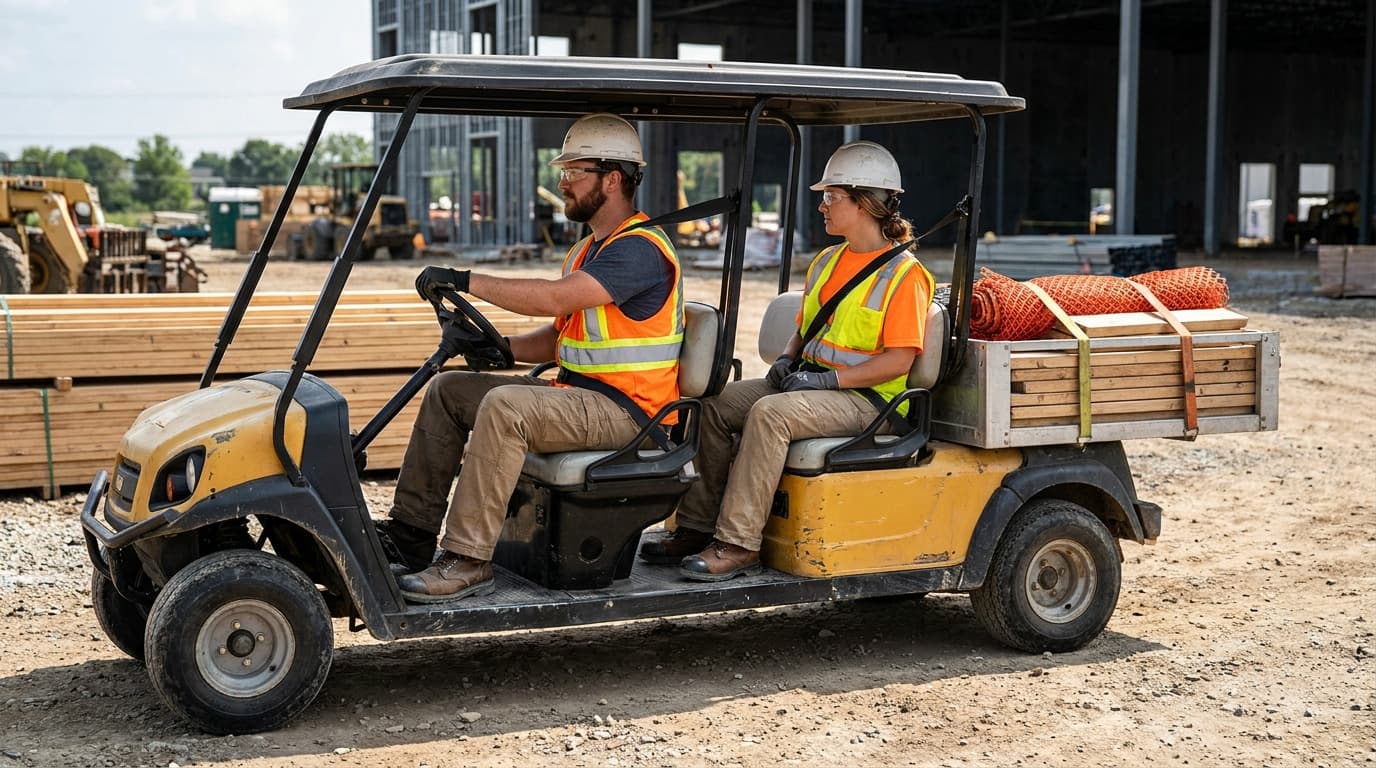
This is the piece almost nobody knows, and it changes what rules apply. A golf cart used to carry people is treated as a passenger vehicle, and it is exempt from the powered industrial truck standard. But the moment that same cart is designed or modified to haul and move materials, it can be classified as a powered industrial truck — and then the full powered-industrial-truck standard applies to it: operator training and evaluation, load capacity, the works. The vehicle did not change shape. What changed is what you put in it. Bolt a cargo bed onto a passenger cart, start using it to move materials around the site, and you may have quietly crossed from "anyone can drive this" into "only a trained, evaluated operator can, and it has a rated capacity you cannot exceed" — without anyone noticing the line was there. And any modification to the vehicle has to be approved by the manufacturer or a qualified engineer, because changing the cart changes its capacity, stability, and safe operation. If your site uses carts to move materials, that is not a detail — it is a different set of rules.
The ROPS only works if you're belted inside it#
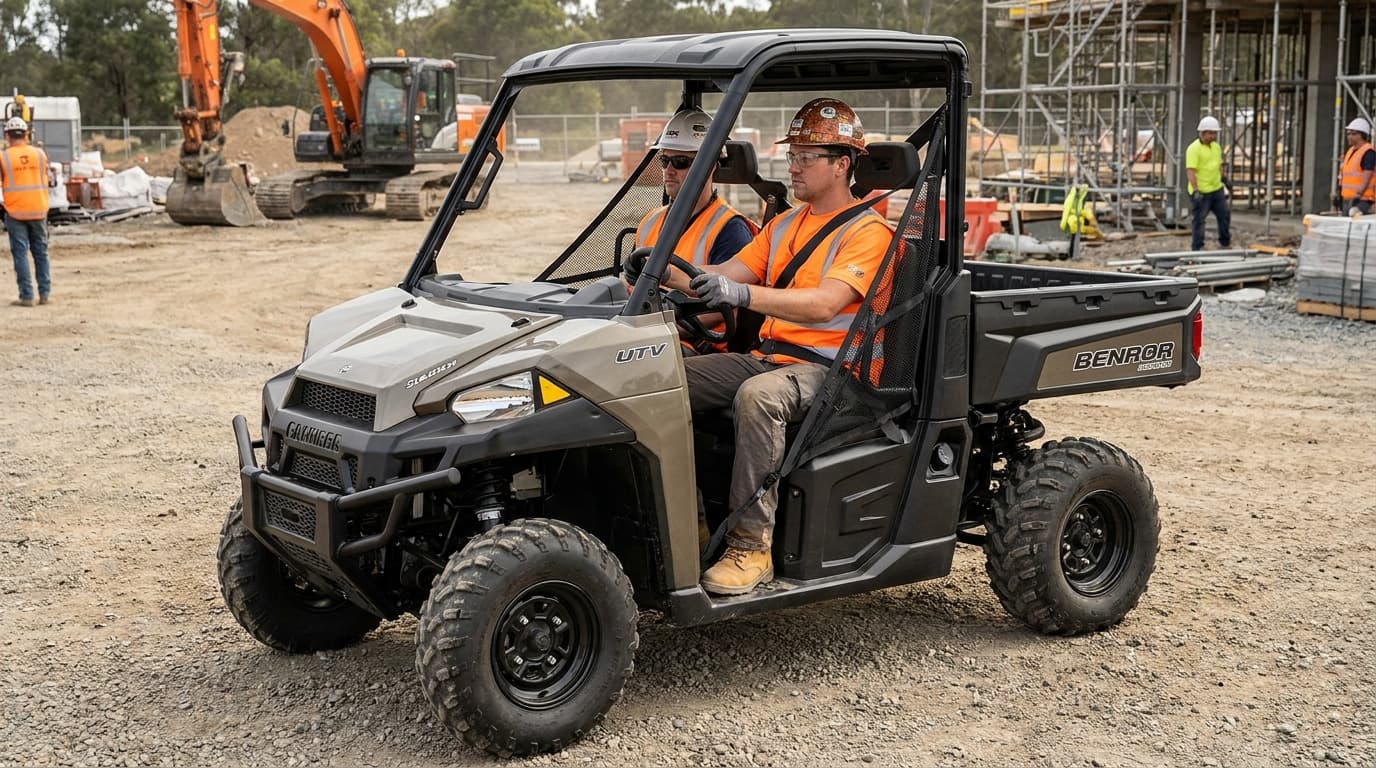
Here is the mechanism that actually kills people in a tip-over, and it is counterintuitive. Many UTVs have a rollover protective structure — a ROPS, the cage-like frame overhead — and people assume the cage is what protects them. It is, but only if they stay inside it. Rollover testing is clear on this: a belted occupant is likely to stay within the protective zone of the ROPS during a rollover, while an unbelted occupant is thrown out — and a person thrown out of a rolling vehicle is often crushed by the very cage that would have saved them if they had stayed in it. This is why the instinct to jump clear of a tipping cart is deadly backwards. You do not beat the vehicle out the side; you get pinned by it. The rule that follows is absolute: seatbelt on, hands and arms and legs inside, every time the vehicle moves. The ROPS is a promise the vehicle can only keep if you are strapped into the space it protects. On UTVs, the consensus standard for these vehicles builds in three-point belts, occupant side-retention, and handholds for exactly this reason — they are there to keep you in the zone.
Tip-over: the small vehicle's signature failure#
Golf carts and UTVs tip more easily than they look like they should, because they are narrow, short, and often top-heavy, especially loaded. The things that tip them are ordinary: taking a turn too fast, crossing a slope instead of driving straight up or down it, a load that raises the center of gravity, a wheel dropping into a rut or off a pavement edge. On a jobsite the terrain is worse than a golf course — grades, gravel, trenches, curbs, debris — so the margin is smaller. The controls are unglamorous and they work: slow down before turns, take slopes straight rather than across, keep loads low and within the rated capacity, and keep all wheels on stable ground near edges and excavations. A cart that feels perfectly stable at a walking pace on flat ground is a different vehicle on a graded haul road with a load in the back.
A slow vehicle in a fast traffic mix#
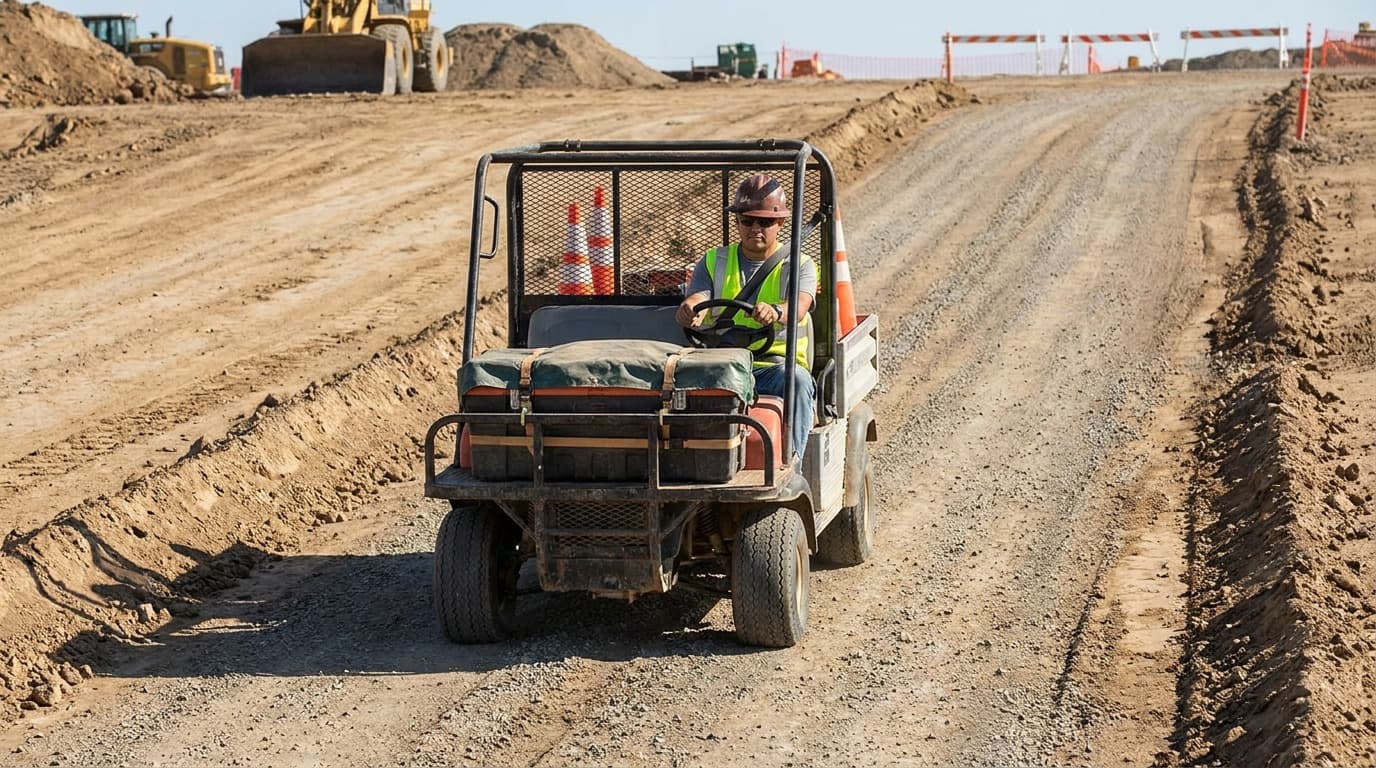
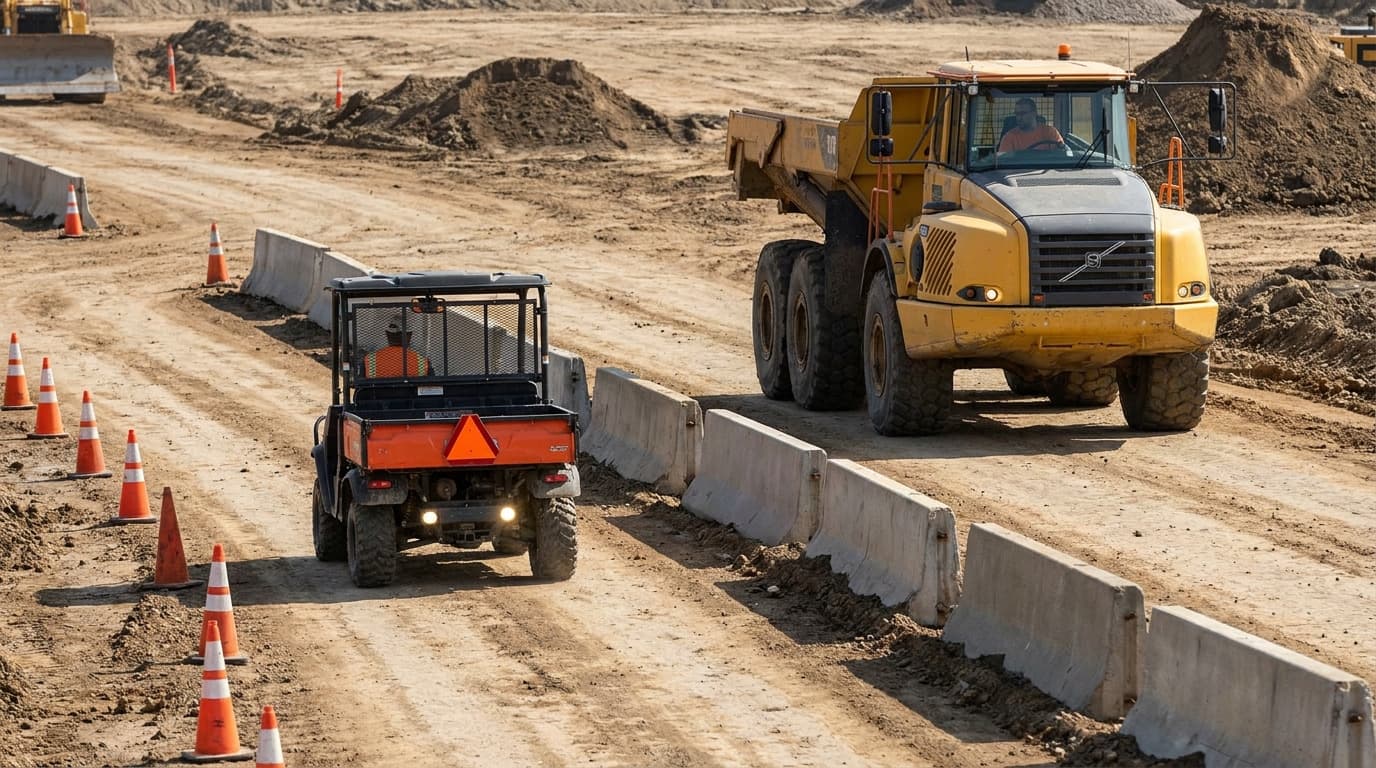
The other way carts hurt people is in the site traffic pattern. A golf cart is quiet, low, and slow, which makes it easy to miss — a truck driver or equipment operator scanning for other big machines may simply not see a cart in a blind spot, and the cart has none of the mass to survive that encounter. And because carts feel nimble, drivers take them where full traffic rules feel like they do not apply — across active equipment areas, behind backing machines, into pedestrian spaces. The cart belongs in the site traffic plan like any other vehicle: defined routes, right-of-way to larger equipment, headlights and a slow-moving marker where visibility is poor, and never in the swing radius or backing path of heavy equipment. Small and slow does not mean exempt from the traffic plan; it means more dependent on it.
Where the duty sits#
There is no specific OSHA golf-cart standard, so the duty is assembled. The General Duty Clause, Section 5(a)(1) requires the employer to protect against this recognized hazard, and the manufacturer's operating instructions are the primary reference for safe use, capacity, and training. If the cart is used to haul or move materials, it can be a powered industrial truck under 1910.178, and then that standard's operator training, evaluation, and capacity requirements apply. For UTVs, the consensus standard ANSI/OPEI B71.9 (Multipurpose Off-Highway Utility Vehicles) sets the ROPS, three-point seatbelt, and occupant-retention requirements built into the vehicle. 1926.21(b)(2) requires training on construction sites, and state or local law may add road-use, age, or licensing limits. Where the manufacturer or a site policy sets a specific requirement — a passenger limit, a speed limit, a no-modification rule — that governs.
What can go wrong?#
- An unbelted rider is ejected in a tip-over and crushed by the ROPS meant to protect them.
- A cart takes a turn too fast or crosses a slope and rolls.
- A passenger rides standing, on the bed, or with a limb outside the vehicle.
- A cart is loaded above its capacity, raising the center of gravity until it tips.
- A cart is modified or fitted with a cargo bed without manufacturer approval.
- A cart used to move materials is driven by an untrained operator as if the PIT rules don't apply.
- A larger machine's operator never sees the low, quiet cart in a blind spot.
- The cart is driven into a backing path, swing radius, or pedestrian area.
How do we manage this properly?#
- Give the cart the respect its appearance denies — treat it as a real vehicle.
- Seatbelt on, all limbs inside, every time it moves — the ROPS only works belted.
- Slow before turns, take slopes straight, keep all wheels on stable ground.
- Keep loads low and within rated capacity; don't let cargo raise the center of gravity.
- One seat, one rider — no standing passengers, no riding on the bed.
- If the cart moves materials, apply the powered-industrial-truck training and capacity rules.
- No modifications without manufacturer or engineer approval.
- Put the cart in the site traffic plan — routes, right-of-way, visibility markers.
Before you start#
- Confirm the operator is trained on this specific vehicle and its manual.
- Confirm every occupant has a seatbelt and uses it, with limbs inside.
- Confirm the load is within the rated capacity and kept low.
- Confirm the number of riders does not exceed the number of seats.
- Confirm the cart hasn't been modified without manufacturer approval.
- Confirm whether the cart's material-hauling use makes it a powered industrial truck.
- Confirm the cart's route keeps it clear of backing paths and swing radii.
- Confirm brakes, steering, lights, and tires are inspected and working.
Talk it over#
- Does anyone here skip the seatbelt on the cart because it's "just a short trip"?
- Is our cart carrying materials — and if so, who's trained to PIT standards on it?
- Where on this site would a cart tip — the grades, the edges, the ruts?
- Where could a big machine fail to see a cart, and how do we prevent it?
The bottom line#
The golf cart is the most dangerous vehicle on site precisely because it doesn't look like one — nobody respects it, so nobody buckles the belt, slows for the turn, or counts the passengers, and it tips or ejects someone doing the thing everyone thought was too minor to be a hazard. The casualness the vehicle invites is the hazard. Two things about it are easy to miss and matter most. First, the same cart lives in two regulatory worlds: carry people and it is a passenger vehicle, but load it with materials and it can become a powered industrial truck with full operator-training and capacity rules — and modifications need manufacturer approval. Second, the ROPS only protects a belted rider: in a tip-over a belted occupant stays inside the protective cage, while an unbelted one is thrown out and often crushed by it, which is why the instinct to jump clear is deadly and the rule is seatbelt on, all limbs inside, every time it moves. Beyond that, respect the tip-over (slow for turns, slopes straight, loads low and rated) and put the small, quiet, slow cart into the site traffic plan where larger machines can account for it. The duty is assembled — 5(a)(1), the manufacturer's instructions, 1910.178 if it hauls materials, and ANSI/OPEI B71.9 for the UTV's built-in protection. The test for anyone about to drive a cart is one question: would you take this turn, at this speed, with this load and these passengers, if the vehicle looked as dangerous as it actually is?
Frequently asked questions about golf cart and UTV safety#
Why treat a golf cart as dangerous when it's so slow?
Because the danger is not top speed — it is tip-over and ejection, and those happen at ordinary cart speeds. A narrow, top-heavy, doorless vehicle rolls on a fast turn or a crossed slope, and an unbelted rider is thrown out. The bigger problem is that the cart's harmless appearance talks people out of basic precautions they would never skip on a "real" machine: the belt, the slow turn, the passenger count, the load limit. Roughly tens of thousands of golf-cart injuries a year need emergency care in the US, and the casual treatment the vehicle invites is a large part of why. Slow does not mean safe.
When does a golf cart become a powered industrial truck?
When it is designed or modified to haul and move materials rather than just carry people. A passenger golf cart is exempt from the powered-industrial-truck standard, but once it is used for materials handling, it can be classified as a powered industrial truck — and then the full standard applies, including operator training and evaluation and a rated load capacity you cannot exceed. The vehicle looks the same; its regulatory status changed with its use. If your site bolts cargo beds onto carts and moves materials with them, treat the operators and the load limits as if it were a forklift, because legally it may be one.
Why is the seatbelt so important if the UTV has a roll cage?
Because the roll cage — the ROPS — only protects you if you stay inside it. Rollover testing shows a belted occupant is likely to remain within the protective zone of the ROPS during a rollover, while an unbelted occupant is thrown out of that zone and can be crushed by the very structure meant to protect them. The instinct to jump clear of a tipping vehicle is exactly backwards: you cannot beat it out the side, and outside the cage is where people get pinned. The belt is what keeps you in the space the ROPS is designed to protect, so it goes on every time the vehicle moves.
What makes golf carts and UTVs tip over?
They are narrow, short, and often top-heavy, so ordinary things tip them: turning too fast, driving across a slope instead of straight up or down, carrying a load that raises the center of gravity, or dropping a wheel into a rut or off an edge. Jobsite terrain — grades, gravel, curbs, trenches — is harder on them than a golf course, so the margin is smaller. The controls are simple: slow before turns, take slopes straight, keep loads low and within capacity, and keep the wheels on stable ground near edges and excavations. A cart that feels stable on flat ground handles very differently loaded on a graded haul road.
Can passengers ride on the back of a cart?
No. One seat, one rider, everyone belted with limbs inside. Standing passengers, riders on the cargo bed, and legs or arms hanging outside are among the most common ways people are ejected or struck in a tip-over or sudden stop. The number of riders should never exceed the number of proper seats with belts, and the cargo area is for cargo, not people. It feels harmless to let someone hop on the back for a short trip, but that is precisely the casual habit that turns a minor tip into a serious injury.
Do we need to put carts in the site traffic plan?
Yes. A cart is quiet, low, and slow, which makes it easy for a truck driver or equipment operator to miss — and the cart has none of the mass to survive being hit. Because carts feel nimble, drivers tend to take them where full traffic rules feel optional, including behind backing machines and through pedestrian areas. The cart needs defined routes, right-of-way yielded to larger equipment, visibility aids like headlights and a slow-moving marker, and a firm rule to stay out of swing radii and backing paths. Being small and slow does not make it exempt from the traffic plan — it makes it more dependent on one.
Download the golf cart and UTV safety toolbox talk PDF#
Get this golf cart and UTV safety toolbox talk as a print-ready PDF — available in English, Spanish, Portuguese, and Turkish. Print it, hand it to the crew, and collect signatures on the included attendance sheet.
Download the PDF — free account required. New members get 3 free downloads.
Related toolbox talks#
Sources#
- OSHA / industry guidance, ATVs, UTVs, and golf carts in the workplace (no specific OSHA standard; General Duty Clause, manufacturer's instructions, and ANSI standards apply; hands-on operator training): https://www.osha.gov/laws-regs/oshact/section5-duties
- OSHA, Powered Industrial Trucks — 1910.178 (a cart designed or modified to haul and move materials can be classified as a powered industrial truck, triggering operator training, evaluation, and capacity requirements): https://www.osha.gov/laws-regs/regulations/standardnumber/1910/1910.178
- ANSI/OPEI B71.9, Multipurpose Off-Highway Utility Vehicles (ROPS, three-point seatbelts, and occupant side-retention devices built into the vehicle; belted occupants stay within the ROPS protective zone): https://blog.ansi.org/ansi/ansi-opei-b71-9-2022-off-highway-utility-vehicles/
This talk is general awareness guidance for training purposes. It does not replace your employer's vehicle program, the OSH Act General Duty Clause, the OSHA powered-industrial-truck standard where it applies, the ANSI/OPEI consensus standards, the vehicle manufacturer's instructions, state or local road-use law, or a competent person's duties, and it is not legal advice. Where a manufacturer's instruction or a site policy sets a stricter requirement, that requirement governs.
Written by FieldSafetyTalk's safety professional — a CSP, ASP, CHST and OSHA Authorized Outreach Trainer with 14+ years of international construction safety experience across federal, heavy civil, and industrial projects.