How to Inspect a Safety Harness
Updated 2026-07-24
In this bundle Fall Protection & Heights
Print-ready PDF
Download this talk as a print-ready PDF, available in 4 languages.
Every other piece of protective equipment on this site tells you when it has failed. A cracked hard hat shows the crack. A torn glove shows the tear. A harness does not work that way. A harness that has been sitting in UV light for a season, or has taken a splash of battery acid, or has already arrested one fall, looks identical to the one that came out of the box last week. This How to Inspect a Safety Harness Toolbox Talk (Safety Talk / Tailgate Talk) is about the only piece of PPE you wear that is never tested until the moment your life depends on it.
Here is the distinction that carries this whole talk: with most equipment, inspection is a way of catching deterioration early. With a harness, inspection is the only opportunity that exists. There is no in-service test. There is no warning stage. The webbing either holds 1,800 pounds of arresting force or it does not, and the first time anyone finds out is the moment the lanyard goes tight. That is why the standard does not ask for a weekly check or a monthly check — and, as you will see below, it is why OSHA was asked to accept a weekly check and specifically refused.
How dangerous is an uninspected harness?#
There is no dedicated national dataset counting deaths caused by defective fall arrest equipment — harness failure is recorded inside broader fall categories, so any number you see quoted for it should be treated with suspicion. What we do have is something arguably more useful: a documented record of OSHA deciding exactly how much risk an uninspected harness represents.
When Subpart M was being written, OSHA specifically asked the public how often fall arrest equipment should be inspected. It raised the question twice, as Issues #9 and #17 of the proposed rule.
- Two industry commenters asked OSHA to change the requirement from before each use to weekly, arguing that a more frequent schedule did not improve worker safety (OSHA preamble to the final rule, Federal Register Vol. 59, pp. 40709–40710, August 9, 1994).
- OSHA refused. The agency stated that it believes it is critical to inspect equipment before each use, because otherwise employees may use defective equipment, which could result in loss of life in the event of a fall. The frequency was not reduced, and the provision was promulgated as proposed.
- In a 2003 letter of interpretation, OSHA put it in one sentence: annual inspections instead of inspections prior to each use would violate §1926.502(d)(21) (OSHA Directorate of Construction, December 18, 2003).
Read that sequence again, because it is the whole talk. The industry asked for weekly. The regulator said weekly is not good enough to keep people alive. Almost every crew that has ever skipped a pre-use inspection was operating on a standard that OSHA examined on the record and rejected as unsafe.
There is a second number worth knowing, and it is a design figure rather than an injury figure. Under 1926.502(d)(4), D-rings and snaphooks must be proof-tested to a minimum tensile load of 3,600 pounds (16 kN) without cracking, breaking, or taking permanent deformation. That is the specification the hardware was built to. So when you find a D-ring that is visibly bent, or a snaphook that no longer sits square, you are not looking at cosmetic damage. You are looking at hardware that has been loaded past a level it was certified to survive without changing shape — by something, at some point, that nobody logged.
OSHA harness inspection requirements (29 CFR 1926 Subpart M)#
- Inspection before each use — 1926.502(d)(21). Personal fall arrest systems must be inspected prior to each use for wear, damage, and other deterioration, and defective components must be removed from service. Note the wording: prior to each use, not once per shift. If the harness comes off at lunch and goes back on afterwards, that is a use.
- Who may perform it — 1926.503(a)(2)(ii). OSHA confirmed in 2003 that the pre-use inspection does not have to be performed by a competent person. But it must be performed by an employee who has been trained by a competent person in the correct procedures for inspecting the fall protection system to be used. Untrained self-inspection does not satisfy the standard.
- After an arrested fall — 1926.502(d)(19). Systems and components subjected to impact loading must be immediately removed from service and must not be used again for employee protection until inspected and determined by a competent person to be undamaged and suitable for reuse. This is the one inspection where competent person status is mandatory, and in practice most manufacturers direct that an impact-loaded harness be destroyed rather than returned.
- Hardware criteria — 1926.502(d)(3) and (d)(4). D-rings and snaphooks must have a minimum tensile strength of 5,000 pounds (22.2 kN) and be proof-tested to 3,600 pounds (16 kN) without cracking, breaking, or permanent deformation.
- Connector type — 1926.502(d)(5). Since January 1, 1998, only locking-type snaphooks may be used. A non-locking snaphook found on a harness in service is not a defect to note — it is equipment that has been prohibited for over a quarter of a century.
- Materials — 1926.502(d)(14). Ropes and webbing used in lanyards, lifelines, and the strength components of harnesses must be made from synthetic fibers, which is why chemical and UV exposure matter so much to this inspection.
- Not for lifting — 1926.502(d)(18). Harnesses and components are for employee protection only and must not be used to hoist materials. A harness used as a sling has been loaded in a way its inspection history does not record.
- Positioning equipment too — 1926.502(e)(9). Positioning device systems carry the same before-each-use inspection duty.
The OSHA defect list — Subpart M, Appendix C, paragraph (g). This is the closest thing to an official checklist that exists, and it is worth knowing by heart. Any component with a significant defect must be withdrawn from service immediately and should be tagged or marked as unusable, or destroyed. The listed defects are:
- Cuts, tears, abrasions, mold, or undue stretching
- Alterations or additions which might affect efficiency
- Damage due to deterioration
- Contact with fire, acids, or other corrosives
- Distorted hooks or faulty hook springs
- Tongues unfitted to the shoulder of buckles
- Loose or damaged mountings
- Non-functioning parts
- Wearing or internal deterioration in the ropes
On USACE and NAVFAC projects, EM 385-1-1 applies and is more prescriptive on documentation and removal-from-service in several places.
What can go wrong with a harness?#
Damage you cannot see from the outside. Synthetic webbing degrades internally. UV exposure breaks down fibres from the surface inward, and a harness stored on a hook in a sunlit conex or left in the back of a pickup for a summer can lose significant strength while looking almost new. Appendix C names wearing or internal deterioration as a defect precisely because the outside is not the whole story.
Chemical contact that nobody reported. Battery acid, concrete admixtures, curing compounds, fuel, and cleaning solvents attack synthetic fibre. The contamination is often invisible after it dries. Appendix C names contact with acids and other corrosives as a stand-alone defect — the damage does not have to be visible for the harness to be finished.
Heat and weld damage. Spatter burns hard glossy spots into webbing. Each one is a stiff point where fibres have fused and lost elasticity, and it will be the place the webbing tears.
A previous arrest that was never declared. This is the most dangerous defect on the list, because it depends entirely on someone speaking up. A harness that has arrested a fall is required to come out of service immediately under 1926.502(d)(19). If a worker fell, was fine, dusted themselves off and hung the harness back on the rack, the next person to wear it is wearing a system that has already spent its energy absorption.
Deployed shock absorbers that were not noticed. A partially or fully deployed energy absorber is sometimes obvious and sometimes only shows as a broken stitch pattern or a torn indicator label under the pack cover. If it has begun to deploy, the arresting force it will allow through on the next fall is not the force it was designed for.
Distorted hardware. Bent D-rings, hooks that no longer close square, keepers that need a shove, springs that have gone soft. Under 1926.502(d)(4) that hardware was proof-tested at 3,600 pounds specifically to not deform. Deformation means something exceeded that.
Buckle and stitching failure. Appendix C singles out tongues unfitted to the shoulder of buckles and loose or damaged mountings. Pulled, cut, burned, or abraded stitching at load-bearing junctions is a structural failure, not a cosmetic one — the stitching is what transfers the load.
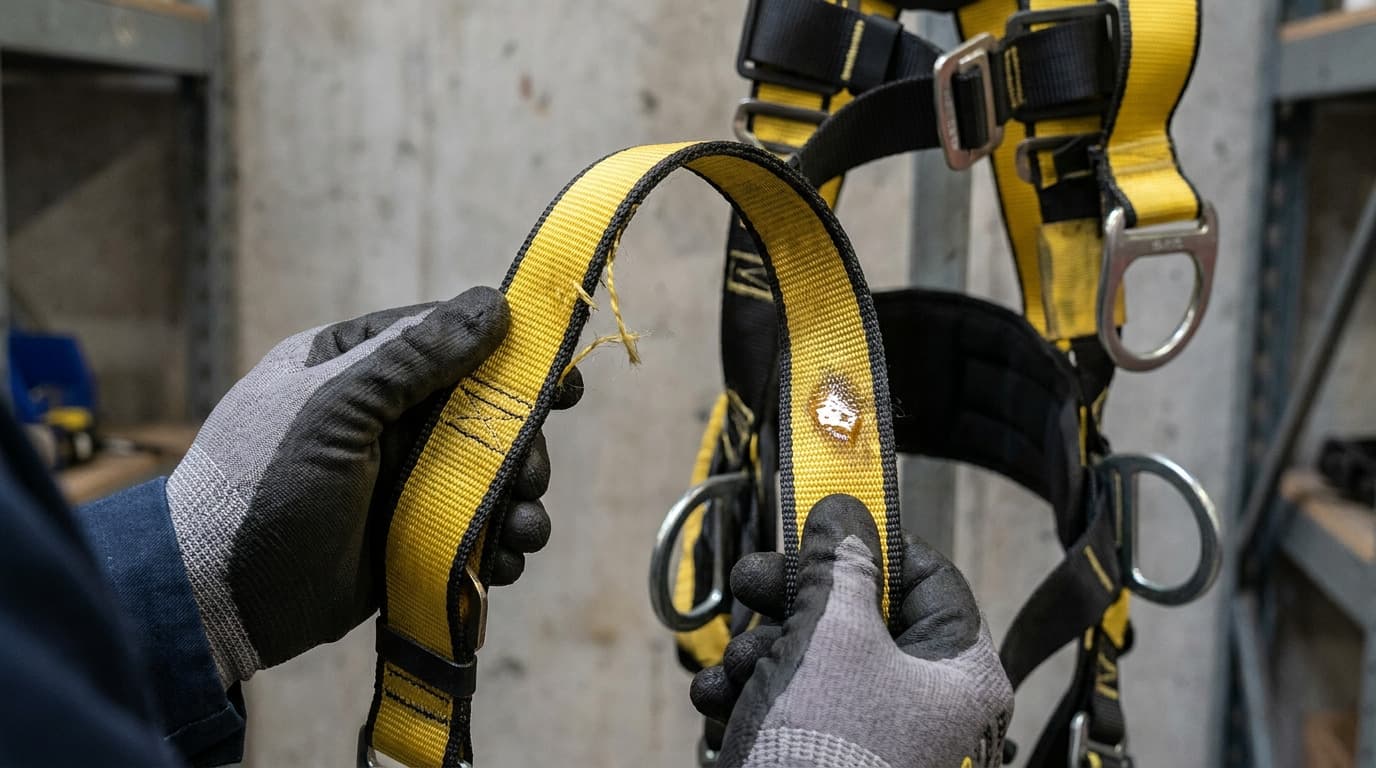
Alterations. Extra holes punched for fit, cut-off leg strap ends, tape covering a worn area, an added D-ring. Appendix C lists alterations and additions as defects in their own right. Modifying a harness voids the certification it was sold under.
Missing labels. If the manufacturer's labels are illegible, you cannot establish the model, the rating, the date of manufacture, or whether it was ever recalled. An unidentifiable harness cannot be verified as compliant.
And the failure that produces all the others: the inspection nobody actually did. A harness pulled from a shared bin at 6:55 a.m., shrugged on in the dark, buckled while walking. That is the normal case, not the rare one.
How do we inspect a harness properly?#
Do it before each use, and do it yourself. The person whose life depends on the equipment is the person who should be looking at it. Under 1926.502(d)(21) it happens before each use; under 1926.503(a)(2)(ii) it happens by someone a competent person has trained to do it.
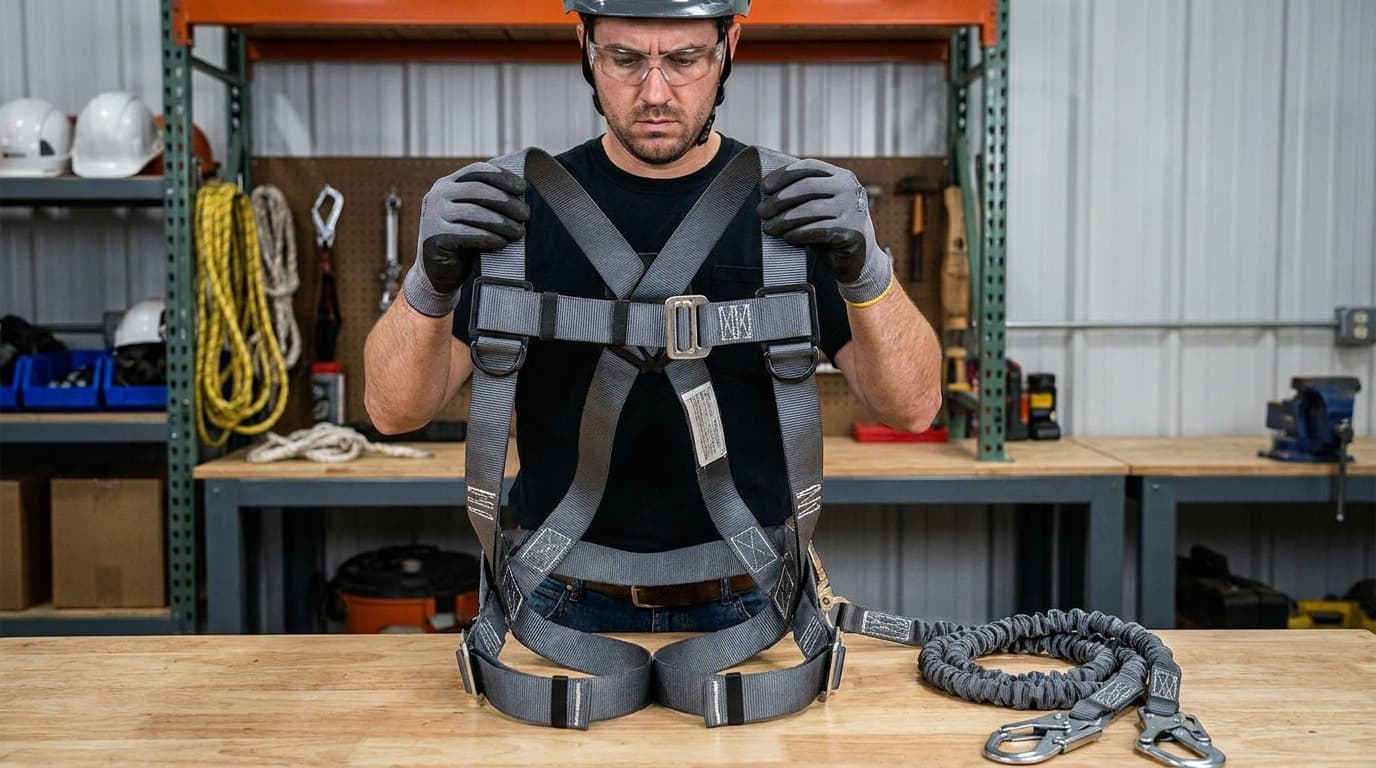
Take it off the rack and give it your full attention. This takes two to three minutes and it cannot be done while walking to the work face. Find light. If you are inspecting in the dark, you are not inspecting.
Work the webbing inch by inch. Grip the webbing with both hands about six to eight inches apart and bend it into an inverted U. The bend fans the fibres and pushes cuts, frays, broken threads, glossy heat damage, and stiff contaminated patches into view where flat webbing hides them. Move your hands along and repeat until you have covered every strap: shoulders, chest, back, legs, and the sub-pelvic strap. Then do the same on the lanyard or SRL leg.
Look for the specific defects Appendix C names, in this order: cuts and tears, abrasion, mold, undue stretching, burns and weld spatter, chemical staining or stiffness, and any change in texture between one section and another. A section that feels different from the rest of the strap is telling you something.
Check every stitch pattern at every junction. Load-bearing seams are usually a box or a bar-tack. Pulled, cut, abraded, or missing threads there mean the harness comes out of service.
Check the hardware individually. Each D-ring, buckle, keeper, and grommet: no cracks, no distortion, no sharp edges, no corrosion pitting, no rough edges that will chew the webbing. Every keeper closes and locks under its own spring, without help. Every buckle latches and holds. Confirm the snaphooks are locking type — required since January 1, 1998 under 1926.502(d)(5).
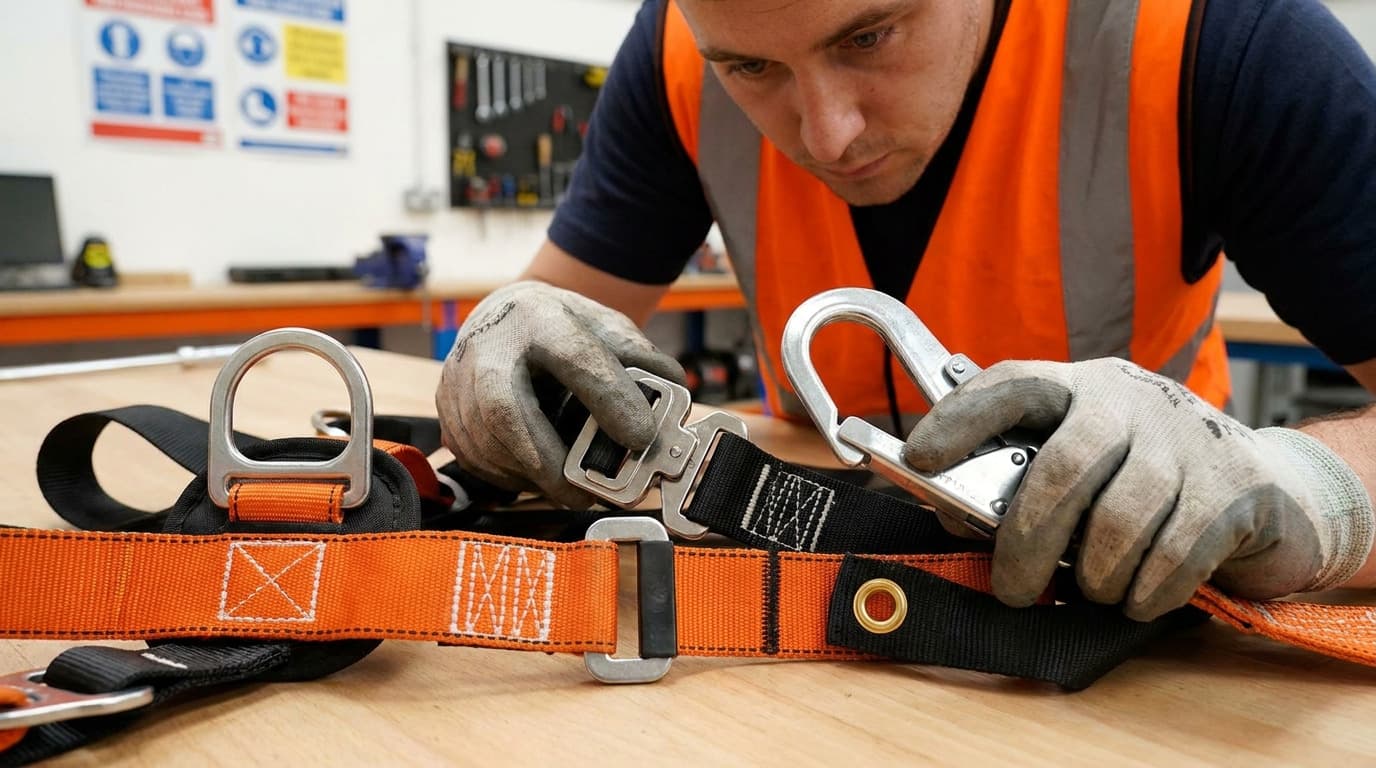
Open the energy absorber pack. Check the indicator, the stitching, and the label. Any sign of deployment removes it from service, no discussion.
Read the labels. Model, rating, date of manufacture, standards mark. If you cannot read them, you cannot verify the equipment, and it comes out of service.
Ask the question nobody asks: has this harness ever caught anyone? Then treat the answer as binding. Under 1926.502(d)(19) an impact-loaded harness is out of service immediately and only a competent person can return it — and manufacturers routinely instruct destruction instead.
Tag it out properly. Appendix C is explicit that defective components should be tagged or marked as unusable, or destroyed. A defective harness put back on the rack "to sort out later" will be worn by someone tomorrow. Cut it, bag it, or lock it away.
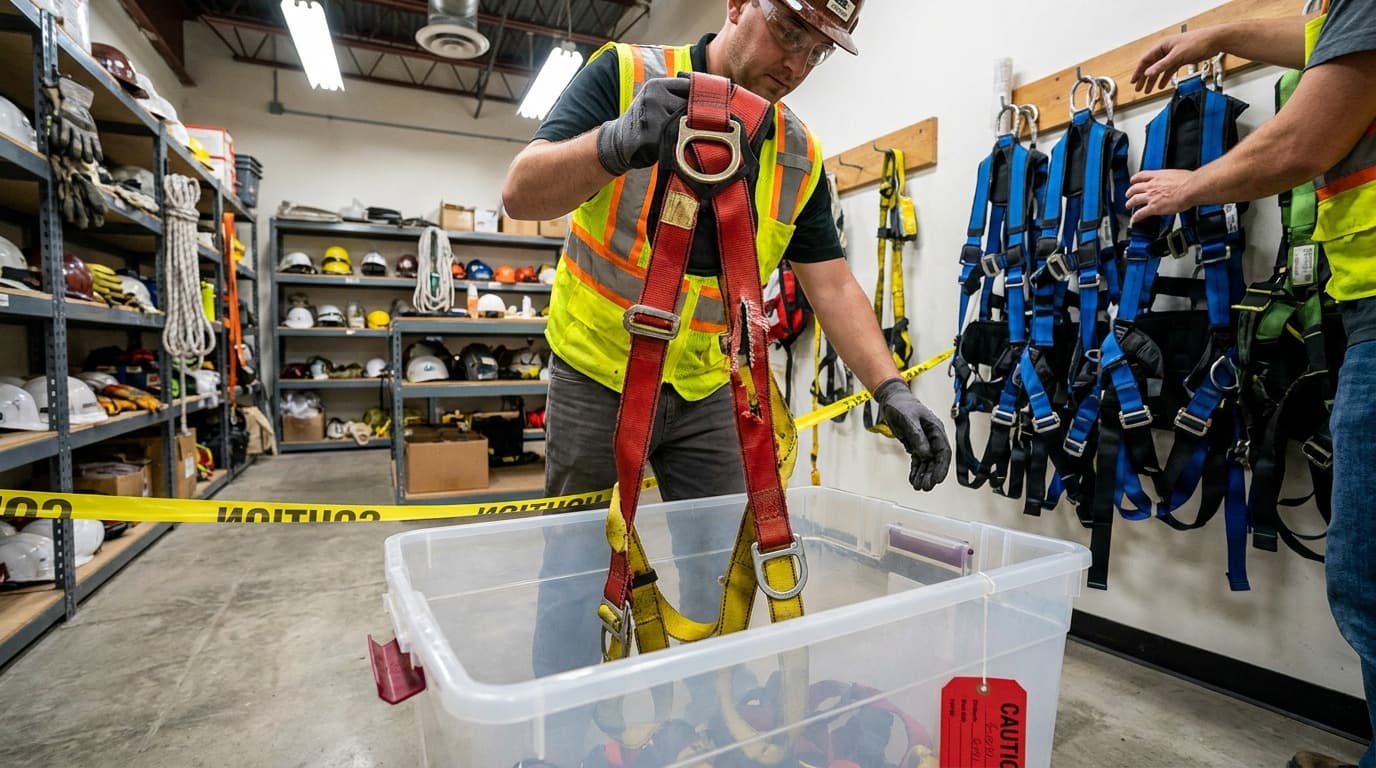
Store it so the next inspection has something to find. Hung, dry, out of sunlight, away from chemicals, welding, and sharp edges. Most of the defects on the Appendix C list are created in storage, not at height.
Before you start#
- Confirm you were trained to inspect this equipment by a competent person, as 1926.503(a)(2)(ii) requires.
- Inspect in adequate light, off the rack, with the harness in your hands and your attention on it.
- Bend the full length of every strap into an inverted U and look at the fanned fibres.
- Check every load-bearing stitch pattern at every junction.
- Check every D-ring, buckle, and keeper for distortion, cracks, corrosion, and spring function.
- Confirm all snaphooks are locking type.
- Check the energy absorber pack and its indicator.
- Confirm the labels are legible and the harness is identifiable.
- Ask whether this harness has ever arrested a fall, and act on the answer.
- Tag out and physically remove anything defective — do not return it to the rack.
Talk it over#
- Pick up the harness you are about to wear. Who inspected it last, and when — and can anyone in this circle actually answer that?
- If this harness had already caught somebody last month, what on it would tell you? Where would you look, and would you find it?
- OSHA was asked to allow weekly inspections instead of before each use, and said no. What is your crew's real, honest inspection frequency this week?
The bottom line#
A harness is the only PPE you wear that gives no warning before it fails, which is why OSHA requires it to be inspected prior to each use under 1926.502(d)(21) — and why, when industry asked for a weekly interval instead, OSHA examined the question on the record and refused, stating that anything less could mean workers using defective equipment and losing their lives in a fall. Inspect it yourself, in the light, bending every strap into a U, checking every stitch and every piece of hardware against the Appendix C defect list. Any harness that has arrested a fall is out of service immediately and only a competent person can clear it. And if you find a defect, tag it, cut it, or bag it — because a bad harness returned to the rack is just a delayed fatality.
Frequently asked questions about harness inspection#
How often must a safety harness be inspected?
Before each use. 29 CFR 1926.502(d)(21) requires personal fall arrest systems to be inspected prior to each use for wear, damage, and other deterioration. OSHA confirmed in a December 18, 2003 letter of interpretation that annual inspections in place of before-each-use inspections would violate the standard, and rejected a request during rulemaking to reduce the frequency to weekly.
Does a competent person have to inspect the harness?
Not for the routine pre-use inspection. OSHA clarified in 2003 that the 1926.502(d)(21) inspection does not have to be performed by a competent person — but under 1926.503(a)(2)(ii) it must be performed by an employee who has been trained by a competent person in the correct inspection procedures. The exception is a harness that has been impact-loaded: under 1926.502(d)(19) only a competent person can determine that it is undamaged and suitable for reuse.
What do I look for when inspecting a harness?
Appendix C to Subpart M, paragraph (g) lists the defects that require immediate withdrawal from service: cuts, tears, abrasions, mold, or undue stretching; alterations or additions that might affect efficiency; damage due to deterioration; contact with fire, acids, or other corrosives; distorted hooks or faulty hook springs; tongues unfitted to the shoulder of buckles; loose or damaged mountings; non-functioning parts; and wearing or internal deterioration in the ropes.
Can a harness be used again after it has stopped a fall?
Under 29 CFR 1926.502(d)(19), any personal fall arrest system or component subjected to impact loading must be immediately removed from service and must not be used again for employee protection until inspected and determined by a competent person to be undamaged and suitable for reuse. Most manufacturers go further and instruct that impact-loaded equipment be destroyed rather than returned to service — follow the manufacturer's instructions.
Why does a bent D-ring mean the harness is finished?
Because of what the hardware was certified to withstand. Under 29 CFR 1926.502(d)(4), D-rings and snaphooks are proof-tested to a minimum tensile load of 3,600 pounds (16 kN) without cracking, breaking, or taking permanent deformation. Visible distortion means the component has been loaded beyond a level it was specifically tested to survive without changing shape.
Is a non-locking snaphook allowed?
No. Under 29 CFR 1926.502(d)(5), only locking-type snaphooks have been permitted since January 1, 1998. Finding a non-locking snaphook in service is not a wear defect — it is prohibited equipment.
What do I do with a harness that fails inspection?
Remove it from service immediately, and make sure it cannot be picked up and worn by someone else. Appendix C, paragraph (g) states that defective components should be tagged or marked as unusable, or destroyed. Returning a defective harness to the shared rack with the intention of sorting it out later is how it ends up on the next worker.
Download the harness inspection toolbox talk PDF#
Get this harness inspection toolbox talk as a print-ready PDF — available in English, Spanish, Portuguese, and Turkish. Print it, hand it to the crew, and collect signatures on the included attendance sheet.
Download the PDF — free account required. New members get 3 free downloads.
Related toolbox talks#
Sources#
- OSHA, 29 CFR 1926.502 — Fall protection systems criteria and practices: https://www.osha.gov/laws-regs/regulations/standardnumber/1926/1926.502
- OSHA, 1926 Subpart M Appendix C — Personal Fall Arrest Systems, Non-Mandatory Guidelines: https://www.osha.gov/laws-regs/regulations/standardnumber/1926/1926SubpartMAppC
- OSHA, Clarification on several issues regarding OSHA's construction industry standards for fall protection, Letter of Interpretation, December 18, 2003: https://www.osha.gov/laws-regs/standardinterpretations/2003-12-18
- OSHA, preamble to the Subpart M final rule, Federal Register Vol. 59, pp. 40709–40710, August 9, 1994
Written by FieldSafetyTalk's safety professional — a CSP, ASP, CHST and OSHA Authorized Outreach Trainer with 14+ years of international construction safety experience across federal, heavy civil, and industrial projects.