Clothing and Entanglement
Updated 2026-08-06
In this bundle Tools & Machinery
Print-ready PDF
Download this talk as a print-ready PDF, available in 4 languages.
Machine guarding is built on one idea: keep the worker out of the dangerous part of the machine. A guard sits between your hand and the blade, the gears, the point of operation, so that you cannot reach in. Entanglement is the exact reverse of that idea, and it is why a machine with every guard correctly in place can still take a hand or a life. Entanglement is not you reaching into the machine — it is the machine reaching out and pulling you in, by catching something loose that you are wearing, on a part that is supposed to be turning in the open. This clothing and entanglement talk is about that reverse hazard, because the defenses against it are completely different from guarding, and most of them happen before you ever touch the equipment.
Here is the distinction that carries this whole talk: a guard keeps you out of the machine; nothing keeps the machine out of you once it's caught something you're wearing — so with rotating equipment the whole defense is over before contact, decided by what you put on that morning. A rotating shaft, a drill bit, a spinning chuck, an auger, a PTO shaft — these are meant to turn in the open, and a guard cannot enclose every one of them and still let the work happen. What protects you from them is not a barrier; it is that nothing you are wearing can be grabbed. Because the moment a sleeve, a glove, a lanyard, or a lock of hair is caught, the machine winds it in faster than any human reflex can pull back, and the body follows whatever is caught. There is no reacting your way out of an entanglement — the only move that works is the one you made before you walked up: not wearing the thing that got caught.
Where the boundary of this talk sits#
The machine guarding talk owns the guards on the machine — enclosing the point of operation, the nip points, the rotating parts, and keeping those guards in place. The caught-in/between talk owns the broader family of being caught in or crushed by equipment and collapsing materials. This talk owns the worker side of entanglement: the loose clothing, gloves, jewelry, long hair, lanyards, and drawstrings that get caught by rotating equipment, and the fact that your own gear can be what pulls you in. Where the question is guarding the machine, that is the machine guarding talk; this one owns what you wear and carry into the rotating hazard.
Why rotating motion is uniquely grabby#
Rotating motion is the most common and most underestimated mechanical hazard, and the reason is that it does not need a gap or a pinch to hurt you — it only needs to touch something that can wrap. OSHA's machine guarding requirements name rotating parts alongside points of operation and nip points as a hazard that must be addressed, and the reason is physical: even a smooth, slowly turning shaft can grip a sleeve or a glove through friction and wind it in, and once it starts, the wrapping tightens and pulls with the full torque of the machine. Collars, couplings, cams, clutches, flywheels, shaft ends, and spindles are all rotating parts that do this, and the danger multiplies when there is a projecting setscrew, key, or bolt on the turning part — a single protrusion turns a smooth shaft into a hook. This is why the hazard is not proportional to how fast or how powerful the machine looks. A slow, quiet motor shaft has taken arms.
The thing you're wearing is the hazard#
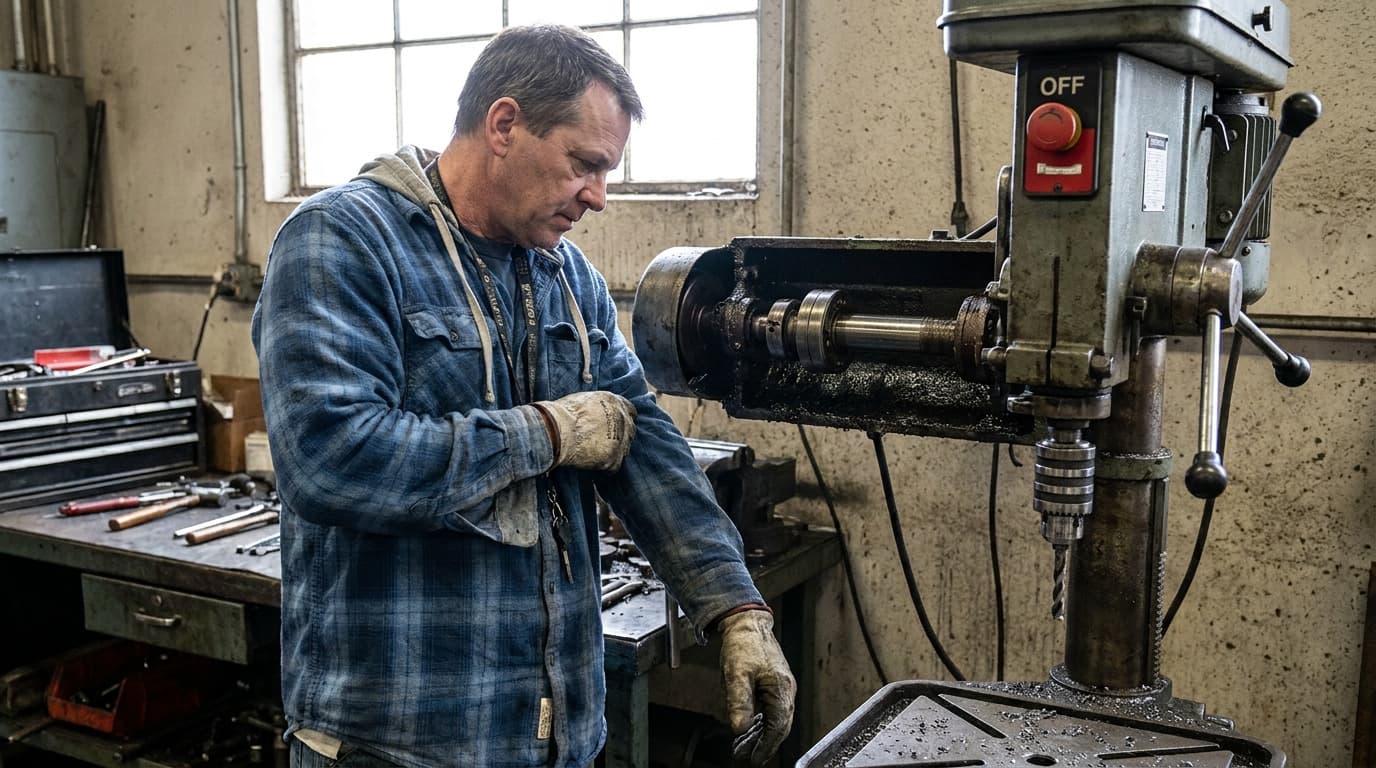
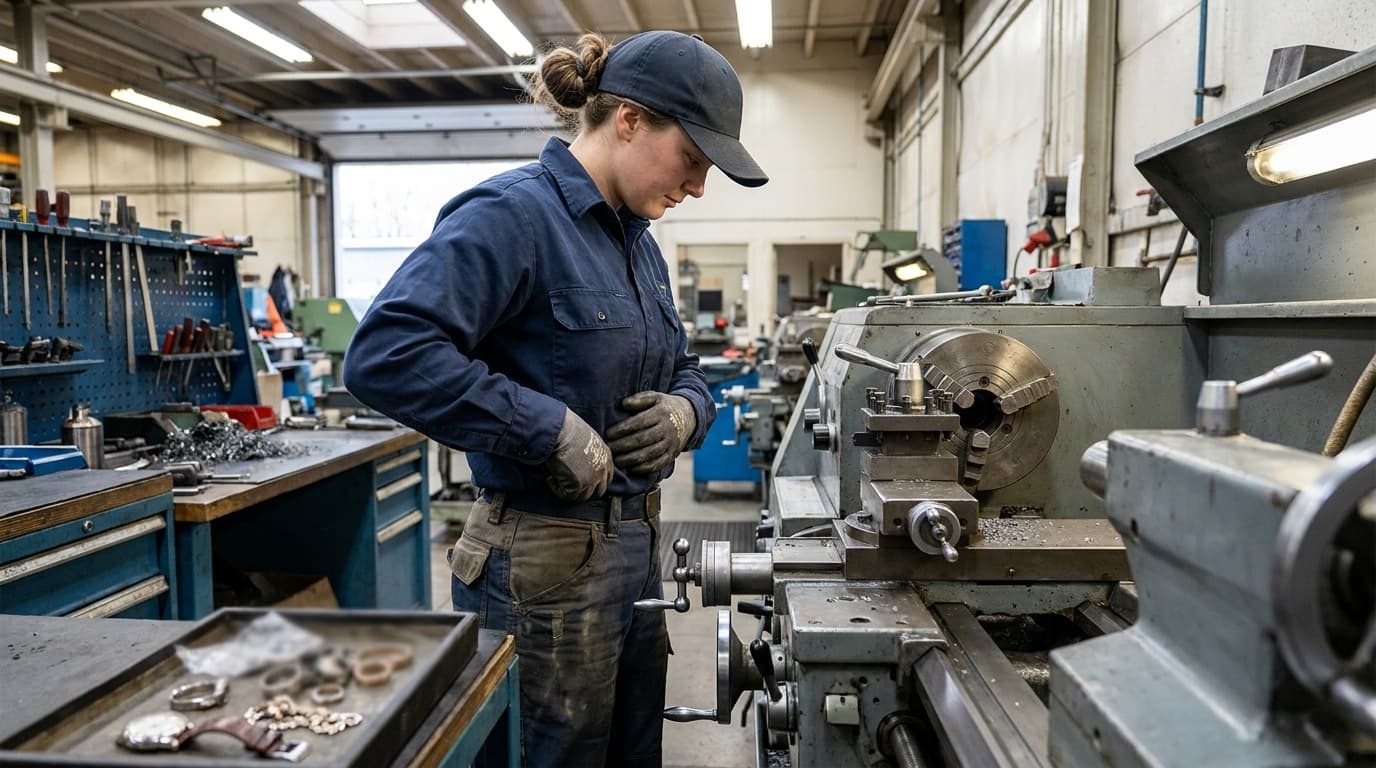
Because the machine part is doing what it is supposed to do, the variable that decides whether you are entangled is what is on your body. Loose or torn sleeves, an unbuttoned or untucked shirt, a hoodie drawstring, a dangling lanyard or badge, a necklace or ring or watch, a loose glove, and unsecured long hair are all things a rotating part can catch. The defenses are simple and physical: sleeves buttoned or rolled and snug, shirts tucked, no dangling cords or jewelry, long hair tied up and under a cap or net, and clothing that fits close rather than flapping. It is worth knowing exactly what OSHA does and does not say here. The machine guarding standard itself does not spell out a rule against gloves or loose clothing; that specific instruction comes from OSHA's guidance — its amputations guidance and its woodworking materials — which advise employers to instruct workers not to wear gloves, jewelry, or loose clothing and to secure long hair around rotating machinery. Under the General Duty Clause, an employer must address entanglement as a recognized hazard, and in practice that is exactly why sites have these clothing rules.
The gloves paradox#
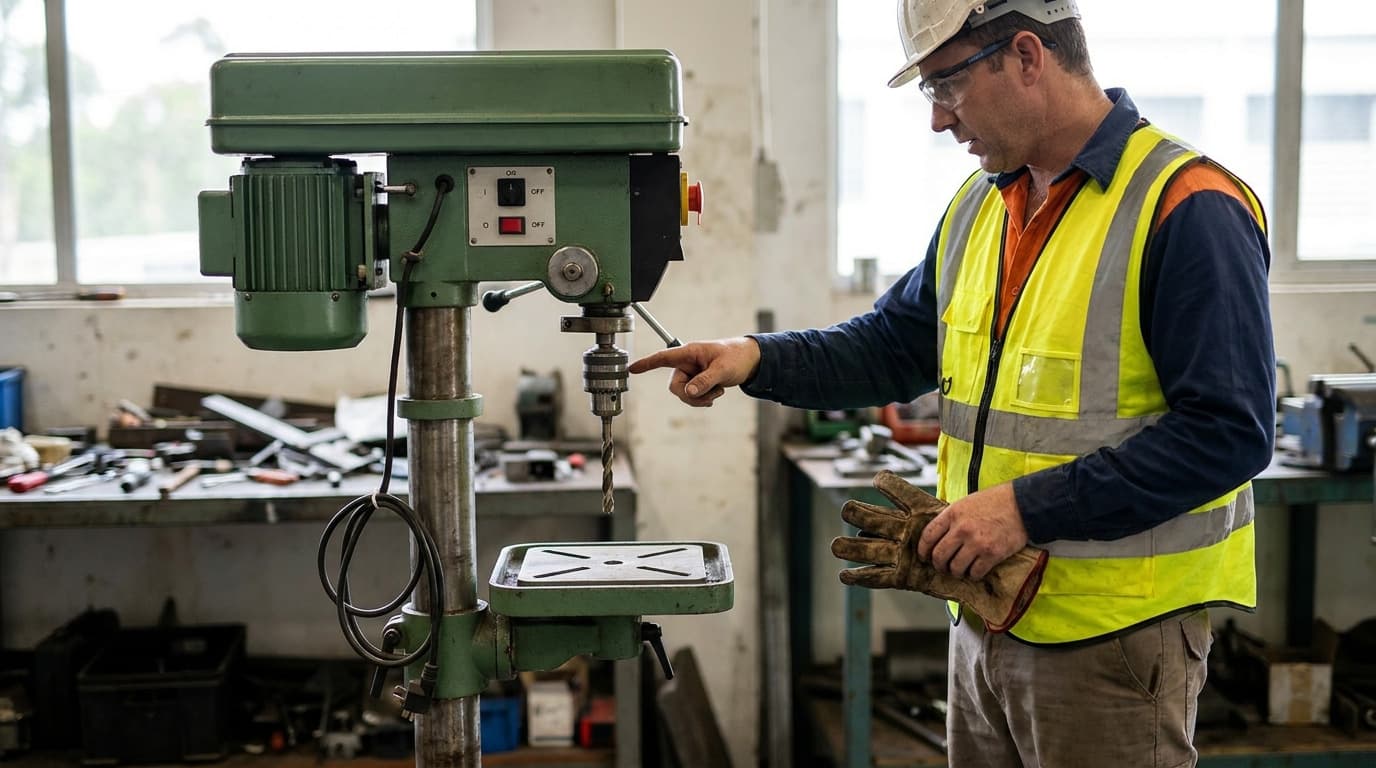
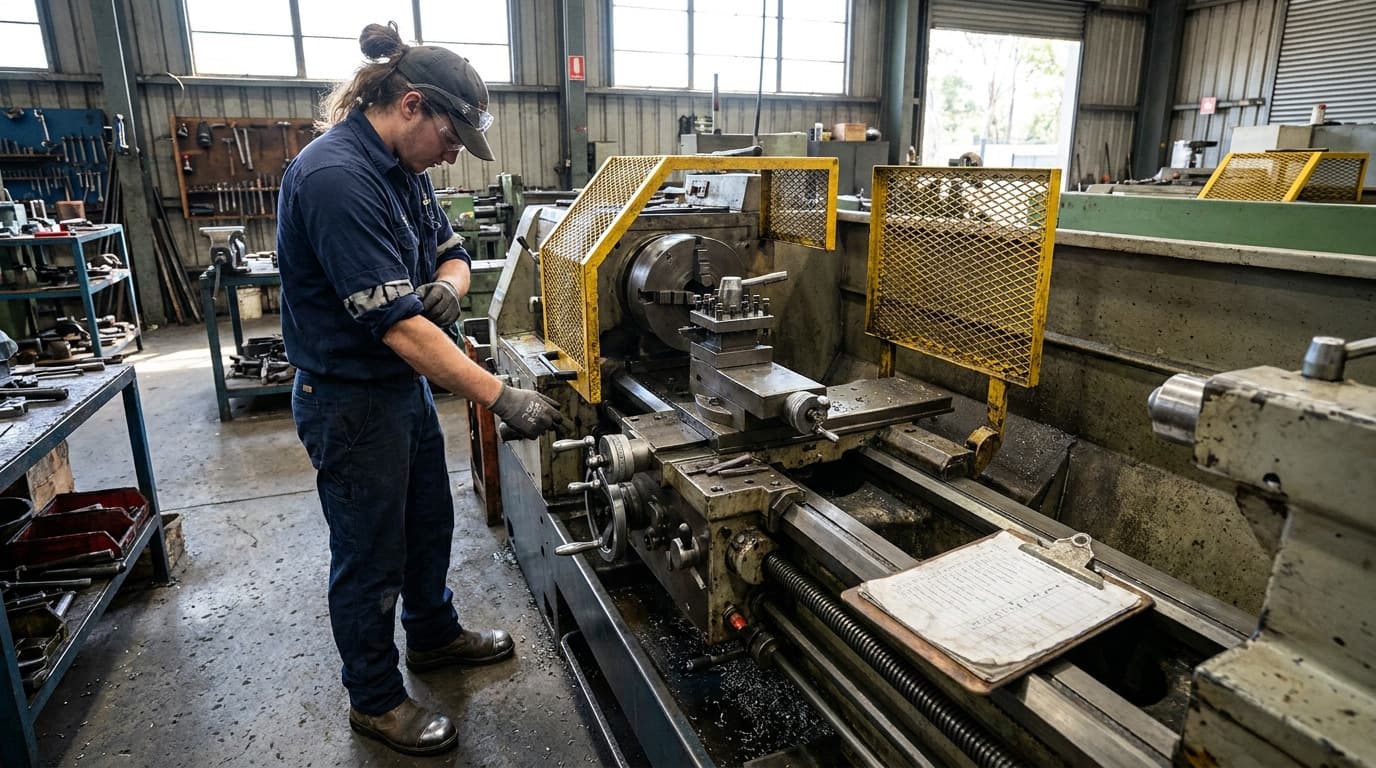
The sharpest version of this hazard is gloves, because gloves are protective equipment that can become the thing that kills you. Gloves are required for a huge range of jobsite hazards — cuts, chemicals, heat, abrasion — and wearing them is often the right call. But around rotating equipment, a glove is a loose, grabbable surface wrapped around your hand, and if it is caught by a drill press, a lathe, a mill, or a spinning bit, it pulls your hand straight into the machine, and a snug fit does not save you once it is caught. This is the paradox: the PPE that protects your hand from a blade is the PPE that feeds your hand into a spindle. The answer is not to abandon gloves and it is not to always wear them — it is to match the PPE to the actual hazard of the specific task. If the hazard is a cut, gloves make sense. If the hazard is a rotating part that can catch, bare and snug beats gloved, and you handle the cut hazard a different way. Wearing every piece of PPE at once is not the safe choice when one piece creates the very hazard another prevents.
Where the duty sits#
The machine guarding requirements that name rotating parts as a hazard live in 1910.212, and they apply to construction through 1926.300, which requires the guarding of moving parts on machines and tools. Those standards require the machine to be guarded; the specific practice of not wearing gloves, loose clothing, or jewelry and of securing long hair around rotating equipment comes from OSHA's guidance documents rather than from a numbered prohibition in the standard itself, and it is enforced through the employer's duty under the General Duty Clause, Section 5(a)(1) to address recognized hazards, together with the training duty in 1926.21(b)(2). The honest picture is that the machine must be guarded by regulation, and the clothing-and-entanglement discipline is a recognized-hazard practice built on OSHA guidance and sound safety policy. Where a manufacturer's instruction or a site rule sets a specific requirement — for instance, prohibiting gloves at a particular machine — that requirement governs.
What can go wrong?#
- A loose sleeve is caught by a rotating shaft and winds the arm in before the worker can react.
- A glove is caught by a drill press or lathe and pulls the hand into the machine.
- Unsecured long hair is caught by a spinning spindle or bit.
- A hoodie drawstring, lanyard, or badge on a cord dangles into a rotating part.
- A ring, watch, or necklace snags on a turning shaft or projecting setscrew.
- A worker wears gloves for a cut hazard on a task whose real hazard is entanglement.
- A smooth, slow-turning shaft grips a sleeve that looked well clear of it.
- A projecting key or setscrew on a rotating part turns it into a hook.
How do we manage this properly?#
- Treat rotating equipment as grabby by default — nothing loose within reach of it.
- Roll and secure sleeves, tuck in shirts, remove dangling cords, lanyards, and drawstrings.
- Remove jewelry — rings, watches, necklaces, bracelets — around rotating parts.
- Tie up and cover long hair with a cap or net near spinning equipment.
- Match PPE to the task's real hazard — don't wear gloves around a rotating part that can catch them.
- Watch for projecting setscrews and keys on rotating parts — they turn smooth into a hook.
- Respect manufacturer and site rules that prohibit gloves at specific machines.
- If something is caught, the machine is already winning — the defense was before contact.
Before you start#
- Confirm what rotating parts are exposed on the equipment you'll use.
- Confirm your sleeves are snug, your shirt is tucked, and nothing is dangling.
- Confirm jewelry is off and long hair is tied up and covered.
- Confirm whether the task's real hazard is a cut (gloves) or entanglement (no gloves).
- Confirm there are no drawstrings, lanyards, or loose straps within reach of the machine.
- Confirm the machine's guards are in place — this talk is in addition to, not instead of, guarding.
- Confirm any manufacturer or site rule about gloves at this machine.
- Confirm everyone near the rotating equipment has done the same check.
Talk it over#
- What rotating equipment on this site is most likely to catch something loose?
- Has anyone here had a sleeve, glove, or cord tug on a turning part?
- On which of our tasks do gloves protect you, and on which could they pull you in?
- What do we wear or carry — lanyards, badges, drawstrings — that dangles without our noticing?
The bottom line#
A guard keeps you out of the machine; nothing keeps the machine out of you once it's caught something you're wearing — so with rotating equipment the whole defense is over before contact, decided by what you put on that morning. Machine guarding keeps you from reaching into the danger; entanglement is the reverse, the machine reaching out and winding you in by whatever loose thing it can grab — and it wins instantly, because a rotating part pulls in a sleeve or a glove faster than any reflex and the body follows what is caught. 1910.212, applied to construction by 1926.300, names rotating parts as a hazard the machine must be guarded against; the discipline of not wearing gloves, loose clothing, or jewelry and of securing long hair comes from OSHA's guidance and the employer's duty under 5(a)(1) to address a recognized hazard, not from a numbered clothing rule in the standard. The sharpest form of it is the gloves paradox — the PPE that protects your hand from a blade is the PPE that feeds it into a spindle — and the resolution is to match PPE to the task's real hazard rather than wear everything at once. Because there is no reacting your way out of an entanglement, the only defense is the one you set before you walked up. The question to carry is simple: is anything I'm wearing — a sleeve, a glove, a cord, a ring, my hair — able to be caught by the part that's about to spin, and have I dealt with it before I turn the machine on?
Frequently asked questions about clothing and entanglement#
If the machine is guarded, why is entanglement still a hazard?
Because guarding and entanglement work in opposite directions. A guard keeps you from reaching into the dangerous part of a machine; entanglement is the machine reaching out and catching something loose you are wearing on a part that has to turn in the open. Not every rotating part can be fully enclosed and still let the work happen — a drill bit, a lathe chuck, a shaft end, an auger, or a PTO shaft is meant to spin exposed. So a machine can have every required guard in place and still entangle a worker whose sleeve, glove, or hair gets caught by the turning part. Guarding is necessary and this talk assumes it is done; entanglement is the hazard that guarding does not cover.
Does OSHA prohibit gloves and loose clothing around machinery?
Not in the machine guarding standard itself. The standard, 1910.212, names rotating parts as a hazard the machine must be guarded against, but it does not spell out a rule against gloves, jewelry, or loose clothing. That specific instruction comes from OSHA's guidance — its amputations guidance and its woodworking materials — which advise employers to keep workers from wearing gloves, jewelry, or loose clothing and to secure long hair around rotating machinery. It is enforced through the employer's duty under the General Duty Clause to address recognized hazards. So the accurate picture is that the machine must be guarded by regulation, and the clothing discipline is a recognized-hazard practice built on OSHA guidance and site policy — real and important, just not a numbered prohibition.
Why is rotating motion so dangerous even when it's slow?
Because rotating motion does not need speed or a pinch point to catch you — it only needs to touch something that can wrap around it. Even a smooth, slowly turning shaft can grip a sleeve or a glove through friction, and once it grabs, the wrapping tightens and pulls with the full torque of the machine, which is far more than a person can resist. The danger multiplies when there is a projecting setscrew, key, or bolt on the rotating part, because a single protrusion turns a smooth shaft into a hook. This is why the hazard is not proportional to how fast or powerful the machine looks — slow, quiet shafts have pulled in arms. Treat any exposed rotating part as able to catch, regardless of its speed.
How can my own gloves be dangerous?
Around rotating equipment, a glove is a loose, grabbable layer wrapped around your hand. If a drill press, lathe, mill, or spinning bit catches it, the glove pulls your hand straight into the machine, and once it is caught a snug fit will not save you. This is the paradox of the gloves that protect you from cuts and chemicals: on a task whose real hazard is a rotating part, those same gloves are what feed your hand in. The answer is not to always wear gloves or never wear them, but to match the PPE to the actual hazard of the specific task. If the hazard is a cut, gloves are right; if it is a rotating part that can catch, bare and snug is safer and you manage the cut hazard another way.
What should I do about long hair and jewelry?
Secure them completely before you go near rotating equipment. Long hair should be tied up and kept under a cap or hair net, because a spinning spindle or bit can catch loose hair and pull the head in — one of the most severe entanglement injuries. Jewelry — rings, watches, necklaces, bracelets — should come off, because any of it can snag on a turning shaft or a projecting setscrew. The same goes for anything that dangles: hoodie drawstrings, lanyards, badge cords, loose straps. None of these feel like a hazard while you are standing still, which is exactly why they get missed — the check has to be deliberate, done before you approach the machine, not left to whether you happen to notice a cord swinging.
Why can't I just react and pull away if something gets caught?
Because the machine is faster than you, by a wide margin, and it never lets go. A rotating part winds in a caught sleeve or glove in a fraction of a second, far quicker than the time it takes to feel the tug, decide to pull, and pull — and it pulls with the full torque of the motor, which no person can out-muscle. Once something is caught, the body follows whatever is caught, and there is no reacting your way out. That is the whole reason the defense against entanglement is different from most hazards: it is not about responding correctly in the moment, it is about making sure there is nothing to catch in the first place. The decision that protects you was made before you switched the machine on.
Download the clothing and entanglement toolbox talk PDF#
Get this clothing and entanglement toolbox talk as a print-ready PDF — available in English, Spanish, Portuguese, and Turkish. Print it, hand it to the crew, and collect signatures on the included attendance sheet.
Download the PDF — free account required. New members get 3 free downloads.
Related toolbox talks#
Sources#
- OSHA, General requirements for all machines — 29 CFR 1910.212 (one or more methods of machine guarding to protect from hazards created by point of operation, in-running nip points, rotating parts, and flying chips and sparks): https://www.osha.gov/laws-regs/regulations/standardnumber/1910/1910.212
- OSHA, General requirements — 29 CFR 1926.300 (guarding of moving parts, applying machine guarding provisions to construction tools and equipment): https://www.osha.gov/laws-regs/regulations/standardnumber/1926/1926.300
- OSHA, Safeguarding Equipment and Protecting Employees from Amputations (OSHA 3170) (guidance advising employers to instruct workers not to wear gloves, jewelry, or loose-fitting clothing and to secure long hair around rotating machinery; entanglement addressed as a recognized hazard under the General Duty Clause): https://www.osha.gov/sites/default/files/publications/OSHA3170.pdf
This talk is general awareness guidance for training purposes. It does not replace your employer's machine safety program, the OSHA machine guarding standards, the OSH Act General Duty Clause, the equipment manufacturer's instructions, or a competent person's duties, and it is not legal advice. Where a manufacturer's instruction or a site rule sets a specific requirement — such as prohibiting gloves at a particular machine — that requirement governs.