Nail Gun Safety
Updated 2026-08-01
In this bundle Tools & Machinery
Print-ready PDF
Download this talk as a print-ready PDF, available in 4 languages.
Every argument about nail gun triggers ends the same way. Somebody says the sequential trigger is safer, somebody else says bump firing is faster, and the conversation stops there because both statements sound obviously true and nobody can have both. The second statement has been measured, and it is not true. This Nail Gun Safety Toolbox Talk (Safety Talk / Tailgate Talk) is about what happens to the argument once that is on the table.
Here is the distinction that carries this whole talk: the contact trigger doubles the injury rate and buys you almost nothing — a study of experienced journeymen carpenters found the productivity difference against a sequential trigger was under one per cent. OSHA states plainly that the risk of a nail gun injury is twice as high when using a multi-shot contact trigger as when using a single-shot sequential trigger nailer. The trade defends bump firing on speed. The speed is not there.
Where the boundary of this talk sits#
Powder-actuated and fuel-actuated fastening tools belong to the powder-actuated tools talk in this same pair — different energy source, different standard, different training rule. Compressed air generally, the hose provisions and the 30 psi cleaning figure belong to the compressed air talk, which owns that number. General power tool duties belong to the hand and power tools talk. Cut and crush injury mechanics belong to the hand injuries talk. This talk owns the nailer: its trigger, its failure modes and its injury data.
The scale, before the argument#
The numbers are the reason this talk exists rather than a paragraph in a general tools briefing.
NIOSH puts nail gun injuries at roughly 37,000 US emergency department visits a year — of which about 68% involve workers and 32% consumers.
OSHA states that injuries from nail guns hospitalise more construction workers than any other tool-related injury.
And the exposure is close to universal in some trades: one study found that 2 out of 5 residential carpenter apprentices experienced a nail gun injury over a four-year period. Duke researchers put it at 44% of apprentices in one four-year training programme injured before finishing.
This is not a rare-event hazard. It is a near-certainty hazard that has been normalised.
What the two triggers actually do#
The mechanism matters because the names are a mess and the tools are indistinguishable.
Full sequential trigger. The safety contact tip must be pushed into the workpiece first, then the trigger squeezed. Both must be released and activated again to fire a second nail. Nails cannot be bump fired. Also called single-shot, restrictive, or trigger fire mode.
Contact trigger. The two controls can be activated in either order, so nails discharge for as long as the trigger stays held and the nose keeps touching things. Also called bump trigger, multi-shot, successive, dual-action, touch trip, contact trip and bottom fire — six names for the same mechanism, which is part of why crews talk past each other.
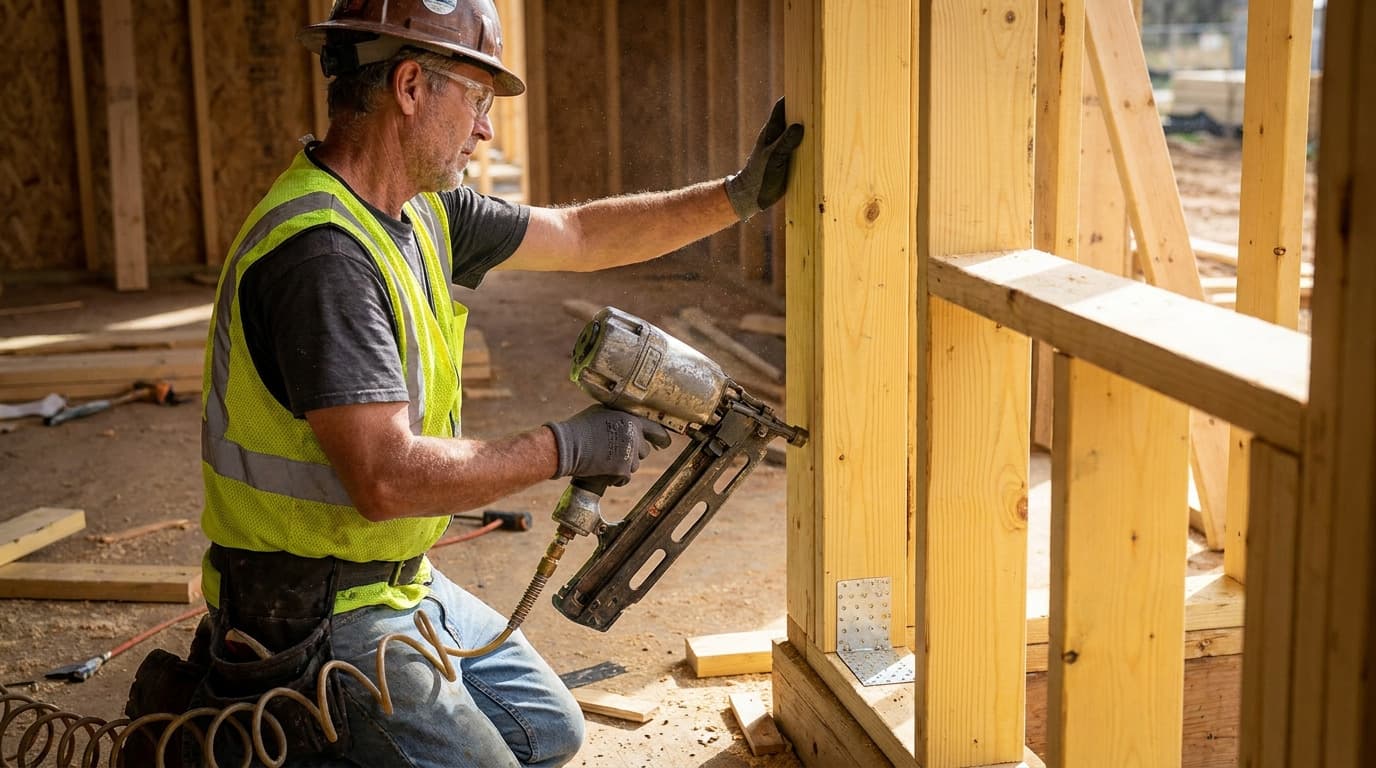
From that difference come the two classic injuries. Double fire: the recoil bounces the tool off the work and, with the trigger still held, it fires again as it lands — often somewhere the operator did not intend. And unintended discharge: with the trigger held while carrying or reaching, anything the nose knocks into fires a nail.
The claim that has been tested#
Here is the part to put in front of anybody who defends the contact trigger.
A study measuring productivity in construction found the contact trip trigger showed no significant difference — less than one per cent — compared with the sequential trigger among experienced users. There was no significant difference in nail count or placement. Workers did differ in work rate, but the difference was the skill of the worker, not the tool. The study used journeymen carpenters averaging 13 years in the trade.
Set that against twice the risk of acute injury, even after accounting for experience and training, and the trade-off collapses. You are buying a doubled injury rate with a productivity gain too small to measure.
The two triggers look exactly alike#
This is the operational consequence that changes what a supervisor does on Monday morning.
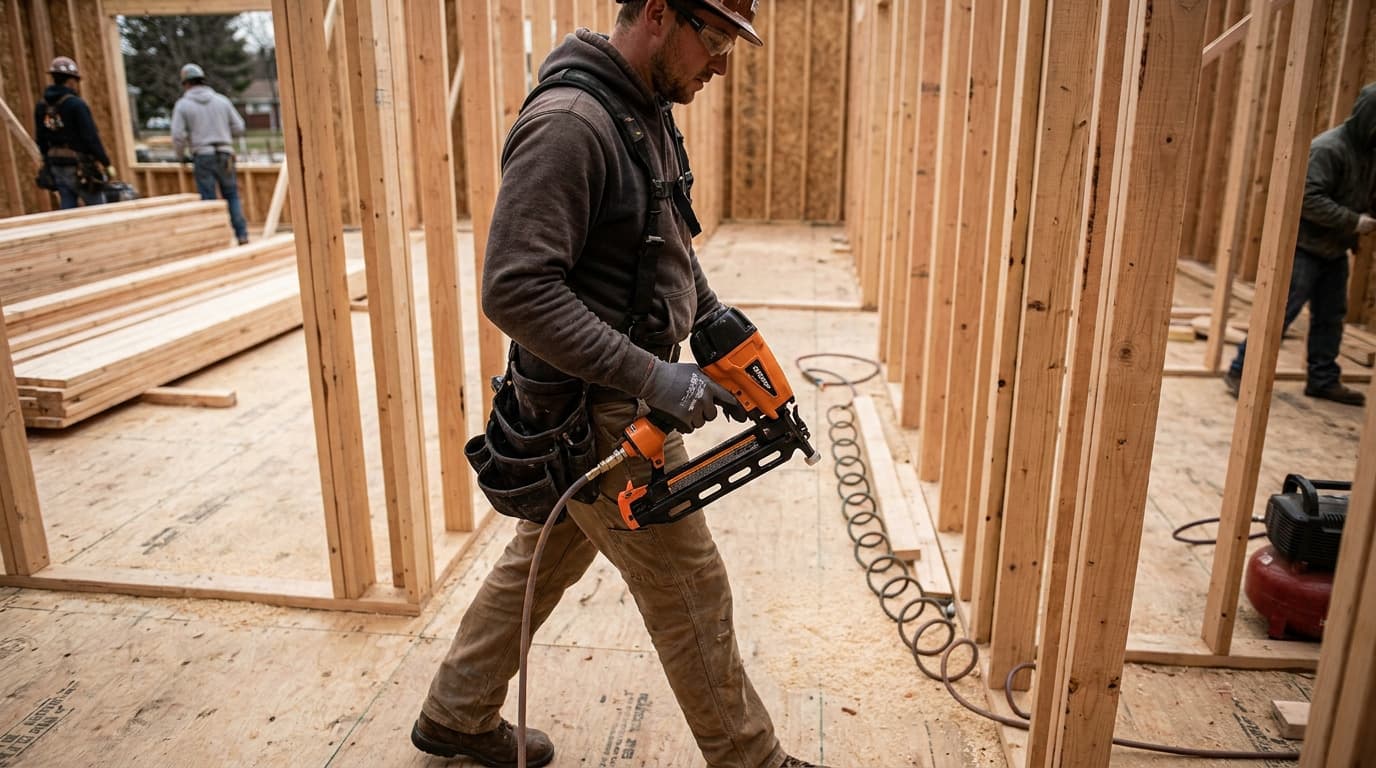
Workers cannot tell them apart by looking. The tools are visually identical, and a number of manufacturers now make models whose triggering mechanism switches back and forth between contact and sequential — so the same tool can be either, depending on how it was left.
That produces three practical duties. Check the tool label and the manufacturer's manual for the trigger name that manufacturer uses, because the naming is not standardised. Verify the mode on switchable tools rather than assuming. And label or segregate the tools on site so a sequential-only area does not quietly acquire a contact-trigger gun.
The seven ways people actually get hurt#
NIOSH lists these as the major risk factors, and every one of them is recognisable on a framing job.
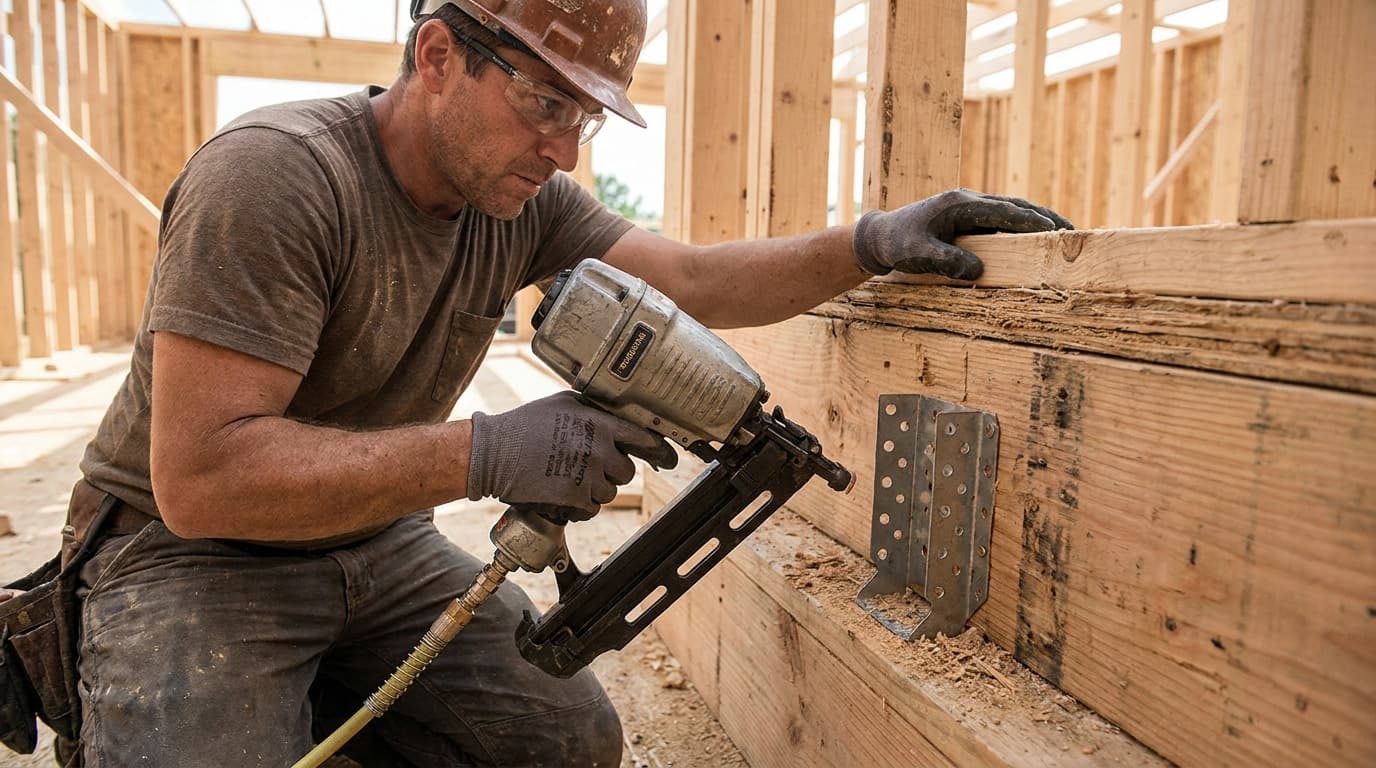
Unintended discharge from double fire. Unintended discharge from knocking the safety contact with the trigger squeezed. Nail penetration through the lumber workpiece — the fastener exits the far side into a hand, a leg or a person. Nail ricochet after striking a hard surface or metal feature such as a hanger, plate or embedded fixing. Missing the workpiece entirely. Awkward-position nailing, where the tool is held out of line and the free hand is somewhere it should not be. And bypassing safety mechanisms — taping the work-contact element down for bump nailing being the standard version.
Note what the list is mostly about: not the nail going where it was aimed, but the nail going somewhere else.
Where the duty sits#
The specific provision is short. 1926.302(b)(3): pneumatic power tools that shoot nails, rivets, staples or similar fasteners and operate at more than 100 p.s.i. pressure at the tool shall have a safety device on the muzzle to prevent the tool from ejecting fasteners unless the muzzle is in contact with the work surface.
Read what that does and does not do. It requires the muzzle contact device. It says nothing about the trigger sequence — so a contact-trigger nailer with a working muzzle safety is fully compliant, and taping that safety down is a clear violation. The trigger choice sits above the standard, not inside it.
Around it: 1926.300(a) requires all hand and power tools to be maintained in a safe condition, which is the hook for a defeated safety device. 1926.102 covers eye and face protection. 1926.21(b)(2) requires instruction in the recognition and avoidance of unsafe conditions. And Section 5(a)(1) applies where nothing specific reaches. NIOSH and OSHA's joint guidance, Nail Gun Safety: A Guide for Construction Contractors, is the recognised source on trigger selection — guidance, not a rule, but it is what a General Duty Clause argument would be measured against.
What can go wrong?#
Defending the contact trigger on speed, when the measured difference is under one per cent.
Taping or wiring down the work-contact element for bump nailing.
Assuming a tool is sequential because it looks like the last one, on a site with switchable models.
Carrying a nailer with a finger on the trigger, so anything the nose touches fires.
Nailing through into a hand or a leg on the far side of the lumber.
Firing into a hanger, plate or embedded fixing and taking the ricochet.
Nailing in an awkward position with the free hand near the line of fire.
Treating a nail gun injury as too minor to report — which is why the data understates it.
How do we manage this properly?#
Specify the full sequential trigger for the work, and buy or hire accordingly. This is the single decision that halves the injury rate.
Check the tool label and manual for that manufacturer's trigger name — the terminology is not standardised across brands.
Verify the mode on switchable tools at the start of every shift, and label or segregate tools so modes do not migrate.
Never defeat the work-contact element, and treat a taped safety as a tool removed from service under 1926.300(a).
Keep the finger off the trigger except at the moment of firing, and disconnect the air before clearing a jam, adjusting or handing the tool over.
Know what is behind the workpiece — a nail through the far side is one of the seven listed mechanisms.
Watch for hangers, plates and embedded metal that will deflect a nail.
Do not nail in awkward positions where the free hand is anywhere near the line of fire — reposition instead.
Report every nail gun injury, including the ones that seem trivial, because unreported injuries are why the hazard stays invisible.
Train hands-on with the actual guns used on the job, covering the causes of injury rather than just the operating sequence.
Before you start#
- Confirm which trigger type is fitted to every nailer on this crew today.
- Confirm no work-contact element has been taped, wired or otherwise defeated.
- Confirm switchable tools are set to sequential and have been checked this shift.
- Confirm everyone knows the manufacturer's name for the trigger on their tool.
- Confirm eye and face protection for operators and anybody working close.
- Confirm what is on the far side of the material being nailed.
- Confirm the air is disconnected before any jam clearing or adjustment.
- Confirm the crew knows that every nail gun injury gets reported.
Talk it over#
- Does anybody here believe bump firing is faster, and what is that belief based on?
- Can anyone tell by looking whether the gun in their hand is sequential or contact?
- Who here has been nailed, and did it get reported?
- What is behind the wall or the joist we are nailing into this morning?
The bottom line#
The contact trigger doubles the injury rate and buys you almost nothing. OSHA states that the risk of a nail gun injury is twice as high when using a multi-shot contact trigger as when using a single-shot sequential trigger nailer, and a productivity study of journeymen carpenters averaging 13 years in the trade found the contact trip showed no significant difference — less than one per cent — with no significant difference in nail count or placement, the variation being the skill of the worker, not the tool. The scale justifies the attention: NIOSH puts nail gun injuries at roughly 37,000 US emergency department visits a year, about 68% workers and 32% consumers; OSHA states nail gun injuries hospitalise more construction workers than any other tool-related injury; and 2 out of 5 residential carpenter apprentices were injured over a four-year period. Mechanically, a full sequential trigger requires the safety contact tip pushed into the work first, then the trigger, with both released and re-activated for each nail; a contact trigger allows either order, so nails fire for as long as the trigger is held and the nose keeps touching things — producing double fire from recoil and unintended discharge from knocking the nose with the trigger squeezed. The operational trap is that the two types look exactly alike, some models switch between modes, and the contact type carries six different names — bump, multi-shot, successive, dual-action, touch trip, contact trip and bottom fire — so check the tool label and manual, verify switchable tools, and segregate or label on site. NIOSH's seven risk factors are double fire; knocking the safety contact with the trigger squeezed; nail penetration through the workpiece; ricochet off a hard surface or metal feature; missing the workpiece; awkward-position nailing; and bypassing safety mechanisms — mostly about the nail going somewhere other than where it was aimed. On duties, 1926.302(b)(3) requires nailers operating at more than 100 p.s.i. at the tool to have a safety device on the muzzle preventing ejection unless the muzzle is in contact with the work surface — it requires the muzzle device and says nothing about trigger sequence, so trigger choice sits above the standard while taping that safety down is a plain violation, caught by 1926.300(a)'s duty to maintain tools in a safe condition. 1926.102 covers eye and face protection, 1926.21(b)(2) instruction, and NIOSH/OSHA's Nail Gun Safety: A Guide for Construction Contractors is guidance rather than a rule.
Frequently asked questions about nail guns#
Isn't bump firing faster? Why give it up?
Because the speed does not survive measurement. A construction productivity study found the contact trip trigger showed no significant difference — less than one per cent — compared with the sequential trigger among experienced users, with no significant difference in nail count or placement; the variation came from the skill of the worker, not the tool. The study used journeymen averaging 13 years in the trade. Set against twice the injury risk, there is nothing on the other side of the trade-off.
What is the actual difference between the triggers?
A full sequential trigger requires the controls in a fixed order: safety contact tip pushed into the workpiece first, then the trigger — and both must be released and activated again for each subsequent nail, so nails cannot be bump fired. A contact trigger allows either order, so the tool fires for as long as the trigger is held and the nose contacts something. That is what produces double fire on recoil and unintended discharge when the nose is knocked.
How do we tell which trigger a gun has?
Not by looking — the two types look exactly alike, and a number of manufacturers make models whose mechanism switches between contact and sequential. Worse, the contact type goes by at least six names: bump trigger, multi-shot, successive, dual-action, touch trip, contact trip and bottom fire. Check the tool label and the manufacturer's manual for that brand's terminology, verify the mode on switchable tools each shift, and label or segregate tools on site.
How common are nail gun injuries really?
Far more common than the trade assumes. NIOSH estimates roughly 37,000 US emergency department visits a year, of which about 68% involve workers. OSHA states that injuries from nail guns hospitalise more construction workers than any other tool-related injury, and that 2 out of 5 residential carpenter apprentices experienced a nail gun injury over a four-year period. Injuries are also frequently unreported or untreated, so the recorded figures understate it.
What does OSHA actually require for a nailer?
1926.302(b)(3): pneumatic tools that shoot nails, rivets, staples or similar fasteners and operate at more than 100 p.s.i. pressure at the tool must have a safety device on the muzzle to prevent ejecting fasteners unless the muzzle is in contact with the work surface. Note what it covers — the muzzle device, not the trigger sequence. So trigger selection is a management decision above the standard, while defeating that muzzle safety is a straightforward violation, also caught by 1926.300(a) ("maintained in a safe condition").
What are the main ways people get hurt?
NIOSH lists seven: unintended discharge from double fire; unintended discharge from knocking the safety contact with the trigger squeezed; nail penetration through the lumber workpiece; nail ricochet after striking a hard surface or metal feature; missing the workpiece; awkward-position nailing; and bypassing safety mechanisms. Most of the list is about the nail going somewhere other than where it was aimed — which is why controlling the trigger and knowing what is behind the work matters more than aim.
Is there ever a good reason to disable a nail gun safety?
No. NIOSH and OSHA's joint guidance states there is no legitimate reason to modify or disable a nail gun safety mechanism, and OSHA requires tools to be maintained in a safe condition under 1926.300(a). The usual version on site is taping the work-contact element down to allow bump nailing. That converts a compliant tool into a non-compliant one and removes the engineered margin the manufacturer designed in — for a productivity gain that measurement says is not there.
Download the nail gun safety toolbox talk PDF#
Get this nail gun safety toolbox talk as a print-ready PDF — available in English, Spanish, Portuguese, and Turkish. Print it, hand it to the crew, and collect signatures on the included attendance sheet.
Download the PDF — free account required. New members get 3 free downloads.
Related toolbox talks#
Sources#
- OSHA, Nail Gun Safety: https://www.osha.gov/nail-gun-safety
- NIOSH / OSHA, Nail Gun Safety: A Guide for Construction Contractors: https://www.osha.gov/sites/default/files/publications/NailgunFinal_508_02_optimized.pdf
- eLCOSH, Nail Guns: Injuries, Productivity and Recommendations: https://elcosh.org/document/2066/d001056/nail-guns:-injuries,-productivity-and-recommendations.html
This talk is general awareness guidance for training purposes. Trigger selection, tool specification and jam clearing procedures must follow the manufacturer's instructions for the specific tool in use, and no safety mechanism should be modified or disabled for any reason.
Written by FieldSafetyTalk's safety professional — a CSP, ASP, CHST and OSHA Authorized Outreach Trainer with 14+ years of international construction safety experience across federal, heavy civil, and industrial projects.