First Aid and AED
Updated 2026-07-24
In this bundle Fire, Hot Work & Emergency
Working in California? See the Cal/OSHA edition → California (Cal/OSHA)Working in Washington? See the WA DOSH edition → Washington (WA DOSH)
Print-ready PDF
Download this talk as a print-ready PDF, available in 4 languages.
There is a number OSHA uses to decide whether your site legally needs a trained first aider, and almost nobody on any jobsite has ever measured theirs against it. It is not a distance. It is three to four minutes — and the way OSHA describes the workplaces it applies to is, word for word, a description of construction. This First Aid and AED Toolbox Talk (Safety Talk / Tailgate Talk) is about the gap between calling for help and help arriving, and who fills it.
Here is the distinction that carries this whole talk: every other control on this site is designed to stop something happening. First aid is the only one that assumes the control failed. It is the plan for the minutes after — and unlike everything else we brief, it is the one nobody rehearses, because rehearsing it means admitting the rest might not work.
Three to four minutes, and why construction is in that bracket#
29 CFR 1926.50(c) sets the test in words rather than numbers: in the absence of an infirmary, clinic, hospital, or physician that is reasonably accessible in terms of time and distance to the worksite, a person who holds a valid certificate in first-aid training — from the U.S. Bureau of Mines, the American Red Cross, or equivalent training verifiable by documentary evidence — shall be available at the worksite to render first aid.
So what does "reasonably accessible" mean? OSHA has answered that repeatedly in letters of interpretation, and the answer is precise:
While the standards do not prescribe a number of minutes, OSHA has long interpreted the term "near proximity" to mean that emergency care must be available within no more than 3-4 minutes from the workplace — an interpretation that has been upheld by the Occupational Safety and Health Review Commission and by federal courts.
And then OSHA describes the workplaces it means:
Accordingly, in workplaces where serious accidents such as those involving falls, suffocation, electrocution, or amputation are possible, emergency medical services must be available within 3-4 minutes, if there is no employee on the site who is trained to render first aid.
Read that list again. Falls. Suffocation. Electrocution. Amputation. That is the Focus Four with confined space added. It is not a description of a category construction might fall into — it is construction. OSHA reserves the longer allowance, up to 15 minutes, for lower-hazard settings such as offices, where a life-threatening outcome is unlikely.
Which turns a vague question into arithmetic. How long does it actually take an ambulance to reach your work face — not your gate, your work face — at the time of day you work? If the honest answer is more than three or four minutes, then under OSHA's own interpretation the site needs a certified first-aid provider present. Not a good idea. Required.
Almost no site has ever timed it. Fewer still have accounted for the parts that make construction slower than a street address: a gate that is locked, a haul road, a floor with no lift yet, a casualty at the top of a structure, and a crew that cannot describe where they are.
What the standard also requires#
29 CFR 1926.50 is short and specific, and several parts of it are routinely missed:
- (b) Plan it before you start. Provisions shall be made prior to the commencement of the project for prompt medical attention in case of serious injury. Before, not during.
- (d)(1) Supplies easily accessible. First aid supplies shall be easily accessible when required. Locked in the site office at night does not qualify.
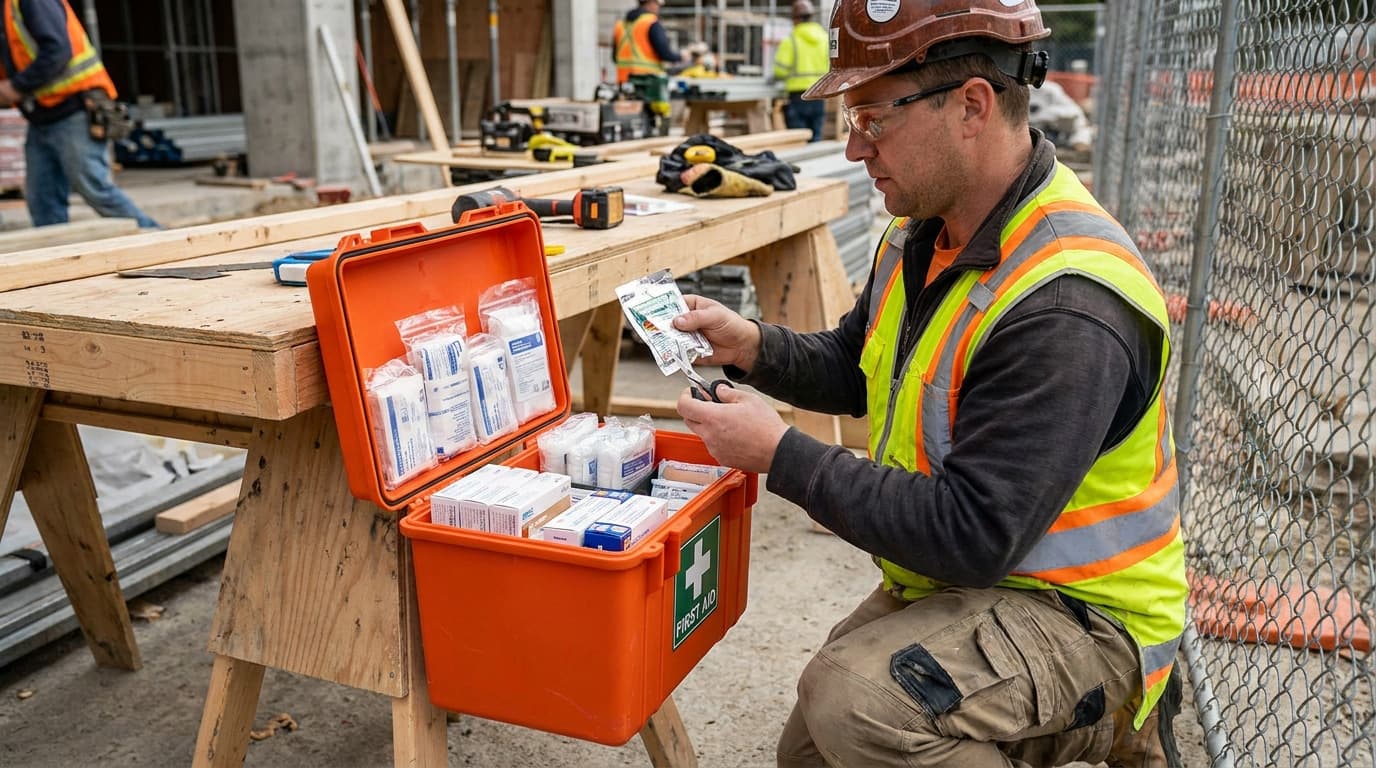
- (d)(2) The weekly check. Contents shall be in a weatherproof container with individual sealed packages for each type of item, and shall be checked by the employer before being sent out on each job, and at least weekly on each job, to ensure expended items are replaced. A weekly duty, on every job, that almost nobody performs.
- (e) Getting them out. Proper equipment for prompt transportation of the injured person, or a communication system for contacting ambulance service, shall be provided.
- (f) Post the numbers. Where 911 is not available, the telephone numbers of physicians, hospitals, or ambulances shall be conspicuously posted.
- (g) Drenching and flushing. Where the eyes or body may be exposed to injurious corrosive materials, suitable facilities for quick drenching or flushing of the eyes and body shall be provided within the work area for immediate emergency use. Within the work area — not at the welfare unit across the site.
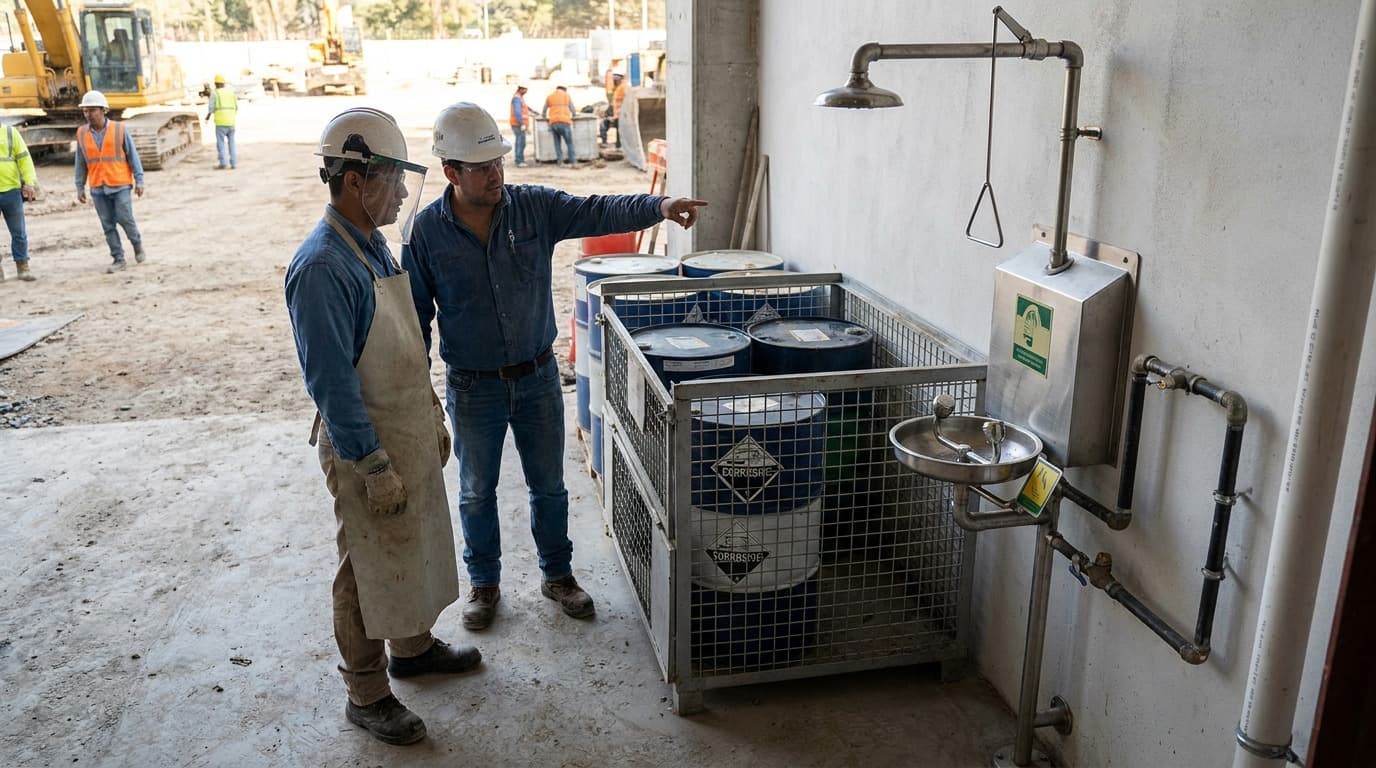
Note also that construction is stricter than general industry on one point: 1926.50(c) requires the trained person to hold a valid certificate, where the general industry rule speaks of someone "adequately trained." On a construction site, documentary evidence matters.
Where AEDs actually stand#
Being straight about this: there is no OSHA construction standard requiring an automated external defibrillator. No 1926 provision mandates one, and nobody will cite you for not having one.
But look at what OSHA put in its own list of the serious accidents that drive the 3-4 minute rule — stopped breathing and cardiac arrest appear explicitly in the reasoning behind that interpretation. The agency's own logic is that in those events, treatment within the first few minutes is what determines whether the outcome is survival, permanent impairment, or death. An AED is the intervention that fits inside that window, and on a site where EMS is more than a few minutes away, it is worth deciding about deliberately rather than by default.
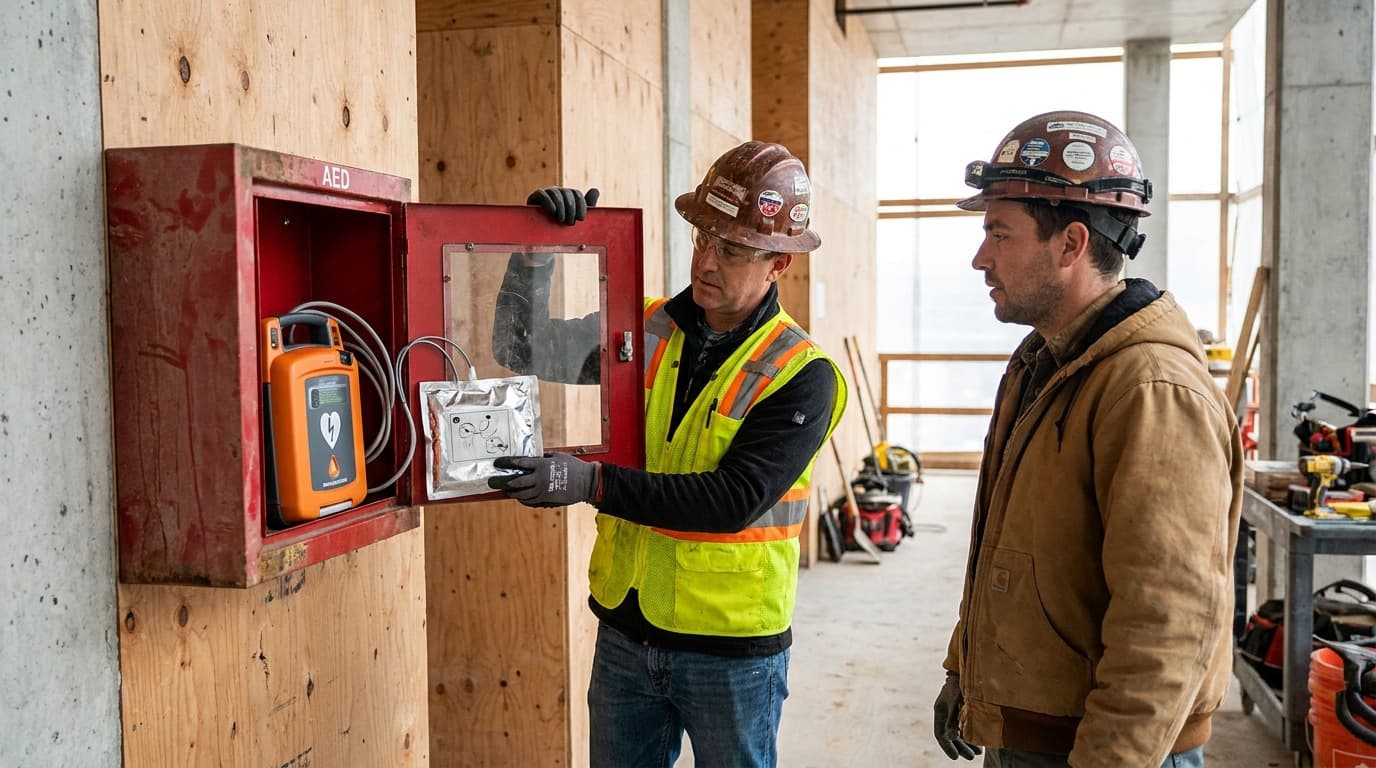
If your site has one: know where it is, know that it is checked and its pads are in date, and make sure more than one person knows how to fetch it. An AED nobody can locate is a box on a wall.
On USACE and NAVFAC projects, EM 385-1-1 applies and is more prescriptive on first aid provision, responder qualifications, and medical planning.
What can go wrong#
Nobody has timed the EMS response. The single most common gap, and the one the whole standard turns on.
The certified first aider is off site. On leave, on another job, or finished at 3 p.m. while the crew works to 6.
The kit is a decoration. Never checked, half empty, out of date, or holding items nobody was trained to use.
The kit is locked away. In the office, in a van that has left, or in a container only the foreman has a key to.
Nobody can say where they are. A large site with no grid reference, no gate number, and a caller describing "the back corner."
The gate is locked and nobody is meeting the ambulance. Minutes lost at the boundary of a site the crew could have opened.
No route in for a stretcher. The casualty is up a structure, down a shaft, or beyond a floor with no access — and nobody planned the extraction.
The eyewash is nowhere near the work. Corrosives being used on one level, drenching facilities on another.
Everyone crowds the casualty and nobody calls. A common failure in real incidents — assume someone else has dialled and nobody has.
The scene is not safe. Rescuers entering the same hazard that produced the casualty: live conductors, unshored trench, suspended load, atmosphere.
No AED, or one nobody can find.
Nobody knows the plan because it was covered at induction, once, months ago.
How do we make this work?#
Time the response, honestly, and write it down. From a 911 call to a paramedic at the work face. If it exceeds three or four minutes, you need a certified first aider present whenever people are working.
Name the first aiders and post their names. Every shift, every phase — with cover for holidays, sickness, and overtime.
Give the location before the injury. Site address, gate number, grid or level reference, and what3words or equivalent, posted at every muster board and saved in phones.
Assign someone to meet the ambulance and open the gate. A named role in the plan, not whoever thinks of it.
Plan the extraction, not just the treatment. How does a casualty come down from height, out of a trench, or off a roof — and with what?
Check the kit weekly, as 1926.50(d)(2) requires, with a signed record and a named person.
Put eyewash where the corrosives are, per (g) — within the work area, for immediate use.
Post the emergency numbers conspicuously, and make sure they are the current ones.
Make the scene safe before anyone approaches. Isolate, shore, secure, ventilate — the first casualty is a tragedy, the second is a failure.
Decide about an AED deliberately, based on your measured EMS response time, and if you have one, make it findable and maintained.
Rehearse it once. A ten-minute walkthrough — who calls, who meets, who fetches, who goes with them — finds every gap in the plan.
Before you start#
- Know who the certified first aider is on this shift, and where they are.
- Know where the first aid kit is and confirm it is accessible right now.
- Know the site's emergency location details well enough to give them under pressure.
- Confirm someone is nominated to meet and direct the ambulance.
- Confirm the access route for a stretcher from where you are working.
- Confirm eyewash or drenching facilities are within the work area if corrosives are in use.
- Confirm emergency numbers are posted and current.
- Know where the AED is, if the site has one.
- Confirm the kit's weekly check has been done and recorded.
- Agree who calls, so it does not become everybody's job and therefore nobody's.
Talk it over#
- How long would it take an ambulance to reach exactly where you are standing? Has anyone measured it?
- If someone went down right now, what would you say on the phone about where we are?
- Who is the certified first aider on this site today — and is that person here?
The bottom line#
29 CFR 1926.50(c) requires a person holding a valid first-aid certificate on site unless medical care is reasonably accessible in terms of time and distance — and OSHA has long interpreted that to mean within no more than 3-4 minutes, an interpretation upheld by the Review Commission and by federal courts. The workplaces OSHA names for that bracket are ones where falls, suffocation, electrocution, or amputation are possible, which is a description of construction. So measure your actual response time to the work face, not the gate. Check the kit weekly as (d)(2) requires, put drenching facilities within the work area under (g), post the numbers under (f), and name who calls, who meets the ambulance, and who fetches the AED — before you need any of them.
Frequently asked questions about first aid on site#
Does OSHA require a trained first aider on a construction site?
Under 29 CFR 1926.50(c), yes — unless an infirmary, clinic, hospital, or physician is reasonably accessible in terms of time and distance to the worksite. Where that is not the case, a person holding a valid certificate in first-aid training, verifiable by documentary evidence, must be available at the worksite to render first aid.
What counts as "reasonably accessible"?
OSHA has interpreted the equivalent term consistently: emergency care must be available within no more than 3-4 minutes of the workplace where serious accidents are possible, an interpretation upheld by the Occupational Safety and Health Review Commission and by federal courts. For lower-hazard workplaces such as offices, a response time of up to 15 minutes may be acceptable.
Why does construction fall into the 3-4 minute bracket?
Because of the accidents OSHA names. Its interpretation applies the 3-4 minute standard to workplaces where serious accidents such as those involving falls, suffocation, electrocution, or amputation are possible. That list describes construction directly, so in practice a construction site should be assessed against the shorter response time rather than the office allowance.
How often must the first aid kit be checked?
Under 29 CFR 1926.50(d)(2), the contents must be in a weatherproof container with individual sealed packages for each type of item, and must be checked by the employer before being sent out on each job and at least weekly on each job to ensure expended items are replaced. It is a weekly duty on every job, not an annual one.
Does OSHA require an AED on a construction site?
No. There is no OSHA construction standard requiring an automated external defibrillator, and the absence of one is not citable under a specific 1926 provision. However, cardiac arrest and stopped breathing appear explicitly in the reasoning behind OSHA's 3-4 minute interpretation, so on sites where EMS response exceeds a few minutes, whether to provide an AED is a decision worth making deliberately rather than by omission.
Where do eyewash or drenching facilities have to be?
Under 29 CFR 1926.50(g), where the eyes or body of any person may be exposed to injurious corrosive materials, suitable facilities for quick drenching or flushing of the eyes and body must be provided within the work area for immediate emergency use — not at a welfare unit elsewhere on the site.
What has to be planned before the job starts?
Under 29 CFR 1926.50(b), provisions for prompt medical attention in case of serious injury must be made prior to the commencement of the project. Under (e), proper equipment for prompt transportation of an injured person, or a communication system for contacting an ambulance, must be provided; and under (f), where 911 is not available the relevant telephone numbers must be conspicuously posted.
Download the first aid toolbox talk PDF#
Get this first aid and AED toolbox talk as a print-ready PDF — available in English, Spanish, Portuguese, and Turkish. Print it, hand it to the crew, and collect signatures on the included attendance sheet.
Download the PDF — free account required. New members get 3 free downloads.
Related toolbox talks#
- Emergency Response
- Emergency Evacuation Routes
- Fall Rescue and Suspension Trauma
- Bloodborne Pathogens
Sources#
- OSHA, 29 CFR 1926.50 — Medical services and first aid: https://www.osha.gov/laws-regs/regulations/standardnumber/1926/1926.50
- OSHA, Clarification of "in near proximity" and OSHA's discretion in enforcing first aid requirements, Letter of Interpretation, March 23, 2007: https://www.osha.gov/laws-regs/standardinterpretations/2007-03-23
- OSHA, Response time and "in near proximity" requirements, Letter of Interpretation, November 19, 1992: https://www.osha.gov/laws-regs/standardinterpretations/1992-11-19-9
Written by FieldSafetyTalk's safety professional — a CSP, ASP, CHST and OSHA Authorized Outreach Trainer with 14+ years of international construction safety experience across federal, heavy civil, and industrial projects.
This talk summarises published regulatory requirements and interpretations. It is not medical advice and is not a substitute for accredited first aid training. Treatment of any casualty should follow the direction of trained first aid providers and emergency medical services.