Heavy Equipment Safety
Updated 2026-07-28
In this bundle Jobsite Fundamentals & Compliance
Print-ready PDF
Download this talk as a print-ready PDF, available in 4 languages.
Heavy equipment kills people who are not operating it. The operator sits in a protected cab with a belt; the person who dies is walking past, guiding a load, taking a measurement or standing where the machine was not expected to go. That is why every requirement in this area is really about the boundary between the machine and everybody else. This Heavy Equipment Safety Toolbox Talk (Safety Talk / Tailgate Talk) is about that boundary.
Here is the distinction that carries this whole talk: the backup alarm is one of two options, not a requirement. Almost everyone on a construction site believes a reversing machine must have a working alarm. What the standard actually says is that it must have an alarm or somebody signalling that it is safe. That matters enormously in practice, because it means a failed alarm does not automatically stop the work — but it does mean you now need a person, and that person has to actually be there.
Reversing: alarm or observer#
The same structure appears twice, for two different classes of equipment.
Motor vehicles — 1926.601(b)(4). No employer shall use any motor vehicle equipment having an obstructed view to the rear unless:
- (i) the vehicle has a reverse signal alarm audible above the surrounding noise level; or
- (ii) the vehicle is backed up only when an observer signals that it is safe to do so.
Earthmoving and compacting equipment — 1926.602(a)(9)(ii). No employer shall permit earthmoving or compacting equipment which has an obstructed view to the rear to be used in reverse gear unless the equipment has in operation a reverse signal alarm distinguishable from the surrounding noise level or an employee signals that it is safe to do so.
Three things follow from that wording.
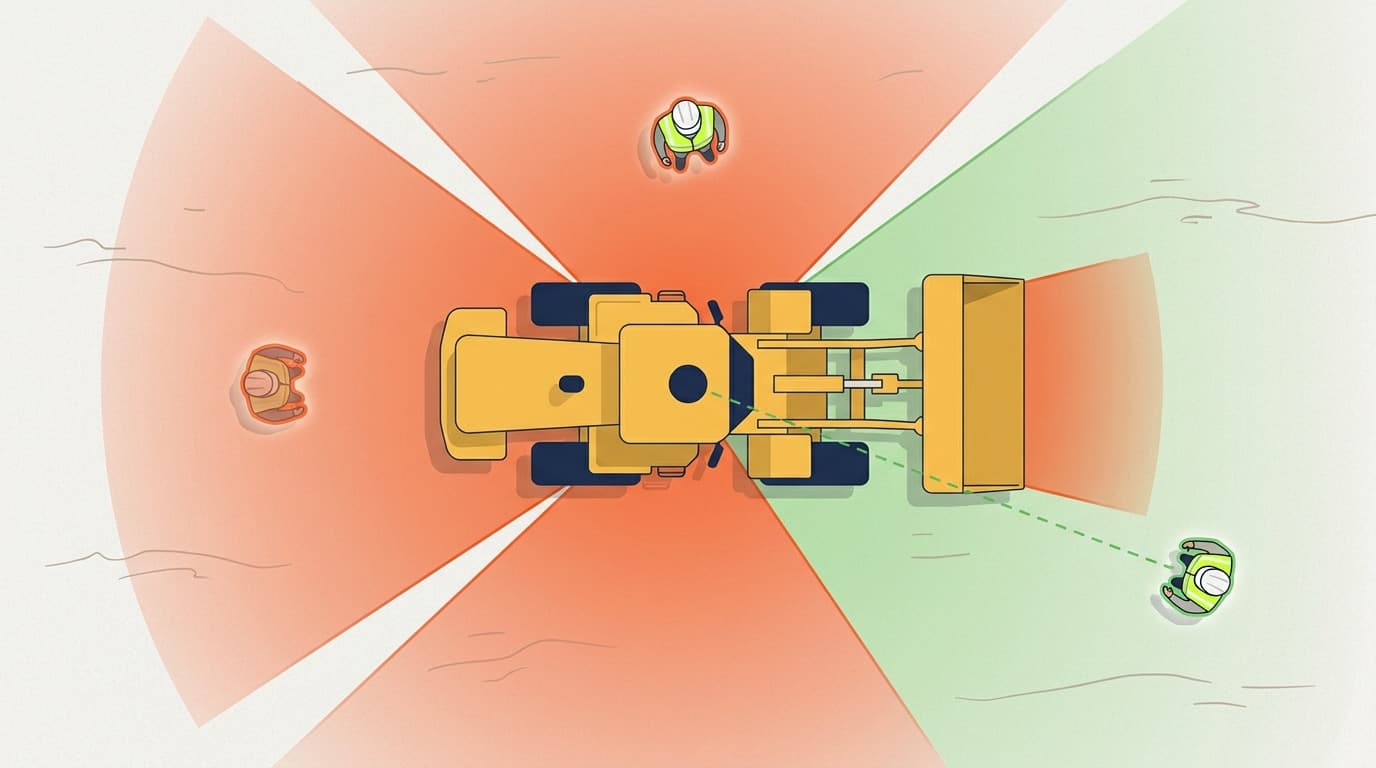
The trigger is an obstructed view to the rear — not the size of the machine. If the operator cannot see behind, the requirement engages.
"Audible above" and "distinguishable from" the surrounding noise level is the actual test — not whether the alarm makes a noise. On a site with breakers, generators and traffic, an alarm that cannot be picked out of the background is not doing the job the standard describes, even though it is working.
The observer option is real, and it is a staffing decision. If you rely on it, someone must be assigned, positioned where they can see and be seen, and understood by the operator. A person who happens to be nearby is not an observer.
The horn rule people forget — 1926.602(a)(9)(i)#
Separate from reversing:
All bidirectional machines, such as rollers, compactors, front-end loaders, bulldozers, and similar equipment, shall be equipped with a horn, distinguishable from the surrounding noise level, which shall be operated as needed when the machine is moving in either direction. The horn shall be maintained in an operative condition.
Note either direction. This is not a reversing provision — it applies to forward travel too, and it makes the horn an active tool the operator is expected to use, not a fitting that merely exists. Rollers and compactors are named specifically, and they are among the machines most often involved in struck-by fatalities precisely because they travel slowly in both directions and people stop noticing them.
Checks, belts and the rest of Subpart O#
Shift-start checks — 1926.601(b)(14). All vehicles in use must be checked at the beginning of each shift to assure that the parts, equipment and accessories listed in the standard are in safe operating condition and free of apparent damage that could cause failure while in use. Defects found must be corrected before the vehicle is placed in service.
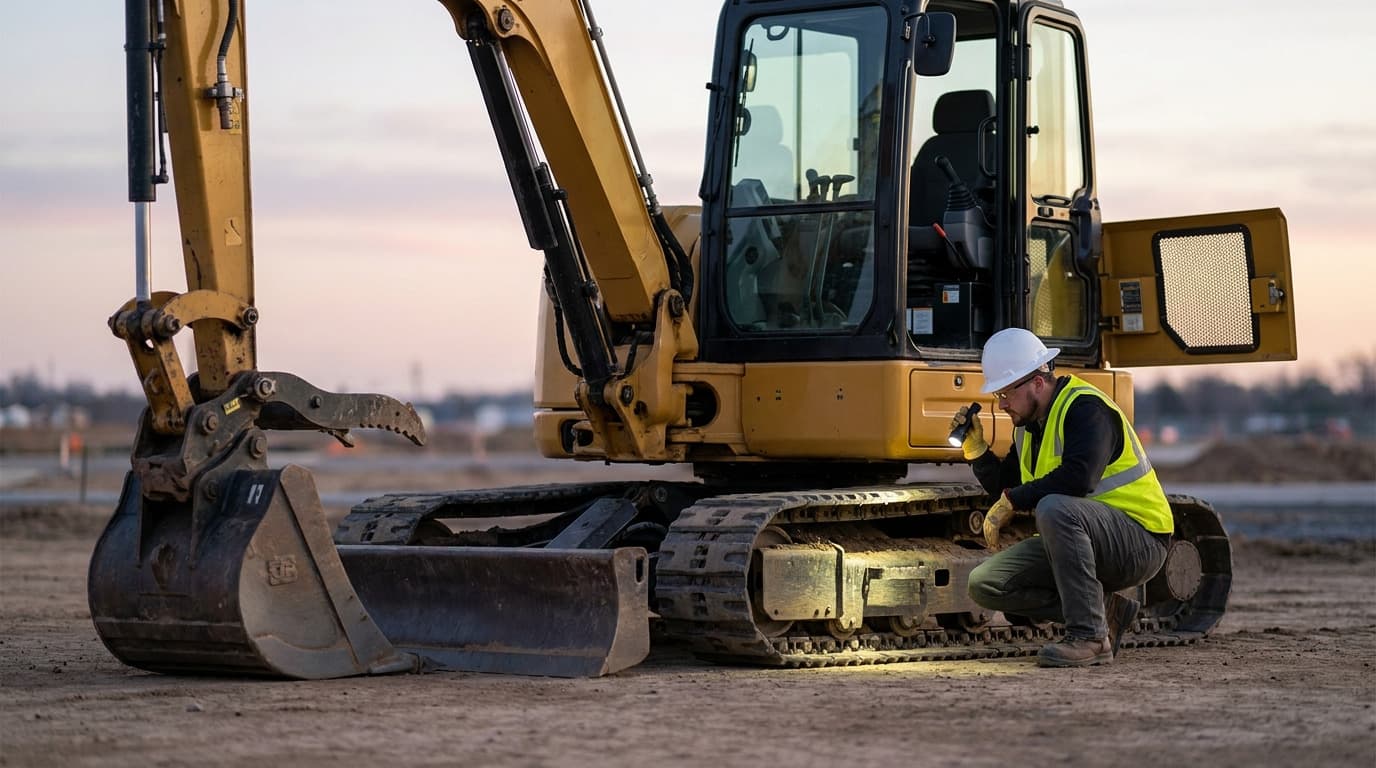
Lights and brakes — 1926.601(b)(1)–(3). A service braking system and a parking brake system, maintained in operable condition. At least two headlights and two taillights whenever visibility conditions warrant additional light. Brake lights in operable condition regardless of light conditions — that phrase catches the daytime argument before it starts. And an adequate audible warning device at the operator's station, in operable condition.
Seat belts — 1926.602(b)(1). Tractors covered by the section shall have seat belts as required for operators when seated in the normal seating arrangement, even though backhoes, breakers or other similar attachments are used on those machines for excavating or other work. The attachment does not change the belt requirement.
Rollover protection — 1926.602(a)(6) points to Subpart W for rollover protective structures and overhead protection. ROPS and the belt work as a system: the structure preserves a survival space, and the belt keeps the operator inside it.
Scissor points — 1926.602(a)(10). Scissor points on all front-end loaders which constitute a hazard to the operator during normal operation shall be guarded.
Runaway control — 1926.602(a)(3)(ii). Every emergency access ramp and berm used by an employer shall be constructed to restrain and control runaway vehicles.
Unattended at night — 1926.600(a)(1). All equipment left unattended at night, adjacent to a highway in normal use or adjacent to construction areas where work is in progress, shall have appropriate lights or reflectors, or barricades equipped with lights or reflectors, to identify the location of the equipment.
What can go wrong?#
Reliance on an alarm nobody can hear above breakers, plant and traffic.
A failed alarm with no observer assigned, so the machine reverses on hope.
An "observer" who is actually just a nearby worker, with no agreed signals and no eye contact.
People walking behind machines because the alarm has become background noise — the psychological failure mode of every audible warning.
The horn treated as a fitting rather than a tool, never used in forward travel.
No shift-start check, or one signed without being done.
Belts unworn because the machine "only moves slowly" on rough or sloping ground.
Ground conditions ignored — edges, soft fill, backfilled trenches and slopes that will not hold the machine.
Equipment left unlit overnight next to a live road or work area.
How do we manage this properly?#
Separate people from machines first. Physical segregation, defined pedestrian routes and exclusion zones do more than any warning device, because they do not depend on anyone hearing anything.
Decide alarm or observer before the shift, and if it is the observer, assign them by name and position them where the operator can see them.
Agree signals and make eye contact the rule. No eye contact, no movement.
Test alarms and horns against the actual site noise, not in the yard on a quiet morning.
Use the horn when moving in either direction, as the standard describes.
Do the shift-start check and fix defects before use, not at the end of the day.
Wear the belt whenever the machine has ROPS, because the two only work together.
Assess the ground — edges, fill, slopes, buried services and the weather since yesterday.
Light or barricade equipment left overnight where it adjoins a road or work area.
Before you start#
- Confirm whether any machine you will work near has an obstructed view to the rear.
- Confirm whether the control is an alarm or an observer, and who that observer is.
- Confirm the alarm is distinguishable above today's site noise, not just working.
- Confirm the shift-start check has been done and defects corrected.
- Confirm pedestrian routes and exclusion zones are physically defined.
- Confirm the operator can see you, and that you have agreed signals.
- Confirm ground conditions where the machine will travel and set up.
- Confirm what happens to the machine overnight — lit, barricaded, secured.
Talk it over#
- Can you hear the reversing alarm from where you are working right now?
- Who is the observer for that machine — by name?
- When did you last walk behind a machine without the operator knowing?
- What is the softest ground that machine will cross today?
The bottom line#
The reversing requirement is an either/or. Under 1926.601(b)(4), motor vehicle equipment with an obstructed view to the rear needs a reverse signal alarm audible above the surrounding noise level or to be backed up only when an observer signals that it is safe; under 1926.602(a)(9)(ii), earthmoving or compacting equipment with an obstructed rear view needs an alarm distinguishable from the surrounding noise level or an employee signalling that it is safe. The test is audibility against site noise, and the observer route is a staffing commitment. Separately, 1926.602(a)(9)(i) requires bidirectional machines — rollers, compactors, front-end loaders, bulldozers — to have a horn, distinguishable from surrounding noise, operated as needed when moving in either direction and maintained operative. 1926.601(b)(14) requires vehicles to be checked at the beginning of each shift; 1926.601(b)(2)(ii) requires brake lights operable regardless of light conditions; 1926.602(b)(1) requires seat belts even where backhoes, breakers or other attachments are fitted; and 1926.600(a)(1) requires equipment left unattended at night beside a highway or work area to carry lights, reflectors or barricades.
Frequently asked questions about heavy equipment#
Is a backup alarm legally required?
Not on its own. 1926.601(b)(4) and 1926.602(a)(9)(ii) both give an either/or: equipment with an obstructed view to the rear must have a reverse signal alarm audible above or distinguishable from the surrounding noise level, or be backed only when an observer or employee signals that it is safe to do so. A failed alarm therefore does not automatically stop the work — but it does commit you to providing a person.
What makes an alarm compliant?
That it can be heard against the site. The standards say audible above the surrounding noise level and distinguishable from the surrounding noise level — so an alarm that functions but cannot be picked out from breakers, generators and traffic is not achieving what the provision requires.
What is the horn requirement?
1926.602(a)(9)(i) requires all bidirectional machines — rollers, compactors, front-end loaders, bulldozers and similar equipment — to be equipped with a horn, distinguishable from the surrounding noise level, which must be operated as needed when the machine is moving in either direction, and maintained in an operative condition. It applies to forward travel as well as reversing.
How often must equipment be inspected?
At the beginning of each shift. 1926.601(b)(14) requires all vehicles in use to be checked at the start of each shift to ensure the specified parts, equipment and accessories are in safe operating condition and free of apparent damage that could cause failure in use, with defects corrected before the vehicle is placed in service.
Do seat belts still apply if the machine has attachments?
Yes. 1926.602(b)(1) requires tractors covered by the section to have seat belts as required for operators when seated in the normal seating arrangement, even though backhoes, breakers or other similar attachments are used for excavating or other work. Fitting an attachment changes nothing about the belt.
What has to happen to equipment left overnight?
It must be identifiable. 1926.600(a)(1) requires all equipment left unattended at night, adjacent to a highway in normal use or adjacent to construction areas where work is in progress, to have appropriate lights or reflectors, or barricades equipped with appropriate lights or reflectors, to identify the location of the equipment.
Why do people still get struck when alarms are fitted?
Because warnings degrade. On a busy site, a reversing alarm sounding all day becomes background noise, and people stop responding to it — which is why physical separation, defined pedestrian routes and exclusion zones protect better than any audible device. The alarm is the last layer, not the first.
Download the heavy equipment toolbox talk PDF#
Get this heavy equipment safety toolbox talk as a print-ready PDF — available in English, Spanish, Portuguese, and Turkish. Print it, hand it to the crew, and collect signatures on the included attendance sheet.
Download the PDF — free account required. New members get 3 free downloads.
Related toolbox talks#
Sources#
- OSHA, 29 CFR 1926.600 — Equipment: https://www.osha.gov/laws-regs/regulations/standardnumber/1926/1926.600
- OSHA, 29 CFR 1926.601 — Motor vehicles: https://www.osha.gov/laws-regs/regulations/standardnumber/1926/1926.601
- OSHA, 29 CFR 1926.602 — Material handling equipment: https://www.osha.gov/laws-regs/regulations/standardnumber/1926/1926.602
Written by FieldSafetyTalk's safety professional — a CSP, ASP, CHST and OSHA Authorized Outreach Trainer with 14+ years of international construction safety experience across federal, heavy civil, and industrial projects.