Floor Openings
Updated 2026-07-24
In this bundle Fall Protection & Heights
Print-ready PDF
Download this talk as a print-ready PDF, available in 4 languages.
Every other fall hazard on this site looks like a fall hazard. An edge is visibly an edge. A leading edge, an open shaft, a roof perimeter — you see them and your body responds before you have finished thinking. A covered floor opening looks like floor. That is the entire problem, and it is why this hazard kills people who were being careful. This floor openings talk is about the hole you cannot see because somebody put a piece of plywood over it.
Here is the distinction that carries this whole talk: with an unprotected edge, the danger is that the protection is missing and you can tell. With a floor opening, the danger is that the protection is present but wrong — a sheet of ply that was never secured, never marked, and never rated for anything. It does not look like a missing control. It looks like a solved problem. A worker walks across it with full confidence, because everything visible says the hole has been dealt with.
What counts as a floor opening under OSHA?#
The definition is far broader than most crews assume. Under 29 CFR 1926.500(b), a hole is:
a gap or void 2 inches or more in its least dimension, in a floor, roof, or other walking/working surface.
Two inches. Not a person-sized opening — two inches. That definition captures core-drilled penetrations, gaps at deck edges, missing floor panels, conduit sleeves, and voids left by removed equipment. The standard is written that way because a 2-inch gap will catch a heel or a toe, and because holes get bigger as work proceeds.
The requirements that follow from it:
- Duty to protect — 1926.501(b)(4)(i). Each employee on a walking or working surface must be protected from falling through holes — including skylights — more than 6 feet above lower levels, by personal fall arrest systems, covers, or guardrail systems erected around the hole.
- Protection from objects — 1926.501(b)(4)(iii). Employees must be protected from objects falling through holes, by covers.
- Cover strength, general — 1926.502(i)(2). Covers must support, without failure, at least twice the weight of employees, equipment, and materials that may be imposed on the cover at any one time.
- Cover strength, roadways — 1926.502(i)(1). Covers in roadways and vehicular aisles must support at least twice the maximum axle load of the largest vehicle expected to cross them.
- Securing — 1926.502(i)(3). All covers must be secured when installed to prevent accidental displacement by wind, equipment, or employees.
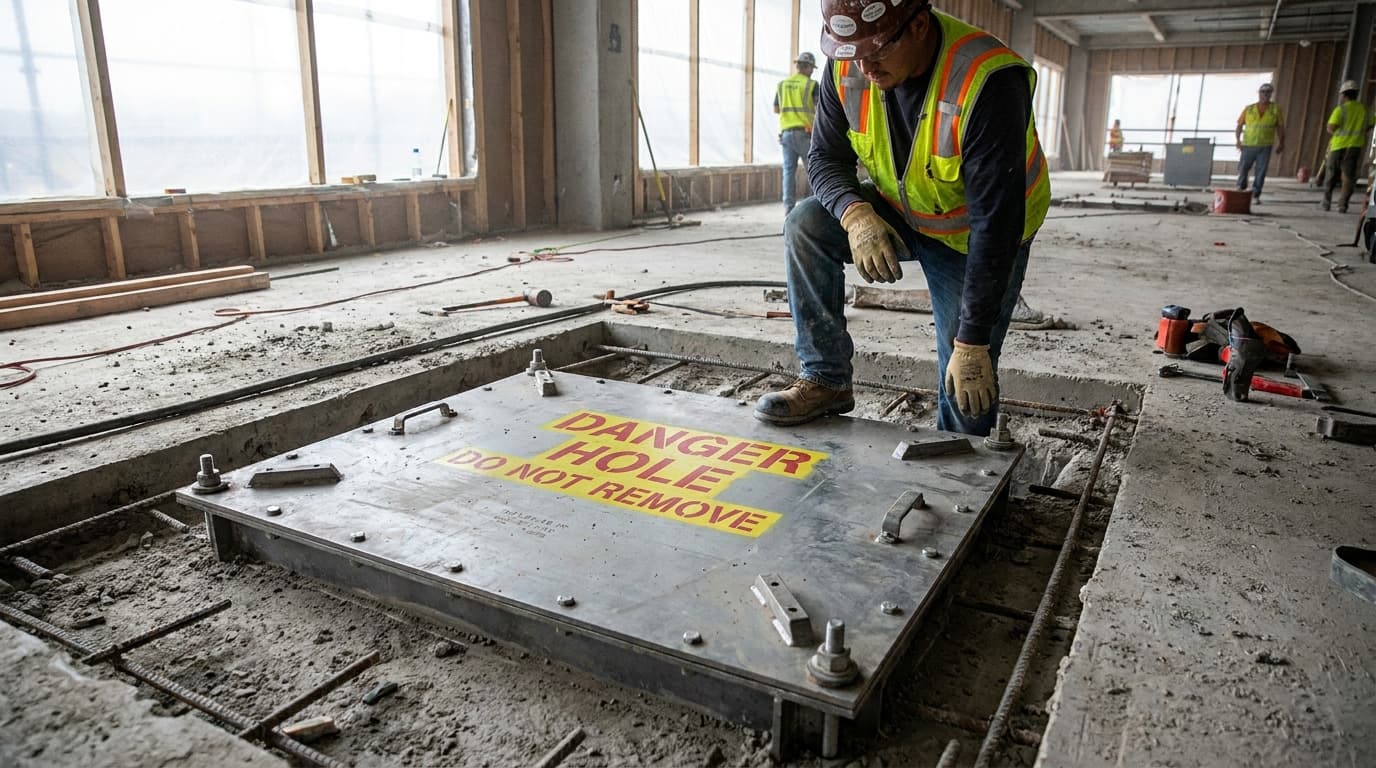
- Marking — 1926.502(i)(4). All covers must be colour-coded, or marked with the word "HOLE" or "COVER" to warn of the hazard.
Two OSHA interpretation letters are worth knowing. In 2007, OSHA confirmed that where a skylight is used to satisfy the hole protection requirement, it must meet the 1926.502(i)(2) strength criterion — most skylights do not. And in 2010, OSHA clarified that a small manhole cover, which bears only a fraction of an axle load, falls under the general twice-the-imposed-weight rule rather than the roadway axle rule.
On steel erection work, 1926.754(e)(3) applies the same twice-the-weight, secured, and marked requirements to roof and floor openings.
On USACE and NAVFAC projects, EM 385-1-1 applies and is more restrictive in several places.
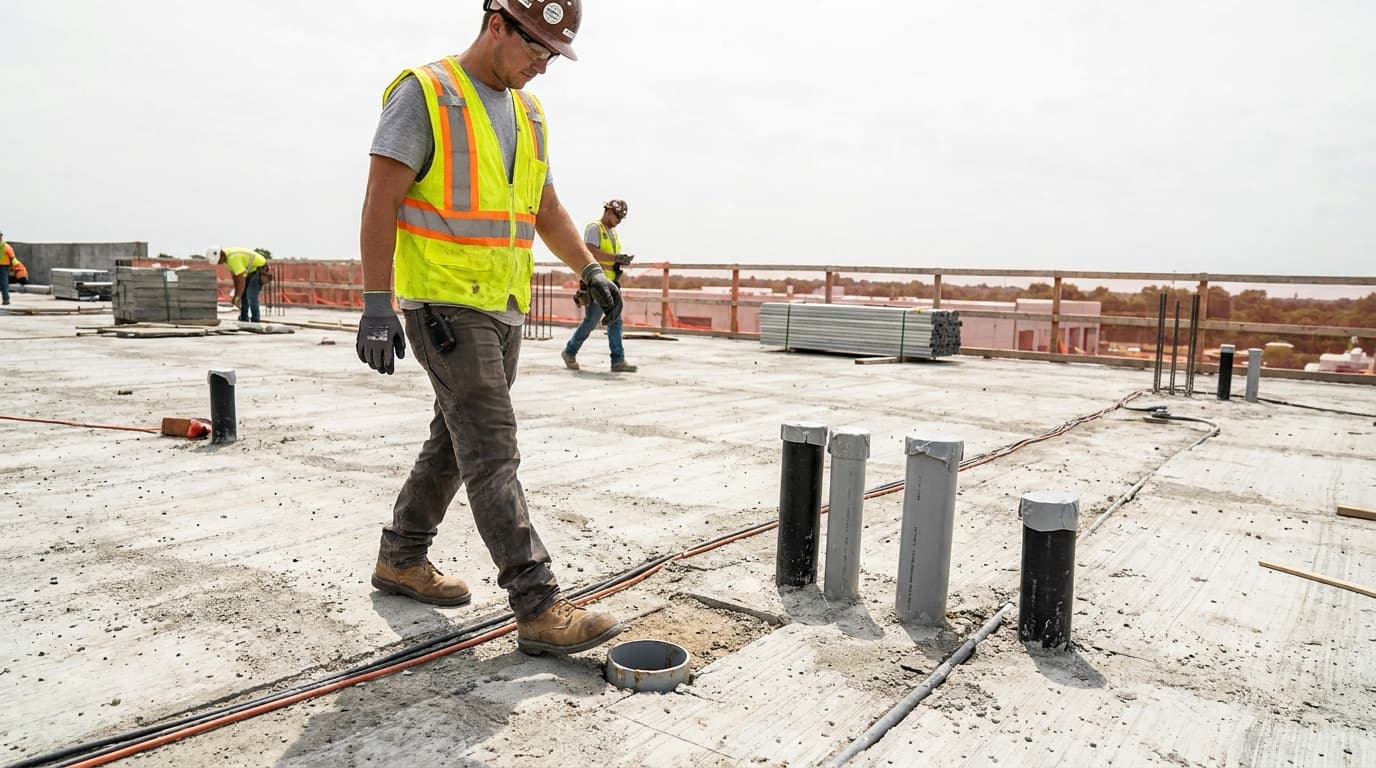
What can go wrong with a floor opening?#
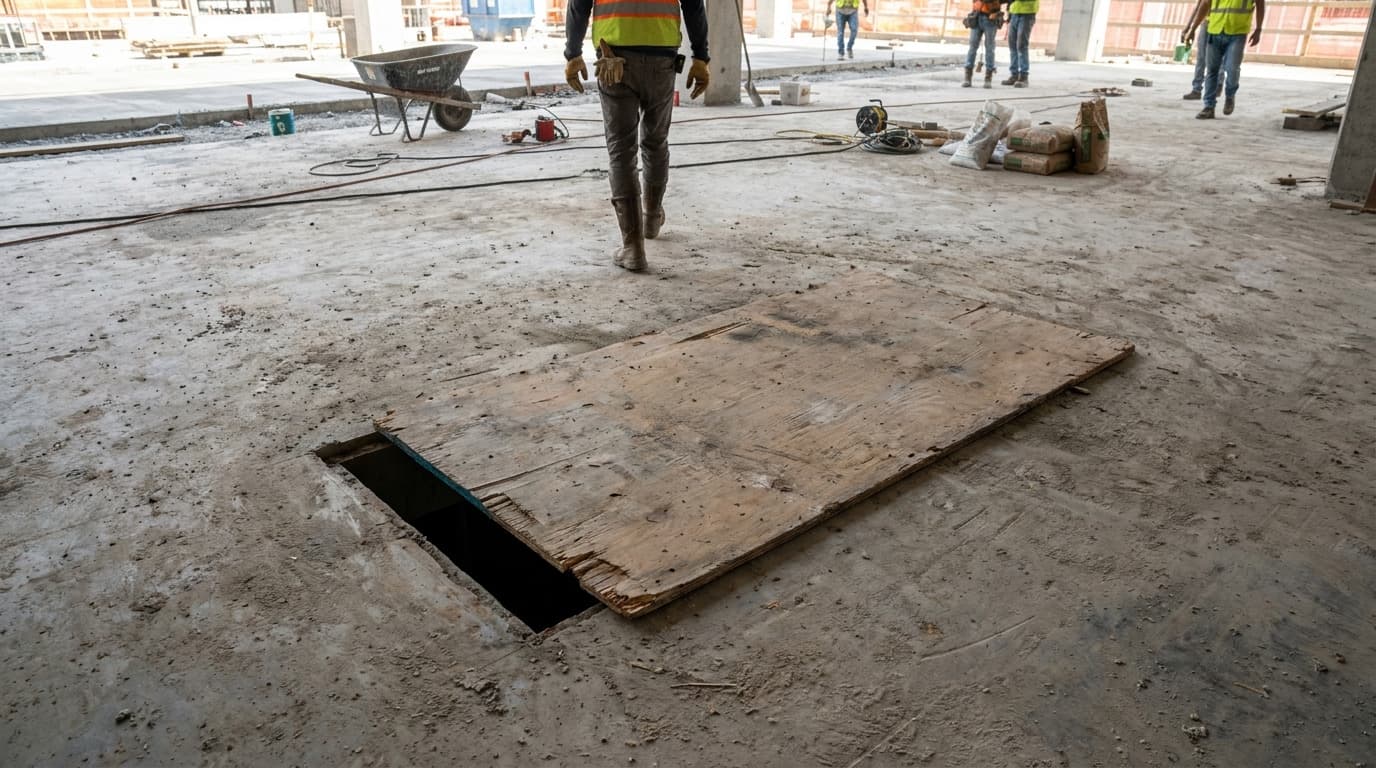
A cover that was never rated for anything. A scrap of plywood, a sheet of OSB, or a piece of form ply laid over a penetration. It holds until someone stands on the unsupported middle, or until a wheel crosses it.
A cover that was never secured. This is the most common failure. An unsecured cover slides when stepped on near the edge, gets kicked aside, blows away, or is moved by a wheelbarrow and never replaced. Under 1926.502(i)(3), securing is not optional.
A cover that was never marked. Nothing distinguishes a hole cover from a piece of scrap material staged on the deck. So somebody picks it up to use it, or moves it out of the way, and the hole is now open and invisible.
A skylight treated as a surface. Skylights look structural and are not. Workers walk on them, kneel on them, and place material on them. Under OSHA's interpretation, a skylight only satisfies the hole requirement if it meets the twice-the-weight criterion — which most do not.
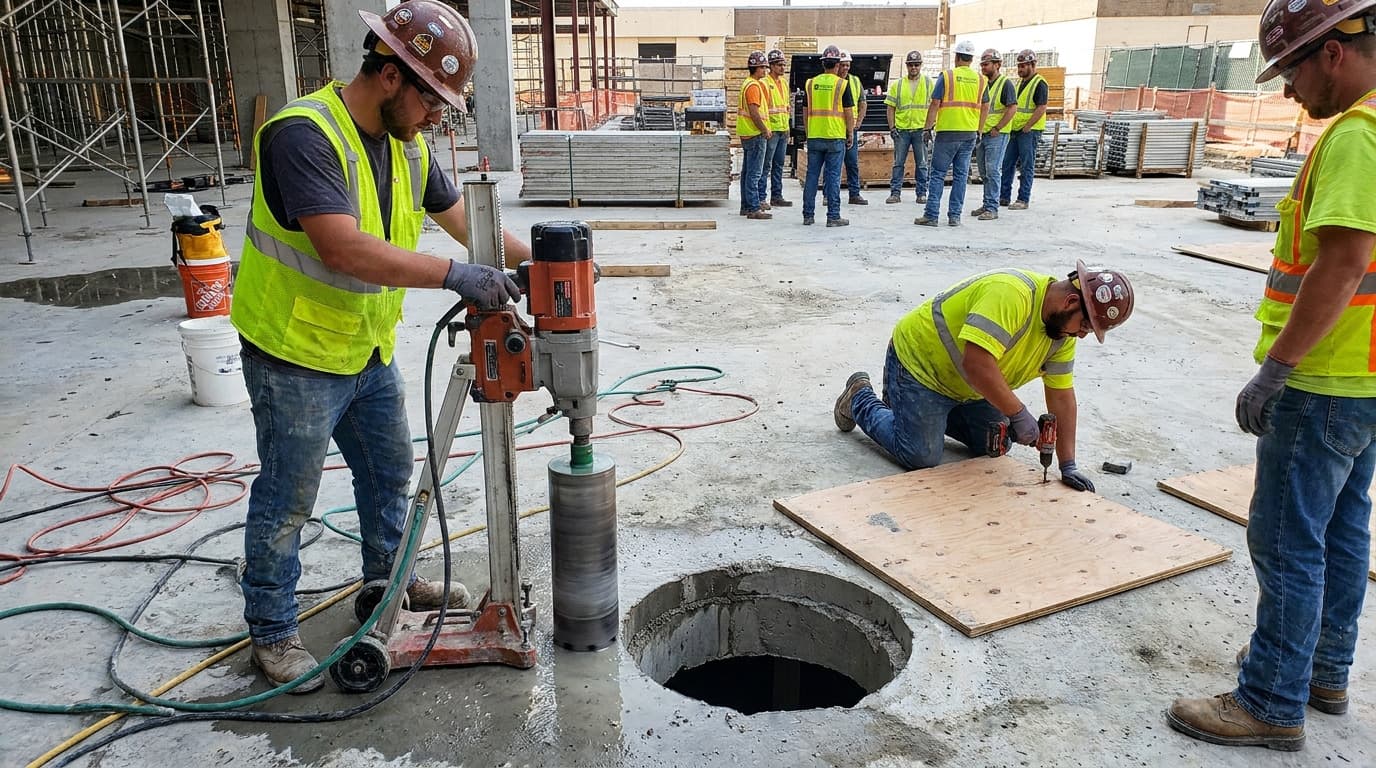
Holes created mid-shift with no protection ready. Core drilling, saw cutting, and demolition all create openings. The gap between "hole exists" and "hole is covered" is where people fall through, and it is frequently unsupervised because the crew that made the hole has moved on.
A cover with material stacked on it. The cover was adequate for a person. It was not adequate for a person plus 400 pounds of block.
Small openings ignored entirely. Anything under about a foot gets treated as not a real hazard, when the standard captures anything 2 inches or more. Those are the ones that break ankles and drop tools onto the crew below.
Openings left over a shift change. The person who created the hole is gone, the covering was temporary, and the incoming crew has no way to know which sheets on that deck are covers and which are material.
How do we control floor openings?#
Cover it, guard it, or arrest the fall — pick one before the hole exists. Under 1926.501(b)(4), the options are covers, guardrails around the opening, or personal fall arrest. Decide which before the drill goes in, not after.
Build covers to the standard, not from what is nearby:
- Rated to support at least twice the weight of workers, equipment, and material that could be on it
- Twice the maximum axle load where vehicles cross
- Made of material with a known capacity — not scrap ply, not OSB offcuts
Secure every cover. Screwed, cleated, bolted, or otherwise fixed so wind, a wheelbarrow, or a boot cannot displace it. A cover that can slide is a hole with a lid on it.
Mark every cover. Colour-coded, or the word "HOLE" or "COVER" written on it in a way that survives site conditions. This is what stops the next crew from picking it up.
Treat skylights as holes, not surfaces. Screen them, guard them, or cover them to the strength requirement. Never walk on, kneel on, or stack material on a skylight, and never assume it will hold.
Close the gap between creating and protecting. Whoever makes the hole owns covering it before leaving the area. If the cover is not ready, the opening gets barricaded and someone stays with it. The hole and the protection arrive together.
Check covers as part of the daily walk. Present, secured, marked, undamaged, and nothing stacked on top. Covers degrade — plywood softens when wet, fixings work loose, and marking wears off.
Never move a cover without owning the hole. If you must lift a cover to run a service through it, you own the opening until it is covered again. Barricade it while it is open, and do not leave the area with it uncovered.
Report an unmarked sheet rather than assuming. A piece of ply lying on a deck is either material or a cover, and the difference matters enormously. If you cannot tell, treat it as a cover and find out.
Before you start#
- Walk your work area and identify every penetration, gap, and void 2 inches or larger.
- For each one, confirm which control applies: cover, guardrail, or fall arrest.
- Check every cover for the three requirements — rated strength, secured, and marked.
- Push a covered opening with your foot near the edge. Does it move?
- Confirm nothing is stacked on any cover.
- Identify any skylight in your area and confirm it is guarded, screened, or covered.
- If your task will create an opening, confirm the cover or barricade is on site before you start.
- Confirm you know who to tell if you find an unmarked or unsecured cover.
- Check whether anyone is working below any opening in your area.
Talk it over#
- Point to every hole on this deck. How many did you know about before I asked?
- Is there a sheet of ply anywhere here that you cannot say for certain is a cover or material?
- If you core a hole this afternoon and get pulled to another task, what happens to that opening?
The bottom line#
A covered floor opening is the only fall hazard that looks like solid ground, which is why it catches people who were paying attention. OSHA defines a hole as anything 2 inches or more — far smaller than most crews assume — and requires covers to hold twice the imposed weight, be secured against displacement, and be marked "HOLE" or "COVER". Most failures are the second and third of those. Whoever makes the hole owns covering it before they leave, and an unmarked sheet of plywood on a deck should be treated as a hole until proven otherwise.
Frequently asked questions about floor openings#
What does OSHA define as a hole?
Under 29 CFR 1926.500(b), a hole is a gap or void 2 inches or more in its least dimension in a floor, roof, or other walking or working surface. That is much smaller than most workers expect, and it captures core-drilled penetrations, deck gaps, and conduit sleeves — not just person-sized openings.
How strong must a hole cover be?
Under 29 CFR 1926.502(i)(2), covers must support without failure at least twice the weight of employees, equipment, and materials that may be on the cover at any one time. Covers in roadways and vehicular aisles must support at least twice the maximum axle load of the largest vehicle expected to cross them, under 1926.502(i)(1).
Do hole covers have to be marked?
Yes. 29 CFR 1926.502(i)(4) requires all covers to be colour-coded or marked with the word "HOLE" or "COVER" to warn of the hazard. This is what prevents the next crew from mistaking a cover for scrap material and moving it.
Do covers have to be secured?
Yes. Under 29 CFR 1926.502(i)(3), all covers must be secured when installed to prevent accidental displacement by wind, equipment, or employees. An unsecured cover slides when stepped on near its edge, which is one of the most common ways workers fall through a "covered" hole.
Is a skylight a hole?
Yes. 29 CFR 1926.501(b)(4)(i) explicitly includes skylights among the holes workers must be protected from. OSHA has confirmed that a skylight only satisfies the cover requirement if it meets the strength criterion in 1926.502(i)(2) — twice the imposed weight. Most skylights do not, so they must be guarded, screened, or covered.
At what height does hole protection become required?
Protection from falling through a hole is required where the hole is more than 6 feet above a lower level, under 1926.501(b)(4)(i). But protection from objects falling through holes is required regardless of height under 1926.501(b)(4)(iii), and a 2-inch hole at ground level is still a trip hazard.
Download the floor openings toolbox talk PDF#
Get this floor openings toolbox talk as a print-ready PDF — available in English, Spanish, Portuguese, and Turkish. Print it, hand it to the crew, and collect signatures on the included attendance sheet.
Download the PDF — free account required. New members get 3 free downloads.
Related toolbox talks#
Sources#
- OSHA, 29 CFR 1926.502 — Fall protection systems criteria and practices: https://www.osha.gov/laws-regs/regulations/standardnumber/1926/1926.502
- OSHA, 29 CFR 1926.500 — Scope, application, and definitions: https://www.osha.gov/laws-regs/regulations/standardnumber/1926/1926.500
- OSHA, Standard Interpretation: whether certain skylights meet the cover criteria of 1926 Subpart M, 20 December 2007: https://www.osha.gov/laws-regs/standardinterpretations/2007-12-20
- OSHA, Standard Interpretation: manhole cover axle load requirements, 6 April 2010: https://www.osha.gov/laws-regs/standardinterpretations/2010-04-06