Welding Safety
Updated 2026-07-24
In this bundle Fire, Hot Work & Emergency
Print-ready PDF
Download this talk as a print-ready PDF, available in 4 languages.
There is a multiplier written into the construction standard that most welders have never seen, and it is not a rule — it is a warning about physics. OSHA states that the inert-gas metal-arc process produces ultraviolet radiation at intensities of 5 to 30 times that produced during shielded metal-arc welding. Not slightly more. Up to thirty times. This welding safety talk is about what that arc does to the people near it — and to the chemicals near it.
Here is the distinction that carries this whole talk. Fire prevention and permits are covered elsewhere in this bundle. This one is about the hazards that reach the welder and the person walking past: radiation that burns eyes and skin at a distance, fume from whatever the metal is coated with, and a welding circuit that is live in ways ordinary tools are not.
The number OSHA put in the regulation#
29 CFR 1926.353(d) opens with an explanation rather than a command, which is unusual for a standard and tells you the agency wanted the reasoning understood:
Since the inert-gas metal-arc welding process involves the production of ultra-violet radiation of intensities of 5 to 30 times that produced during shielded metal-arc welding, the decomposition of chlorinated solvents by ultraviolet rays, and the liberation of toxic fumes and gases, employees shall not be permitted to engage in, or be exposed to the process until the following special precautions have been taken…
Three separate hazards in one sentence, and the crew usually knows about none of them.
First — the radiation reaches people who are not welding. UV does not care that you are only walking past. Arc eye is a burn to the surface of the eye, and it arrives hours after the exposure, typically in the middle of the night. The person who gets it is very often not the welder — the welder had a helmet on.
Second — chlorinated solvents. This is the requirement that surprises everyone: 1926.353(d)(1)(i) requires that the use of chlorinated solvents be kept at least 200 feet (61 m), unless shielded, from the exposed arc, and that surfaces prepared with chlorinated solvents be thoroughly dry before welding on them. Two hundred feet. The reason is in the opening sentence — UV decomposes those solvents, and the standard describes the result as the liberation of toxic fumes and gases. On a jobsite the source is rarely a labelled drum. It is degreaser, brake cleaner, or a parts-cleaning aerosol that somebody used on the workpiece twenty minutes ago.
Third — the fume depends on what the metal is wearing, which the next section covers.
Goggles under the helmet#
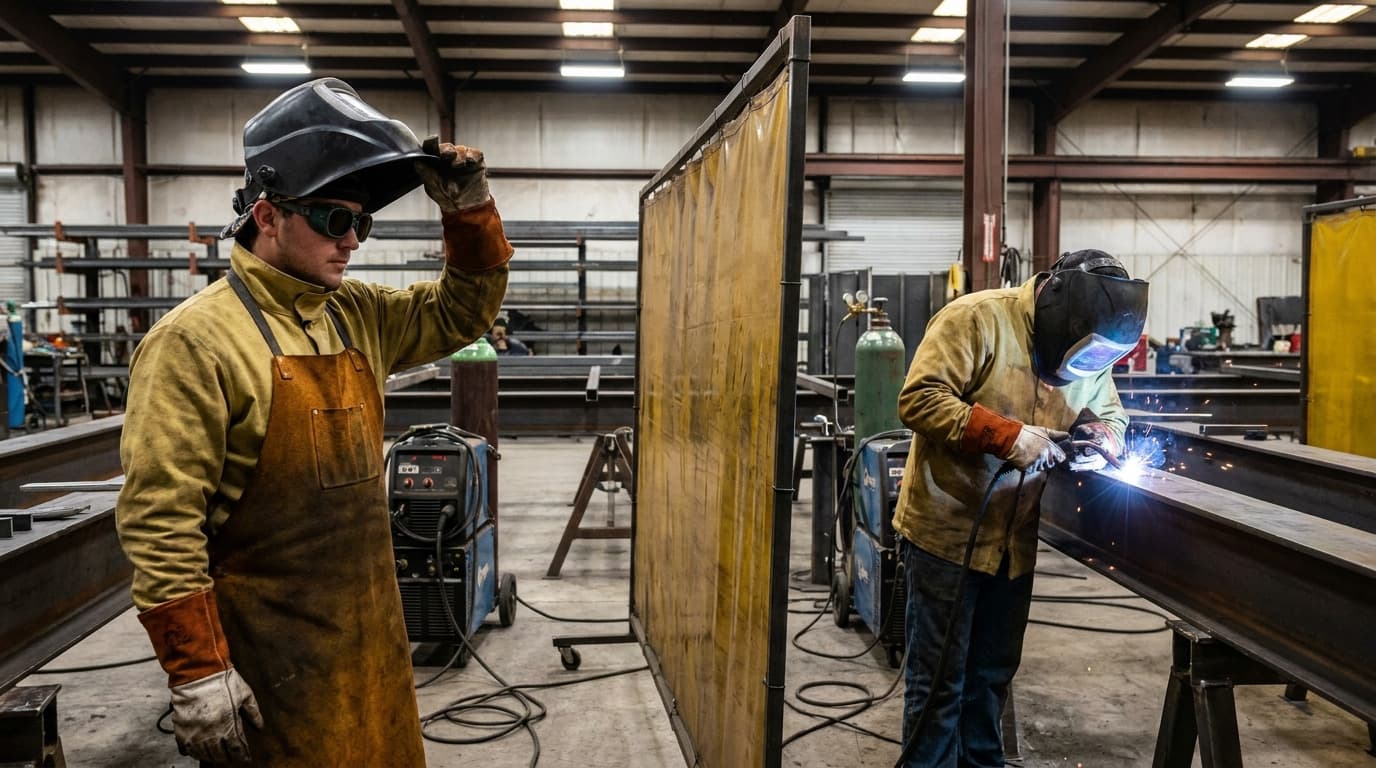
1926.353(d)(1)(ii) contains an instruction almost nobody follows: employees in the area not protected from the arc by screening shall be protected by filter lenses — and when two or more welders are exposed to each other's arc, filter lens goggles of a suitable type shall be worn under welding helmets.
Under the helmet. Because your own helmet protects you from your own arc, and does nothing at the moment you lift it while the welder beside you is still burning. That lift is when arc eye happens.
The same paragraph adds two more details worth knowing:
- 1926.353(d)(1)(iii) — welders and others exposed to radiation shall be protected so that the skin is covered completely to prevent burns and other damage by ultraviolet rays. UV burns exposed forearms and necks the way strong sun does, and welders often notice it only the following day.
- Helmets and hand shields shall be free of leaks and openings, and free of highly reflective surfaces. The reflective part is the subtle one — a bright surface near an arc becomes a second source, which is why bare stainless and polished panels around a welding position matter.
Fume: it is about the coating, not the steel#
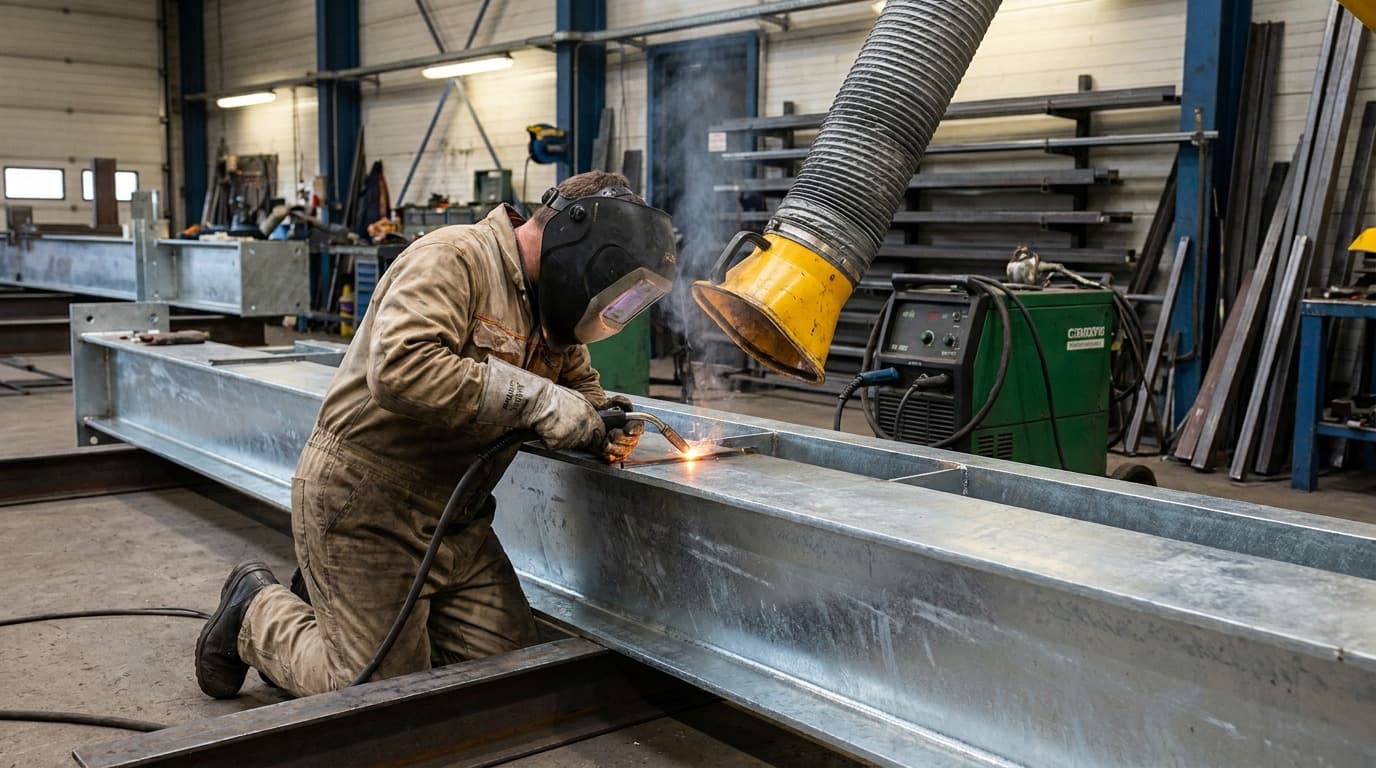
1926.353(c) deals with metals of toxic significance, and the list is a list of things found on ordinary construction steel: zinc-bearing base or filler metals or coatings (galvanised), lead base metals, cadmium-bearing filler materials, and chromium-bearing metals. Galvanised steel is the everyday one — welding it releases zinc oxide fume, which is the classic cause of metal fume fever.
The standard's approach is ventilation first. 1926.353(a) sets mechanical ventilation requirements for welding in confined or restricted spaces, and 1926.353(b) deals with welding, cutting and heating in confined spaces specifically. Where inert-gas metal-arc welding is performed on stainless steel, 1926.353(d)(1)(iv) requires the (c)(2) provisions to be met to protect against dangerous concentrations of nitrogen dioxide.
The practical rule that follows from all of it: know what the metal is coated with before you strike an arc, and get the fume away from the breathing zone rather than relying on the helmet, which is not respiratory protection.
The circuit is live in ways your tools are not#
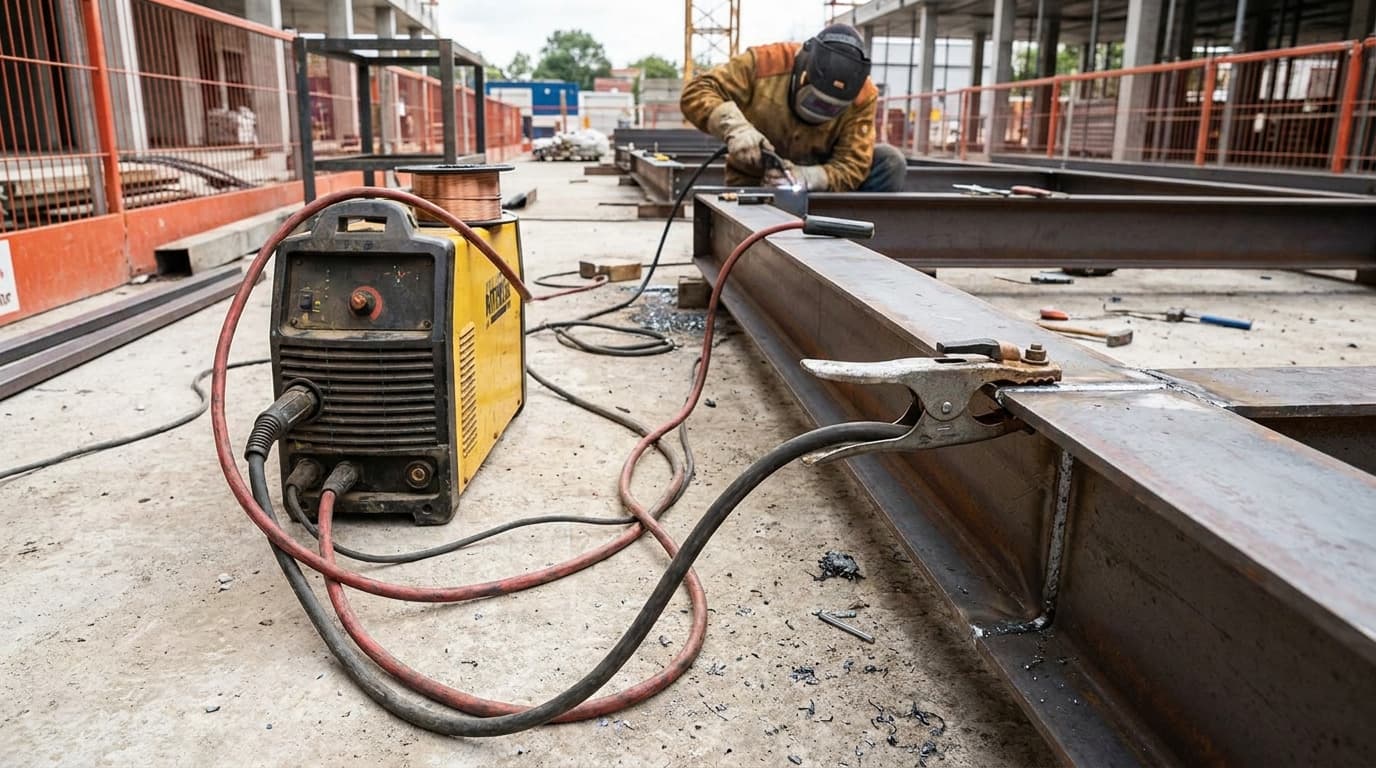
Arc welding equipment is governed by 29 CFR 1926.351, and the parts crews break most often are the simple ones:
- Cables and holders. Cables must be completely insulated and capable of handling the current; cables with damaged insulation or exposed conductors must be replaced, not taped. Holder jaws and the gripped portion must be fully insulated.
- Unattended holders. When electrode holders are to be left unattended, the electrodes shall be removed and the holders placed so employees cannot contact them.
- Never dip a hot holder in water.
- Leaving the work or moving the machine. When the welder leaves the work or stops for any appreciable length of time, or when the machine is to be moved, the power supply switch shall be opened.
- Ground return. The work lead is part of the circuit. Using the structure, scaffold, or piping as a return path puts current through everything it touches, including bearings, rigging, and other trades' equipment.
Add the conditions that make the same voltage far more dangerous: sweat, rain, standing in water, working inside a vessel or on a steel deck, and cramped positions where the body bridges the circuit.
On USACE and NAVFAC projects, EM 385-1-1 applies and is more prescriptive on welding operations, ventilation, and screening.
What can go wrong#
Arc eye in someone who was not welding. Passers-by, labourers, and the person who lifted their hood while the next bay was burning.
Chlorinated solvent near the arc. Brake cleaner or degreaser used on the workpiece, or an open container within the 200-foot radius.
Welding a coated surface without knowing the coating. Galvanising, primer, paint, plating, or cadmium fasteners.
Helmet used as respiratory protection. It is not, and never was.
No screening. Nothing between the arc and the rest of the site.
Reflective surfaces around the position. Bare stainless, polished panels, light-coloured walls turning one arc into several.
Skin exposed. Open collars, rolled sleeves, gaps at the wrist and neck.
Wrong or damaged filter lens. Shade too light for the process and current, cracked lens, or a helmet with a leak.
Damaged cable taped rather than replaced.
Work lead clamped anywhere convenient, sending return current through the structure.
Welding in wet conditions or inside a vessel without additional precautions.
Confined space treated as ordinary welding — the fume and gas hazard changes completely.
How do we control it?#
Identify the metal and its coating before striking an arc. Galvanised, painted, plated, or unknown means the fume plan changes before the work starts.
Sweep the area for chlorinated solvents. Degreasers, brake cleaners, parts washers, and anything used to prepare the surface. Keep them the required distance, or shielded, and make sure prepared surfaces are thoroughly dry.
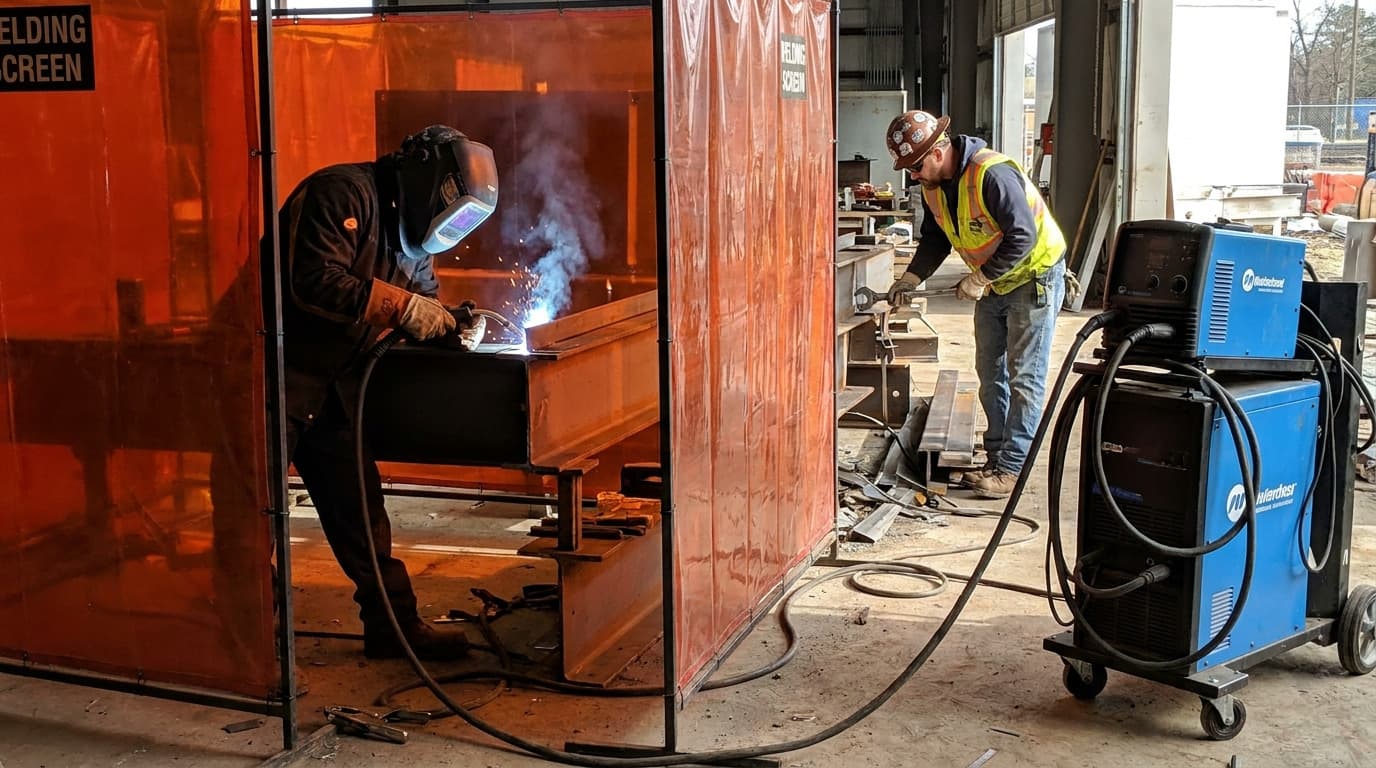
Screen the arc. Portable screens or curtains around the position, so the radiation stops at the boundary rather than at somebody's cornea.
Wear goggles under the helmet where more than one arc is running, and issue them to anyone working near.
Cover the skin completely. Collar up, sleeves down, gloves overlapping cuffs, no gap at the neck.
Check the helmet for leaks, cracks, and openings, and use the right shade for the process and current — a shade that is too light is a slow injury rather than an obvious one.
Ventilate at the source. Local exhaust close to the arc beats general ventilation, and neither is optional in confined or restricted spaces.
Inspect cables and holders every shift. Replace damaged insulation; do not tape it.
Clamp the work lead to the workpiece, as close to the weld as practical — not to the structure at large.
Open the power supply switch when leaving the work or moving the machine, and remove electrodes from unattended holders.
Treat confined space welding as a separate operation with its own controls and its own authorisation.
Before you start#
- Confirm what the metal is and what it is coated with.
- Sweep for chlorinated solvents — degreasers, brake cleaner, parts washer — and clear or shield them.
- Confirm any surface prepared with solvent is thoroughly dry.
- Put screens up so the arc is not visible to the rest of the site.
- Confirm anyone near the arc has eye protection, and goggles under the helmet where arcs overlap.
- Check skin is fully covered — neck, wrists, forearms.
- Inspect the helmet for leaks, cracks, and the correct filter shade.
- Inspect cables and the holder for damaged insulation.
- Clamp the work lead to the workpiece, not the structure.
- Confirm ventilation at the arc, and treat any confined space as a separate operation.
Talk it over#
- Who else can see your arc from where they are working right now?
- What was used to clean that workpiece, and is the container still nearby?
- If you lift your hood while the welder next to you is still going, what protects your eyes?
The bottom line#
OSHA wrote the reasoning into the regulation: the inert-gas metal-arc process produces UV at 5 to 30 times the intensity of shielded metal-arc welding, decomposes chlorinated solvents, and liberates toxic fumes and gases — 1926.353(d). So keep chlorinated solvents at least 200 feet (61 m) from the exposed arc unless shielded, and make sure solvent-prepared surfaces are thoroughly dry. Screen the arc so the radiation stops before it reaches passers-by, wear goggles under the helmet where two or more arcs are running, and cover the skin completely. Know what the metal is coated with before you strike, ventilate at the source rather than trusting the helmet, and treat the welding circuit as live — cables replaced not taped, work lead on the workpiece, switch opened when you walk away.
Frequently asked questions about welding safety#
How much more UV does MIG or TIG produce than stick welding?
OSHA states it in the regulation. 29 CFR 1926.353(d) describes the inert-gas metal-arc welding process as producing ultra-violet radiation of intensities of 5 to 30 times that produced during shielded metal-arc welding. The same sentence also cites the decomposition of chlorinated solvents by ultraviolet rays and the liberation of toxic fumes and gases as reasons for the special precautions that follow.
Why must chlorinated solvents be 200 feet from the arc?
Because ultraviolet radiation from the arc decomposes them, and the standard describes the result as the liberation of toxic fumes and gases. 1926.353(d)(1)(i) requires the use of chlorinated solvents to be kept at least 200 feet (61 m), unless shielded, from the exposed arc, and requires that surfaces prepared with chlorinated solvents be thoroughly dry before welding is permitted on them. On site the usual source is degreaser, brake cleaner, or a parts-cleaning aerosol used on the workpiece.
Do I need goggles under a welding helmet?
Where arcs overlap, yes. 1926.353(d)(1)(ii) provides that when two or more welders are exposed to each other's arc, filter lens goggles of a suitable type shall be worn under welding helmets. Your own helmet protects you from your own arc but does nothing in the moment you lift it while a neighbouring arc is still running — which is when arc eye is typically taken.
Does a welding helmet protect against fume?
No. A helmet is eye and face protection against radiation, spatter and heat. It provides no respiratory protection. Fume control is a ventilation question under 1926.353(a) and (b), with respiratory protection where ventilation is not sufficient — particularly for the metals of toxic significance named in 1926.353(c).
Which metals and coatings need extra precautions?
1926.353(c) identifies metals of toxic significance including zinc-bearing base or filler metals or coatings (galvanised), lead base metals, cadmium-bearing filler materials, and chromium-bearing metals. Where inert-gas metal-arc welding is performed on stainless steel, 1926.353(d)(1)(iv) requires the (c)(2) provisions to be met to protect against dangerous concentrations of nitrogen dioxide.
Why does the standard mention reflective surfaces?
Because they turn one arc into several. 1926.353(d)(1)(iii) requires that welding helmets and hand shields be free of leaks and openings, and free of highly reflective surfaces. The same logic applies to the work area — bare stainless, polished panels and light-coloured surfaces near a welding position redirect ultraviolet radiation towards people who believe they are out of the line of sight.
What are the main electrical rules for arc welding?
Under 29 CFR 1926.351, cables must be completely insulated and adequate for the current, and cables with damaged insulation or exposed conductors must be replaced rather than repaired with tape; holders must be fully insulated where gripped; electrodes must be removed from unattended holders; hot holders must not be dipped in water; and the power supply switch must be opened when the welder leaves the work for any appreciable time or the machine is moved.
Download the welding safety toolbox talk PDF#
Get this welding safety toolbox talk as a print-ready PDF — available in English, Spanish, Portuguese, and Turkish. Print it, hand it to the crew, and collect signatures on the included attendance sheet.
Download the PDF — free account required. New members get 3 free downloads.
Related toolbox talks#
Sources#
- OSHA, 29 CFR 1926.353 — Ventilation and protection in welding, cutting, and heating: https://www.osha.gov/laws-regs/regulations/standardnumber/1926/1926.353
- OSHA, 29 CFR 1926.351 — Arc welding and cutting: https://www.osha.gov/laws-regs/regulations/standardnumber/1926/1926.351
- OSHA, 29 CFR 1926.102 — Eye and face protection: https://www.osha.gov/laws-regs/regulations/standardnumber/1926/1926.102