Pesticide and Herbicide
Updated 2026-08-06
In this bundle Health & Environmental Exposure
Print-ready PDF
Download this talk as a print-ready PDF, available in 4 languages.
Pesticides and herbicides show up on more sites than people expect — vegetation control along fence lines and rights-of-way, weed abatement before earthwork, termite and rodent treatment around structures, and the routine landscaping that keeps a finished site presentable. They are handled casually because they are sold over a counter and sprayed from a backpack, and that casual familiarity is the problem. This Pesticide and Herbicide Toolbox Talk (Safety Talk / Tailgate Talk) is about the one thing that makes these chemicals different from almost everything else in the gang box: the rules that govern them are not advice.
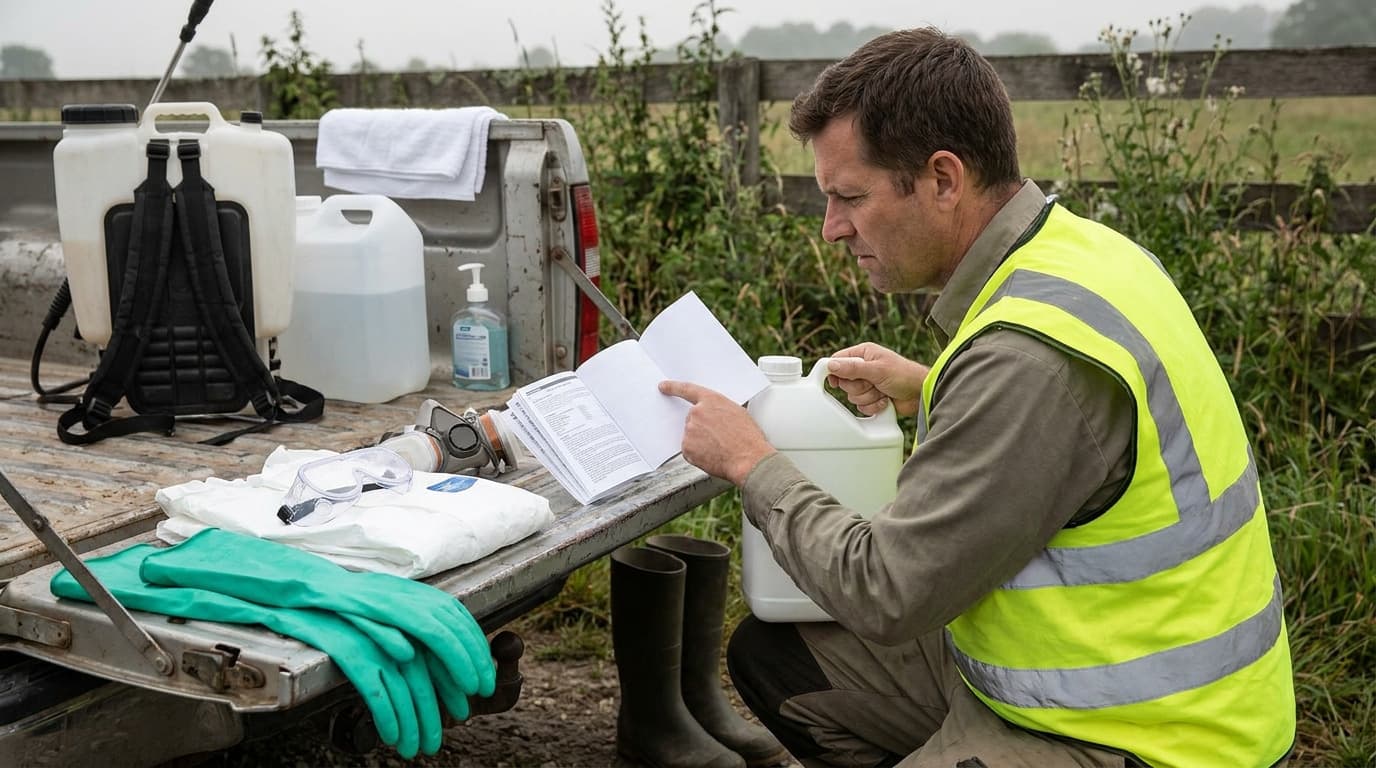
Here is the distinction that carries this whole talk: for a pesticide, the label is not guidance — it is federal law. Under FIFRA, the federal pesticide statute, it is a violation to use a pesticide in a manner inconsistent with its labeling. That flips the usual relationship you have with a chemical container. An ordinary product's safety data sheet informs you — it tells you what the hazards are and lets you decide how to work safely. A pesticide label commands you — the personal protective equipment it lists, the application rate it sets, the sites it permits, and the time it makes you wait before re-entering a treated area are all legally binding. Reading the label is not diligence on a pesticide; it is the law, and doing anything the label does not authorize is an offense in itself.
Where the boundary of this talk sits#
The hazard communication talk owns the SDS and the general label-and-pictogram system for all workplace chemicals; the chemical labeling talk owns labeling practice; the spill response talk owns a failed container; the skin, respiratory, and PPE talks own those exposure routes and controls. This talk owns pesticides and herbicides specifically — why their label is legally binding under FIFRA, the Worker Protection Standard that protects the people who apply and re-enter, the restricted-entry interval, and the split between handlers and workers. Where a generic SDS, a spill, or a respirator is the question, those talks own it; this one owns the pesticide label as a legal instrument and the field it was sprayed on.
The label is the law: what FIFRA actually means#
FIFRA — the Federal Insecticide, Fungicide, and Rodenticide Act — is the statute the EPA administers to register and regulate every pesticide sold in the country. Its central rule for the person using the product is short and absolute: use only in accordance with the labeling. The label on a pesticide container is not marketing and not a summary of an SDS kept somewhere else; it is an EPA-approved legal document, and every instruction on it carries the force of law.
That has concrete consequences. The signal word — CAUTION, WARNING, or DANGER — gives the acute hazard category at a glance, set by the EPA, not manufacturer discretion. The PPE section lists exactly what you must wear to handle or apply the product, a floor you cannot go below. The application rate and the sites and targets the label names are the only lawful uses — spraying a herbicide at double strength to "make sure," or using a product labeled for one setting in another, is not poor practice, it is a FIFRA violation. And critically, if the label is more restrictive than a general rule, the label governs. The most useful habit this talk can leave you with is simple: before you open a pesticide, read its label, because on this product the label is the standard you are legally held to.
The restricted-entry interval: a field that looks safe but isn't#
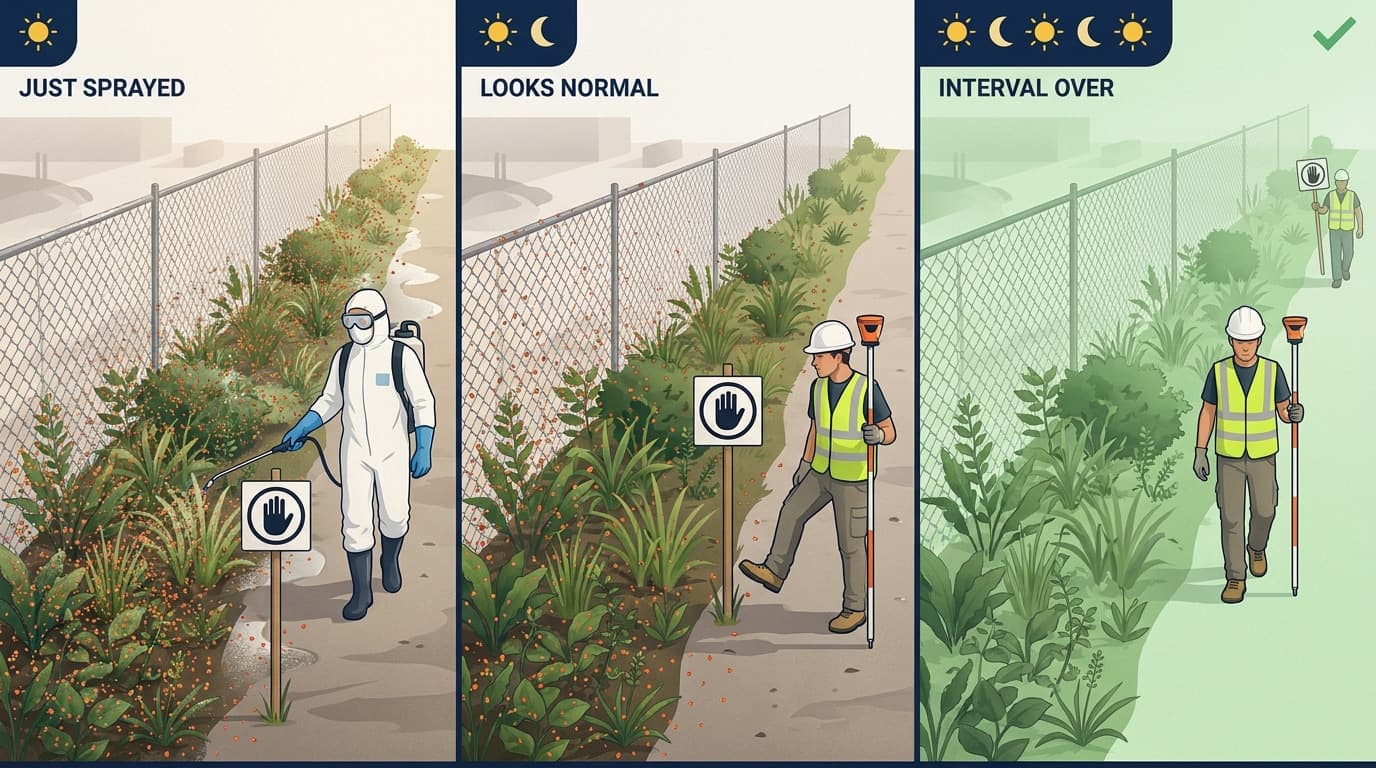
The rule that catches people out is the one you cannot see. After a pesticide is applied, the label specifies a restricted-entry interval — the REI — a set period during which no one may enter the treated area. The treated field looks completely normal. The spray has dried, there is no smell, nothing warns you. But the residue is still active, and the REI is the label's judgment about how long it takes to become safe. Entering before the interval expires is exactly the kind of invisible exposure that sends people to the hospital hours later wondering what happened.
This is enforced under the EPA's Worker Protection Standard, 40 CFR Part 170 — the regulation, issued under FIFRA, that protects agricultural workers and the people who handle pesticides. The employer must not allow or direct anyone into a treated area before the REI on the label has expired and the warning signs have been removed or covered. There are narrow early-entry exceptions, and they are deliberately hard to meet: entry is generally barred in the first hours after application, limited to a short time within a 24-hour period, and permitted only with the specific PPE the label requires for early entry. The practical rule for a crew is far simpler than the exceptions: a field under an REI is closed. If a treated area is posted, you do not enter it, and no one gets to wave you in.
Handlers and workers: two jobs, two sets of duties#
The Worker Protection Standard draws a line that matters on a mixed site, between two kinds of people around a pesticide.
A handler is anyone who mixes, loads, or applies the pesticide, cleans or repairs application equipment, or otherwise handles the concentrated or in-use product. Handlers have the highest exposure — they touch the concentrate, they are in the spray — and they carry the fullest duties: the label's handler PPE, training specific to handling, decontamination supplies within reach, and the knowledge to use the equipment correctly. A worker is someone who performs tasks in an area that has been treated — the person who goes back into the field to do other work. Workers are protected mainly by the REI, by posting and notification, by training, and by decontamination access. The reason the distinction matters is that it is easy to become a handler without realizing it: the laborer sent to rinse out a sprayer, or to top up a tank, has just stepped into the handler category and needs the handler's PPE and training — the job, not the title, decides which duties apply.
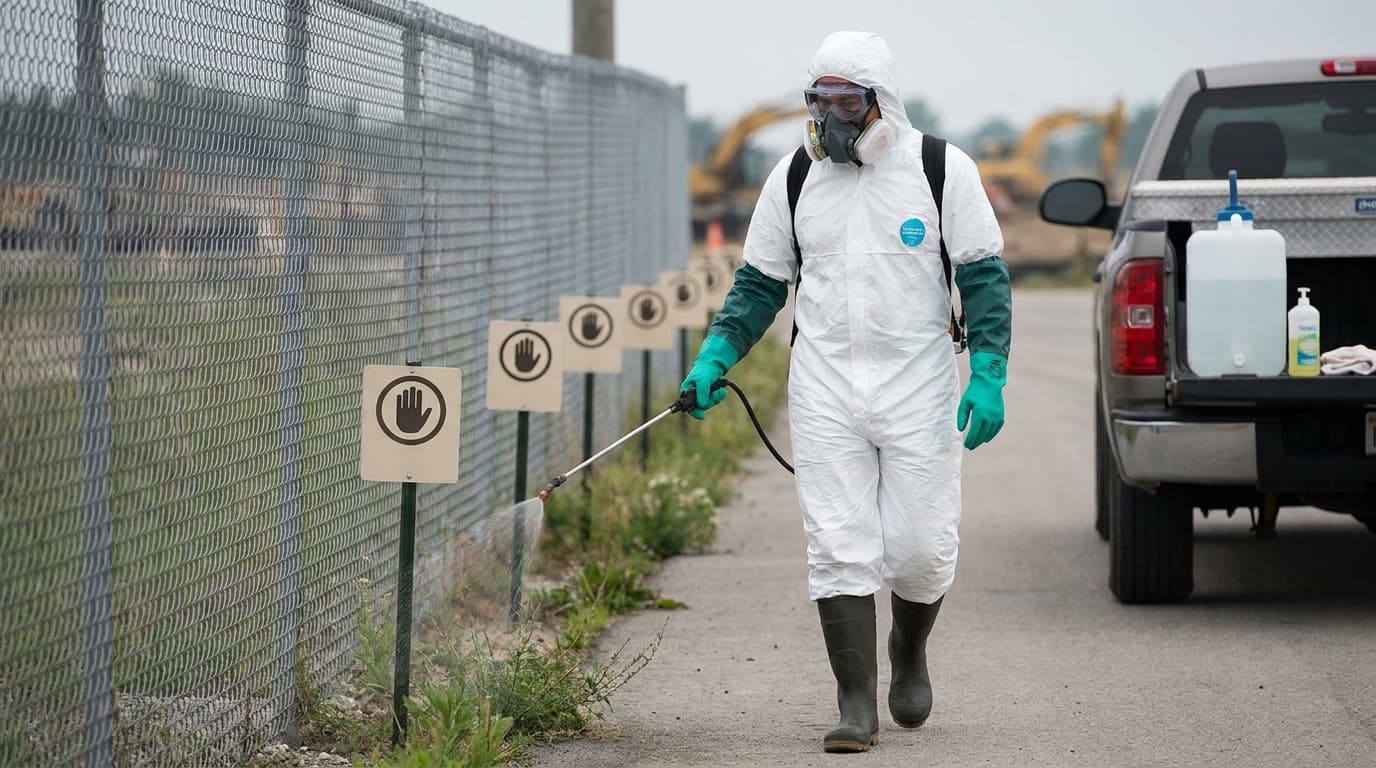
Around both roles sit the standard exposure controls this talk points back to: the label's PPE (chemical-resistant gloves at a minimum, often coveralls, eye protection, and a respirator for certain products), decontamination — clean water, soap, and a change of clothes to wash off residue promptly — and the plain rule that you never eat, drink, or smoke while handling, and wash before you do. Pesticide-contaminated clothing is laundered separately, and heavily contaminated clothing is discarded, because the residue transfers.
Reading the poisoning that hides in plain sight#
Pesticides can harm through the skin, by inhalation, and by ingestion, and the most dangerous cases are the ones that build quietly. Many pesticides — the organophosphates and carbamates in particular — act on the nervous system, and their early symptoms are easy to dismiss as something else: headache, nausea, dizziness, sweating, blurred vision, a runny nose, tightness in the chest. A worker who feels "a bit off" after a day near a spray program may be in the early stage of a poisoning, not coming down with a cold.
The response that saves people is to take those symptoms seriously and act fast: remove the person from exposure, get them to fresh air, remove contaminated clothing, wash affected skin, and get medical help — and bring the label with you, because the label and its emergency information tell the clinician what they are treating and how. That last point is the whole reason the "label is the law" principle has teeth in an emergency: the label is not only the rulebook before the job, it is the medical reference during a crisis. A crew that treats the label as disposable has thrown away the one document a doctor needs.
Where the duty sits#
Pesticides sit under a different federal agency from most of what a crew handles, and that is the key structural fact.
The governing statute is FIFRA, administered by the EPA — not OSHA — and the label requirements flow from it through 40 CFR Part 156 (labeling) and the Worker Protection Standard, 40 CFR Part 170 (protection of handlers and agricultural workers: training, decontamination, notification, emergency assistance, PPE, and the restricted-entry interval). Restricted-use pesticides additionally require a certified applicator under 40 CFR Part 171. OSHA's Hazard Communication Standard, 1910.1200 (1926.59 in construction) still applies to worker information and training on the general hazards, and OSHA's exposure and PPE standards back up the controls — but the pesticide-specific commands come from the EPA label and the WPS. For non-agricultural structural and site uses, the label's directions and any state pesticide-control requirements still govern; the label is the through-line in every setting.
On federal contract work, EM 385-1-1 carries its own pesticide-application, PPE and notification requirements, generally at least as strict as the baseline; where the label or the contract sets a tighter limit, that limit governs. And across all of it, the product label is the authority on that specific pesticide — two products in similar jugs can carry entirely different signal words, PPE, REIs, and permitted sites.
What can go wrong?#
- A worker enters a treated field during the restricted-entry interval because it looks and smells completely normal.
- A pesticide is applied at a stronger rate than the label sets, "to make sure it works" — a FIFRA violation and an overexposure.
- A product labeled for one use or site is used somewhere the label does not permit.
- A laborer is sent to rinse a sprayer or top up a tank without handler PPE or training, becoming a handler unaware.
- Early symptoms of poisoning — headache, nausea, sweating, blurred vision — are dismissed as a cold or heat.
- The label is thrown away or left behind, so no one has it when a doctor needs it in an emergency.
- Pesticide-contaminated clothing is worn home or washed with the family laundry.
- Someone eats, drinks, or smokes with pesticide residue on their hands.
How do we manage this properly?#
- Read the label before opening the product — it is a legal document, and its PPE, rate, sites, and REI are binding.
- Never exceed the label's application rate or use the product on a site or target it does not name.
- Stay out of any area under a restricted-entry interval and keep treated-area warning signs posted until the REI expires.
- Know whether you are acting as a handler (mixing, loading, applying, cleaning equipment) and wear the handler PPE and training that role requires.
- Provide and use decontamination — water, soap, clean clothes — and never eat, drink, or smoke while handling; wash first.
- Treat early poisoning symptoms seriously: remove from exposure, fresh air, wash, seek medical help, and bring the label.
- Launder pesticide clothing separately, discard heavily contaminated clothing, and never wear it home.
- Keep the label and its emergency information with the product and available on site.
Before you start#
- Confirm the label has been read and its PPE, rate, permitted sites, and REI are understood for this specific product.
- Confirm the signal word (CAUTION / WARNING / DANGER) and what it means for handling this product.
- Confirm who is acting as a handler and that they have the label's handler PPE and training.
- Confirm decontamination supplies — clean water, soap, and a change of clothes — are on site and reachable.
- Confirm any area under an REI is posted and closed, and nobody will enter it.
- Confirm the label and its emergency/first-aid information are on hand in case of exposure.
- Confirm contaminated clothing will be laundered separately and heavily contaminated clothing discarded.
- On federal work, confirm the EM 385-1-1 pesticide-application and notification requirements are met.
Talk it over#
- On this product, what does the label require for PPE and what is the restricted-entry interval — and has everyone read it?
- Who on this crew is a handler today, and do they have what the handler role requires?
- If someone entered a treated field before the REI expired, how would we even know something was wrong?
- If a person showed poisoning symptoms right now, where is the label, and who is taking them to get help?
The bottom line#
For a pesticide, the label is not guidance — it is federal law. Under FIFRA it is a violation to use a pesticide in a manner inconsistent with its labeling, which flips the usual relationship: an ordinary SDS informs you, but a pesticide label commands you — its PPE, application rate, permitted sites, and restricted-entry interval are all legally binding, and where the label is more restrictive than a general rule, the label governs. The rule that catches people out is the restricted-entry interval: after application the field looks and smells completely normal, but the residue is still active, and entering before the label's REI expires is an invisible overexposure — enforced under the EPA's Worker Protection Standard, 40 CFR Part 170, which bars entry until the REI ends and the warning signs come down, with only narrow, hard-to-meet early-entry exceptions. The WPS splits the people around a pesticide into handlers (mix, load, apply, clean equipment — highest exposure, fullest PPE and training) and workers (enter treated areas — protected by the REI, posting, and decontamination), and the trap is becoming a handler without noticing, like the laborer sent to rinse a sprayer. Provide decontamination, never eat, drink, or smoke while handling, launder pesticide clothing separately, and take early poisoning symptoms — headache, nausea, sweating, blurred vision — seriously: remove from exposure, wash, get medical help, and bring the label, because it is the doctor's reference as much as the crew's rulebook. Pesticides answer to the EPA under FIFRA, not primarily to OSHA, and the product label is the authority on that specific chemical. The test for any pesticide job is one question: have we read this label — the legal document we are held to — and is anyone about to walk into a field it has closed?
Frequently asked questions about pesticides and herbicides#
Why is the pesticide label treated as law and not just guidance?
Because it legally is. FIFRA, the federal pesticide statute, makes it a violation to use a pesticide in a manner inconsistent with its labeling. The label is an EPA-approved legal document, so its PPE, application rate, permitted sites, and restricted-entry interval are binding requirements, not recommendations. Doing anything the label does not authorize — including applying at a stronger rate — is itself an offense.
What is a restricted-entry interval?
It is the period after a pesticide application during which no one may enter the treated area, specified on the product label. The field can look and smell completely normal while the residue is still active, so the REI is the label's judgment of how long it takes to become safe. Under the Worker Protection Standard, entry is barred until the REI expires and the warning signs are removed, with only narrow early-entry exceptions.
What is the difference between a handler and a worker?
A handler mixes, loads, or applies the pesticide, or cleans and repairs application equipment — the highest-exposure role, carrying the fullest PPE and training duties. A worker performs other tasks in an area that has been treated and is protected mainly by the restricted-entry interval, posting, and decontamination access. The catch is that someone can become a handler without realizing it — for example, by being sent to rinse a sprayer — and then needs the handler's protections.
Can I use more product than the label says to be sure it works?
No. Exceeding the label's application rate is a FIFRA violation and an overexposure risk. The rate on the label is a legal maximum set through EPA review, not a suggestion, and "more" does not mean "better" — it means higher residue, longer real re-entry risk, and an illegal application. Use only the rate, sites, and targets the label names.
What PPE do I need for a pesticide?
Exactly what the product label specifies, which is a legal floor you cannot go below. That commonly means chemical-resistant gloves at a minimum, and often coveralls, eye protection, and a respirator for certain products, but it varies by product and by whether you are handling or re-entering. Because the requirement is product-specific, the only correct answer is to read that label's PPE section before you start.
What should I do if someone shows signs of pesticide poisoning?
Act fast and treat it seriously: remove the person from exposure, get them to fresh air, take off contaminated clothing, wash affected skin, and get medical help — and bring the label with you. Early symptoms like headache, nausea, dizziness, sweating, and blurred vision are easy to mistake for a cold or heat. The label carries the emergency and first-aid information the clinician needs to treat the specific product.
Which agency regulates pesticides — OSHA?
Primarily the EPA, not OSHA. Pesticides are governed by FIFRA, administered by the EPA, with the label requirements in 40 CFR Part 156 and worker protections in the Worker Protection Standard at 40 CFR Part 170. OSHA's Hazard Communication Standard still applies to general hazard information and training, and its PPE and exposure rules back up the controls, but the pesticide-specific commands come from the EPA label and the WPS.
Download the pesticide and herbicide toolbox talk PDF#
Get this pesticide and herbicide toolbox talk as a print-ready PDF — available in English, Spanish, Portuguese, and Turkish. Print it, hand it to the crew, and collect signatures on the included attendance sheet.
Download the PDF — free account required. New members get 3 free downloads.
Related toolbox talks#
Sources#
- EPA, Federal Insecticide, Fungicide, and Rodenticide Act (FIFRA) — overview and the requirement to use pesticides consistent with labeling: https://www.epa.gov/laws-regulations/summary-federal-insecticide-fungicide-and-rodenticide-act
- EPA, 40 CFR Part 170 — Agricultural Worker Protection Standard (restricted-entry interval, handler and worker protections): https://www.ecfr.gov/current/title-40/chapter-I/subchapter-E/part-170
- EPA, 40 CFR Part 156 — Labeling Requirements for Pesticides and Devices: https://www.ecfr.gov/current/title-40/chapter-I/subchapter-E/part-156
This talk is general awareness guidance for training purposes. It does not replace your employer's pesticide-safety program, the product's EPA-approved label and Safety Data Sheet, the Worker Protection Standard, applicable state pesticide requirements, or a certified applicator's duties, and it is not legal advice. The pesticide label is a legal document; where it or a contract sets a specific requirement, that requirement governs.
Written by FieldSafetyTalk's safety professional — a CSP, ASP, CHST and OSHA Authorized Outreach Trainer with 14+ years of international construction safety experience across federal, heavy civil, and industrial projects.