Emergency Evacuation Routes
Updated 2026-07-24
In this bundle Fire, Hot Work & Emergency
Print-ready PDF
Download this talk as a print-ready PDF, available in 4 languages.
The construction site is the only workplace where the escape route is being destroyed by the work itself. In an office, the way out was designed, signed, and inspected before anyone moved in, and it will be the same route next year. Here, the building is being assembled around the exit. A stair is not poured yet. A delivery landed in the corridor at ten. Scaffold went up across the opening after lunch. This Emergency Evacuation Routes Toolbox Talk (Safety Talk / Tailgate Talk) is about a control that expires continuously and gets checked almost never.
Here is the distinction that carries this whole talk: most safety controls fail because somebody did something wrong. An evacuation route fails because somebody did their job — stacked the material, ran the hose, erected the scaffold, closed the floor. Nothing careless happened. The route just stopped existing, and nobody was watching it, because watching it is nobody's task.
Three sentences, and what they demand#
29 CFR 1926.34 is one of the shortest standards in the construction rules. It is also one of the most demanding, and the language repays reading slowly.
(a) General. In every building or structure exits shall be so arranged and maintained as to provide free and unobstructed egress from all parts of the building or structure at all times when it is occupied. No lock or fastening to prevent free escape from the inside of any building shall be installed, with a narrow institutional exception.
(b) Exit marking. Exits shall be marked by a readily visible sign. And — this is the half that gets missed — access to exits shall be marked by readily visible signs in all cases where the exit or the way to reach it is not immediately visible to the occupants. Marking the door is not enough if you cannot see the door from where you work.
(c) Maintenance and workmanship. Means of egress shall be continually maintained free of all obstructions or impediments to full instant use in the case of fire or other emergency.
Now look at the words that are doing the work. All parts. At all times. Continually. All obstructions. Full instant use.
Not "reasonable access." Not "clear where practicable." Not "checked weekly." Full instant use means a person who is frightened, in smoke, possibly carrying someone, can go from where they are to outside without stopping, climbing, moving anything, or working out where to turn. If they have to step over a bundle of rebar, the route does not comply. If they have to squeeze past a stack of board, it does not comply. If the door is there but nobody can see how to reach it, it does not comply.
The plan, and the part of it everyone forgets#
29 CFR 1926.35 requires employee emergency action plans and sets out what they must contain. The elements are the ones you would expect — escape procedures and route assignments, procedures for anyone who stays behind to shut down critical operations, rescue and medical duties, how to report an emergency, and who to contact — plus an alarm system and training so that people actually know the plan.
And one element that is missing from most construction sites: procedures to account for all employees after the evacuation.
That is the head count, and it is not administrative. It is the control that determines whether anybody goes back into a burning building looking for someone who is already standing in the car park. On a site with multiple subcontractors, rotating crews, deliveries, visitors and inspectors, "who is still inside" is a genuinely hard question — and it is asked at the worst possible moment, in the dark, in the rain, by someone who is not sure how many people were on the third floor.
1926.150(a)(1) sits behind all of it: the employer is responsible for the development and maintenance of an effective fire protection and prevention programme at the job site throughout all phases of the construction, repair, alteration, or demolition work. Throughout all phases. The programme is supposed to move with the build.
On USACE and NAVFAC projects, EM 385-1-1 applies and is more prescriptive on egress, signage, and emergency planning.
What can go wrong#
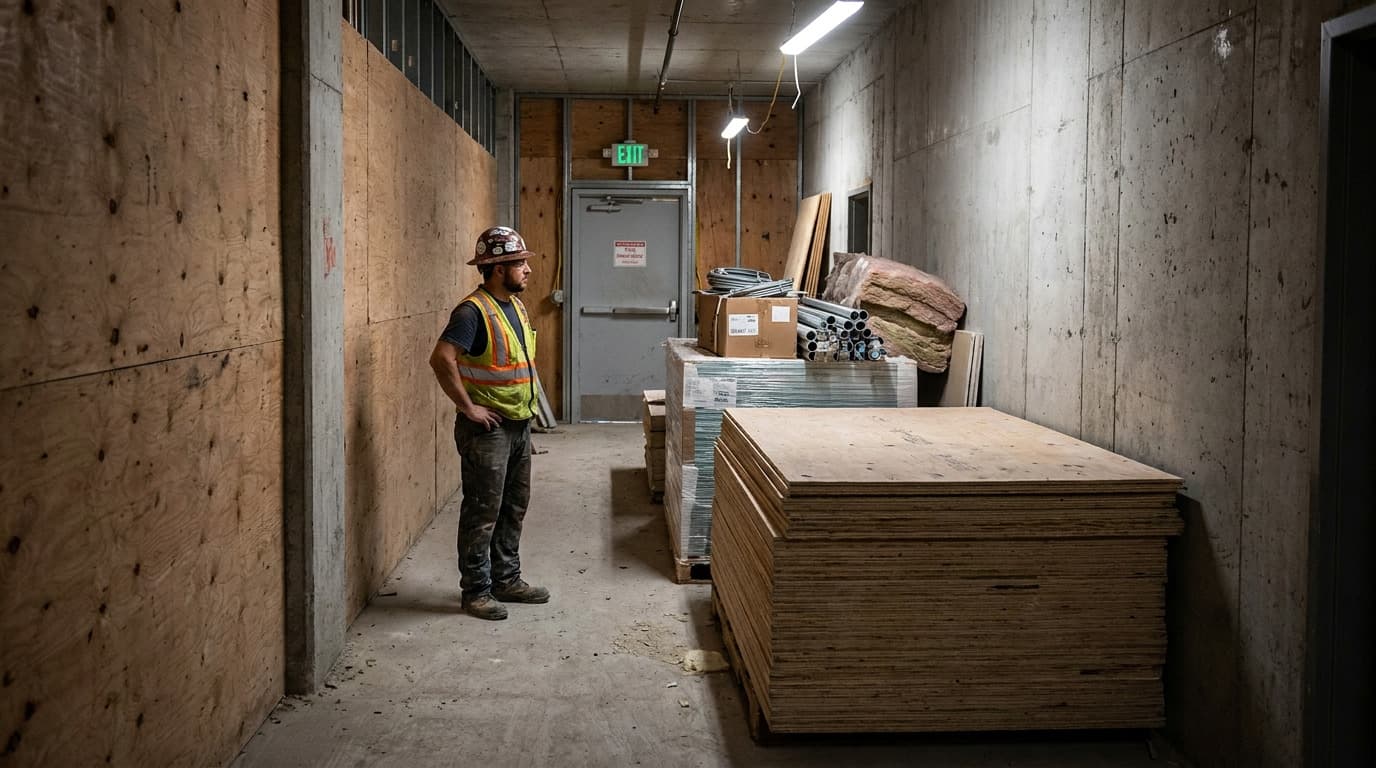
The route was blocked by the work. Material staged in the corridor, a delivery in the lobby, plant parked across the gate, a skip in front of the door.
Hoses and cords across the escape path. Air lines, welding leads, extension cords and vacuum hoses — the things you can walk over in daylight and cannot in smoke.
The stair is not built yet. Temporary stairs removed, ladders substituted, or a floor opening left where the flight will go.
Scaffold across the opening. Erected legally, blocking the route completely.
Nobody can see the exit. The door exists and complies, but from the work position there is no sign showing the way to it — the (b) requirement.
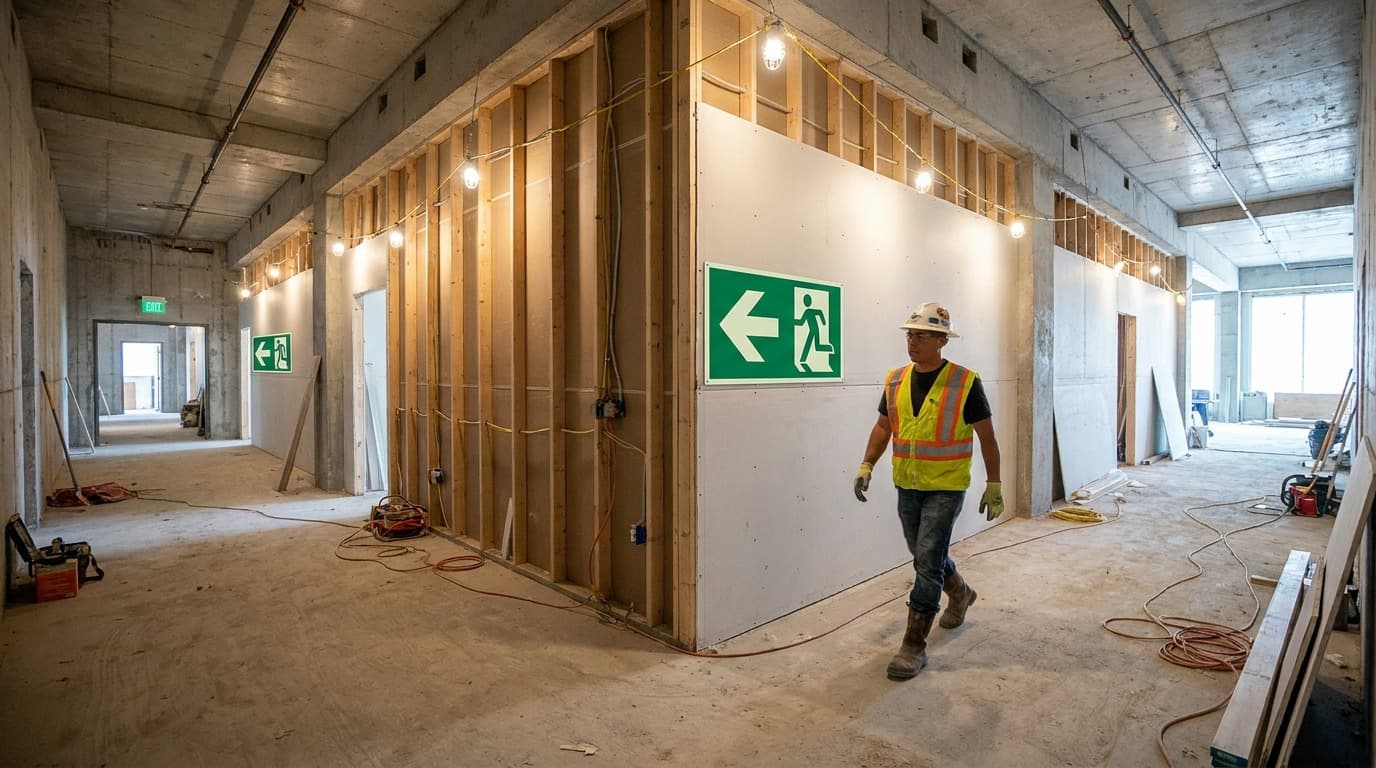
The route changed and nobody said. The plan on the noticeboard shows last month's building.
Signage that only makes sense in daylight. No illumination, no photoluminescence, and a route that is unlit once the temporary lighting goes down with the power.
Locked or fastened exits. Chained gates, padlocked stair doors, hoardings secured for security overnight while people are still working.
One way out. A dead-end area with a single route, and the fire in it.
No head count, or a head count nobody can complete. No sign-in, no subcontractor lists, no muster discipline.
Muster point in the wrong place. Downwind, in the crane's radius, inside the collapse zone, or on the access road the fire service needs.
Visitors and deliveries. Present on site, not on any list, not briefed on where to go.
Nobody has ever walked it. The route exists on a drawing and has never been travelled from the far corner of the top floor.
How do we control it?#
Walk the route from the worst place on site, not from the gate. The test is whether someone at the furthest, highest, most enclosed work position can get out — not whether the exit door is clear.
Make it somebody's daily task. The route changes with the work, so the check has to happen with the same frequency the work does. Add it to the daily walk, by name.
Treat blocking an egress route as a stop-work condition, not a housekeeping note for later. Material in an escape route gets moved now.
Mark the way, not just the door. Signs at every decision point where the exit or the way to it is not immediately visible — which on a partly built structure is most of them.
Light it. Escape routes need to work when the power that failed was the reason you are evacuating.
Never lock or fasten an occupied route. Security arrangements have to fail safe in the direction of people getting out.
Keep a second way out wherever the work allows, and treat any single-route area as a planning problem to solve rather than a fact to accept.
Update the plan when the building changes. New floor, new hoarding, new scaffold, new phase — new route drawing on the board.
Run the head count properly. Sign-in for everyone including visitors and deliveries, subcontractor lists at the muster point, a named person per crew, and a clear way to report "all accounted for" or "one missing, last seen where."
Choose the muster point deliberately — upwind, outside collapse and crane radius, clear of the fire service access route, and big enough for everybody on site at peak.
Brief every new arrival on the way out before they start, not at induction three weeks ago when the building was a different shape.
Practise it. A drill is the only way to discover that the route you drew has a scaffold across it.
Before you start#
- Identify your nearest exit and your second exit from where you will actually be working today.
- Walk the route once, from your work position, before you start.
- Confirm nothing is stored, staged, or parked in it.
- Confirm hoses, leads, and cords do not cross it.
- Confirm the way to the exit is signed from where you cannot see the door.
- Confirm the route is lit, or that you know it well enough in the dark.
- Confirm no gate, door, or hoarding on the route is locked or fastened.
- Confirm you know where the muster point is and how you will be counted.
- Confirm any visitors, delivery drivers, or new starters with you know all of the above.
- Report a blocked route immediately — it is a stop-work condition, not a tidy-up.
Talk it over#
- From where you are standing right now, describe your way out. Then describe your second one.
- What has been put in an escape route on this job in the last week — and who moved it?
- If we evacuated in ten minutes' time, how would anyone know you were out?

The bottom line#
29 CFR 1926.34 is three sentences and every word counts: exits arranged to give free and unobstructed egress from all parts of the structure at all times when it is occupied, exits and the way to reach them marked by readily visible signs, and means of egress continually maintained free of all obstructions or impediments to full instant use. Full instant use — not reasonable access, not clear when someone gets round to it. On a construction site that duty is continuous because the route is invalidated by the work itself, every day. So walk it from the worst position on site, make checking it somebody's named daily task, treat a blocked route as stop-work, and get the head count right under 1926.35 — because the only thing worse than someone still inside is a rescuer going in for someone who is already out.
Frequently asked questions about evacuation routes#
What does OSHA require for evacuation routes in construction?
29 CFR 1926.34 requires that exits be arranged and maintained to provide free and unobstructed egress from all parts of the building or structure at all times when it is occupied; that exits be marked by a readily visible sign, with access to exits also marked wherever the exit or the way to reach it is not immediately visible; and that means of egress be continually maintained free of all obstructions or impediments to full instant use in case of fire or other emergency.
What does "full instant use" actually mean?
It sets a high bar deliberately. The route must be usable immediately, without anyone having to move an object, climb over something, squeeze past, unlock anything, or work out where to go. If a person in smoke — possibly assisting someone else — would have to stop for any reason, the route does not meet the standard. It is not satisfied by a route that is "mostly clear" or "clear enough."
Is marking the exit door enough?
No. 1926.34(b) requires exits to be marked by a readily visible sign and requires that access to exits be marked by readily visible signs in all cases where the exit or the way to reach it is not immediately visible to the occupants. In a partly constructed building, that usually means signage at every decision point along the route, not just at the door.
What must an emergency action plan contain?
29 CFR 1926.35 sets out the required elements of employee emergency action plans, including emergency escape procedures and route assignments, procedures for employees who remain to operate critical operations before evacuating, rescue and medical duties, the preferred means of reporting emergencies, and the names or job titles of people to contact — together with an alarm system and training. It also requires procedures to account for all employees after an evacuation, which is the element most often missing in practice.
Why does the head count matter so much?
Because it determines whether anyone re-enters. Without a reliable count, the site cannot tell the difference between "everyone is out" and "somebody is still on the third floor" — and that uncertainty puts rescuers into a burning structure looking for someone who may already be standing at the muster point. On a multi-subcontractor site with deliveries and visitors, the count only works if sign-in, crew lists, and muster discipline were set up beforehand.
Can an exit route be locked for site security?
No, not while the area is occupied. 1926.34(a) prohibits locks or fastenings that prevent free escape from the inside of a building, subject only to a narrow institutional exception that does not apply to construction. Security arrangements must fail in the direction of letting people out.
How often should evacuation routes be checked?
Continuously, in the sense the standard means it — 1926.34(c) requires means of egress to be continually maintained, and 1926.34(a) requires egress at all times when the structure is occupied. Because the route on a construction site is changed by the work itself, the practical answer is a named check every day, plus immediate action any time material, plant, hoses, or scaffold enter the route.
Download the evacuation routes toolbox talk PDF#
Get this emergency evacuation routes toolbox talk as a print-ready PDF — available in English, Spanish, Portuguese, and Turkish. Print it, hand it to the crew, and collect signatures on the included attendance sheet.
Download the PDF — free account required. New members get 3 free downloads.
Related toolbox talks#
Sources#
- OSHA, 29 CFR 1926.34 — Means of egress: https://www.osha.gov/laws-regs/regulations/standardnumber/1926/1926.34
- OSHA, 29 CFR 1926.35 — Employee emergency action plans: https://www.osha.gov/laws-regs/regulations/standardnumber/1926/1926.35
- OSHA, 29 CFR 1926.150 — Fire protection: https://www.osha.gov/laws-regs/regulations/standardnumber/1926/1926.150
Written by FieldSafetyTalk's safety professional — a CSP, ASP, CHST and OSHA Authorized Outreach Trainer with 14+ years of international construction safety experience across federal, heavy civil, and industrial projects.