Fatigue Management
Updated 2026-07-28
In this bundle Jobsite Fundamentals & Compliance
Print-ready PDF
Download this talk as a print-ready PDF, available in 4 languages.
Fatigue is the only hazard on a construction site that the worker brings with them and nobody can see. There is no meter for it, no marking on the equipment, and the person carrying it is the least reliable judge of how much they have — because the first thing impaired is the judgement doing the assessing. This fatigue management talk is about a hazard that hides inside normal-looking people.
Here is the distinction that carries this whole talk: fatigue cannot be trained away, willed away or worked through. Sleep is the only treatment. Coffee borrows alertness against a debt that is still owed. A cold shower, fresh air, loud music and the radio all change how tired you feel without changing how impaired you are — and the gap between those two is exactly where the incident happens.
The impairment equivalence#
The most useful thing ever established about fatigue is that it is measurable against something everybody already treats as serious.
Published research comparing sustained wakefulness with alcohol intoxication found that after roughly 17 hours awake, performance had declined to a level equivalent to a blood alcohol concentration of about 0.05% — and that after around 24 hours awake, the equivalent was approximately 0.10%, which is over the legal driving limit in most jurisdictions.
Sit with what 17 hours means on a construction site. Up at 5 a.m., on site at 7, finish at 5 p.m., drive home at 6 — that is 13 hours. Add a long commute, an early start, or a poor night before, and the drive home is happening at an impairment level nobody on the site would tolerate from a bottle.
That is the comparison worth making at a toolbox talk, because it converts a vague complaint into a measurable one. No site would let a worker operate a machine after two drinks. The same site routinely schedules the eighteenth hour.
The only hard limits that exist#
OSHA has no fatigue standard. There is no maximum shift length, no minimum rest period and no limit on consecutive days in the construction standards. The duty runs through Section 5(a)(1) and its recognised hazards, and through 1926.21(b)(2) on instructing employees in recognising and avoiding unsafe conditions.
The hard numbers exist in one place only: the hours-of-service rules in 49 CFR Part 395, which bind commercial motor vehicle drivers. For property-carrying drivers those include an 11-hour driving limit within a 14-hour on-duty window following 10 consecutive hours off duty, a required 30-minute break after 8 cumulative hours of driving, and 60- or 70-hour limits across 7 or 8 consecutive days.
Two things follow. If you run CMVs, those limits are law and they are enforced through logs. And if you do not, there is no legal ceiling at all — which means the only thing standing between a crew and the eighteenth hour is the schedule somebody wrote.
Where fatigue comes from#
Sleep debt. Lost sleep accumulates and does not clear with one good night. A week of six hours produces a deficit that behaves like a night without sleep.
Time awake. Independent of debt — being up for 17 hours impairs you even after a full night.
Circadian timing. The body has two low points every day: a deep one between roughly 2 and 6 a.m. and a second, milder dip in the early afternoon. Errors cluster in both, and the afternoon one catches day crews who assume fatigue is a night-shift problem.
Shift pattern. Night work fights the body clock, and the first night of a run is the worst because no adaptation has occurred. Rotating patterns are hardest of all.
Work itself. Heat, noise, vibration, physical load and sustained concentration all consume the same reserve.
Everything outside work. A second job, a new baby, a long commute, illness. The crew arrives with whatever their life gave them, and the schedule does not know about it.
What fatigue actually does#
Reaction time lengthens — the effect that matters most for driving and plant.
Attention lapses. Brief microsleeps of a few seconds, often unnoticed by the person having them. At road speed, four seconds is a long distance travelled unconscious.
Risk assessment degrades before skill does. A tired worker can still perform the task competently while making a much worse decision about whether to attempt it.
Working memory shrinks, which is why fatigue defeats permits, isolations and multi-step sequences — anything requiring you to hold several conditions in mind at once.
Communication narrows. Tired people say less, ask fewer questions and check less, which removes the layer that catches everybody else's errors.
Mood and tolerance drop, which is where fatigue and conflict on site meet.
What can go wrong?#
The drive home. Statistically the most dangerous part of a long shift, and entirely outside every site control.
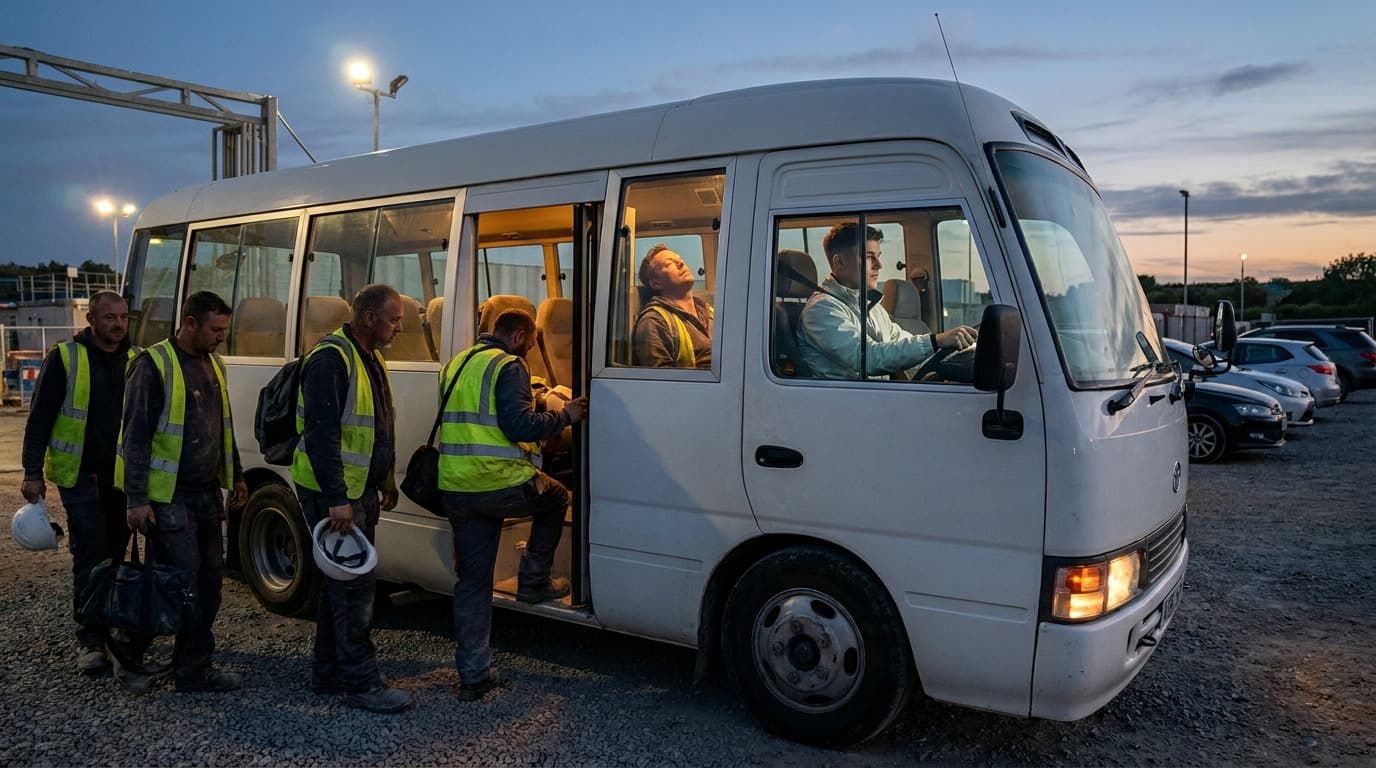
Overtime that becomes standard, so a 12-hour day stops being exceptional and nobody re-plans for it.
Consecutive days without a full rest day, where the debt compounds invisibly.
The first night shift of a run, when nothing has adapted.
Safety-critical work in the early hours — isolations, permits, lifts — scheduled into the circadian low.
Self-assessment relied upon, when impaired judgement is the thing doing the assessing.
A culture where admitting tiredness looks like weakness, so nobody does.

Caffeine treated as a control, deferring rather than repaying the debt.
How do we manage this properly?#
Schedule against it, because it is a scheduling problem. Shift length, consecutive days, start times and rest between shifts are all decided in an office and are the only real controls.
Put safety-critical work outside the circadian lows wherever the programme allows — not at 3 a.m. and not immediately after lunch.
Plan the commute as part of the shift. A long drive after twelve hours is the highest-risk hour of the day. Consider transport, accommodation or a shorter shift where journeys are long.
Make reporting fatigue safe and consequence-free, and treat someone standing themselves down as the system working, not as a problem.
Use rotation and breaks for genuinely demanding work — the same principle as vibration and heat.
Do not rely on self-assessment alone. Ask about hours, second jobs and sleep, and watch for the crew's own observations of each other.
Respect the CMV limits absolutely where they apply, and adopt something equivalent where they do not.
Be honest that sleep is the only fix. Coffee has a place; it is not a control.
Before you start#
- Confirm how many hours you have been awake, and how you slept.
- Confirm how many consecutive days you have worked without a full rest day.
- Confirm whether any of today's tasks are safety-critical, and when they are scheduled.
- Confirm whether you are driving today, and how long the journey home is.
- Confirm any hours-of-service limits that apply to you or to drivers on the crew.
- Confirm you can say you are too tired without it costing you anything.
- Confirm someone knows if you are on a second job or a long commute.
- Confirm what the plan is if somebody stands themselves down.
Talk it over#
- How many hours had you been awake by the end of your last shift?
- Who has the longest drive home from this site?
- Would you tell the foreman you were too tired to work at height? Honestly?
- When is the hardest hour of your shift, and what are you doing during it?
The bottom line#
Sleep is the only treatment. Published research comparing sustained wakefulness with alcohol found that around 17 hours awake produces performance impairment equivalent to roughly 0.05% blood alcohol, and around 24 hours awake to about 0.10% — over the legal driving limit in most places. OSHA has no fatigue standard: no maximum shift, no minimum rest, no cap on consecutive days, so the duty runs through Section 5(a)(1) and 1926.21(b)(2). The only hard limits are the hours-of-service rules in 49 CFR Part 395 binding commercial motor vehicle drivers — for property-carrying drivers an 11-hour driving limit in a 14-hour window after 10 hours off, a 30-minute break after 8 cumulative driving hours, and 60/70-hour limits over 7/8 days. Everyone else has no legal ceiling, which means the schedule is the control. Watch the circadian lows — roughly 2 to 6 a.m. and the early afternoon — remember that risk assessment degrades before skill does, and treat the drive home as part of the shift, because it is the most dangerous hour of a long day.
Frequently asked questions about fatigue#
How impaired does being awake a long time make you?
Measurably. Published research comparing sustained wakefulness with alcohol intoxication found performance after about 17 hours awake equivalent to a blood alcohol concentration of roughly 0.05%, and after about 24 hours awake equivalent to approximately 0.10% — above the legal driving limit in most jurisdictions. It is the comparison worth making, because no site would knowingly allow the alcohol equivalent.
Does OSHA limit how long a shift can be?
No. There is no OSHA fatigue standard — no maximum shift length, no minimum rest period and no limit on consecutive days worked in the construction standards. The obligation arises through Section 5(a)(1), the General Duty Clause, on recognised hazards, and 1926.21(b)(2) on instructing employees in recognising and avoiding unsafe conditions.
Are there any hard hours limits at all?
Only for commercial motor vehicle drivers, under the hours-of-service rules in 49 CFR Part 395. For property-carrying drivers these include an 11-hour driving limit within a 14-hour on-duty window following 10 consecutive hours off duty, a required 30-minute break after 8 cumulative hours of driving, and 60- or 70-hour limits across 7 or 8 consecutive days.
When during the day is fatigue worst?
At two points. The deep circadian low falls roughly between 2 and 6 a.m., and there is a second, milder dip in the early afternoon. Errors cluster in both — and the afternoon dip catches day crews who assume fatigue only affects night shifts.
Does coffee help?
It changes how you feel without changing how impaired you are, and that gap is dangerous. Caffeine defers a sleep debt that is still owed; it does not repay it. It has a legitimate short-term place, but describing it as a fatigue control misrepresents what it does.
Why is fatigue especially bad for permits and isolations?
Because it shrinks working memory. Tasks that require holding several conditions in mind at once — a permit's conditions, an isolation sequence, a multi-step lift — are exactly what degrade first. A tired worker may perform the physical task perfectly while losing track of the step that made it safe.
What is the most dangerous part of a long shift?
The drive home. It happens at the point of maximum accumulated wakefulness, usually alone, often in the dark, and it sits entirely outside every control the site has. Planning the commute as part of the shift — through transport, accommodation or shorter shifts where journeys are long — addresses the risk that the site's own procedures cannot reach.
Download the fatigue management toolbox talk PDF#
Get this fatigue management toolbox talk as a print-ready PDF — available in English, Spanish, Portuguese, and Turkish. Print it, hand it to the crew, and collect signatures on the included attendance sheet.
Download the PDF — free account required. New members get 3 free downloads.
Related toolbox talks#
Sources#
- FMCSA, 49 CFR Part 395 — Hours of Service of Drivers: https://www.ecfr.gov/current/title-49/subtitle-B/chapter-III/subchapter-B/part-395
- NIOSH, Work Schedules: Shift Work and Long Hours: https://www.cdc.gov/niosh/fatigue/about/index.html
- OSHA, 29 CFR 1926.21 — Safety training and education: https://www.osha.gov/laws-regs/regulations/standardnumber/1926/1926.21
This talk summarises published research and regulatory guidance. It is not medical advice. Persistent fatigue that is not explained by hours worked or sleep obtained can have medical causes and should be discussed with a physician or other qualified health professional.