Holiday Safety: Staying Focused on Site
Updated 2026-11-13
In this bundle Mental Health & Human Factors
What is holiday season distraction on a construction site?
Holiday season distraction on a construction site is the drop in attention between Thanksgiving and New Year's, when a shutdown deadline, short days, lost sleep, phones, money worries, parties and stand-in workers pull a crew's focus away from hazards that have not changed. It is controlled by deciding early what waits, not by working faster.
Print-ready PDF
Download this talk as a print-ready PDF, available in 4 languages.
This holiday safety toolbox talk (Safety Talk / Tailgate Talk) covers the weeks between Thanksgiving and New Year's, when the site looks the same as it did in October and the crew on it does not. The trench is the same depth and the saw turns at the same speed. What changes is the people: a shutdown date everyone is racing, short days, short sleep, a busy phone, money on the mind, last night's party, and a stand-in on the crew. This is holiday safety at work the way a crew lives it.
Where the boundary of this talk sits#
The fatigue talk owns sleep. The situational awareness talk owns how you read what is around you. The common unsafe behaviors talk owns shortcuts. The winter driving talk owns the road, and the cold stress talk owns what cold does to the body. This talk owns the holiday period itself: the mindset and the schedule pressure of the last weeks of the year — the race to finish before shutdown, the split attention, the morning after the party, the stand-in on the crew, the site left alone for a week, and the first morning back.
The anchor#
Here is the distinction that carries this whole talk: the holidays do not bring one new hazard onto the site — they change the people standing next to the old ones; the trench and the saw do not know what day it is, so a crew that tries to beat the date by going faster is spending attention it has less of than at any other time of year, and the control is not "be more careful" — it is to decide, a week ahead and out loud, what will not be finished before the break.
Why the holidays are a high-risk time on site#
Start with what the numbers do not say. When the Bureau of Labor Statistics counted fatal work injuries by month for 1992 through 2011, July had the most and February the fewest. Those are counts, not rates, but they rule out the easy headline: December is not the deadliest month at work.
What December does is stack pressures on the same people at the same time. OSHA's worker fatigue page reports accident and injury rates 18% higher on evening shifts and 30% higher on night shifts than on day shifts, and a 37% higher injury risk on 12-hour days — the hours a crew adds to beat a shutdown date. In an American Psychological Association survey, 89% of U.S. adults said something causes them stress during the holiday season, and 58% named spending too much or not having enough money. Each takes a share of the attention the real hazards need.
Distractions at work: the holiday traps#
Five traps show up on almost every site in the last weeks of the year.
Rushing to finish before shutdown. The date is fixed and the work is not done, so the plan gets squeezed. What goes first is whatever takes time and shows no progress: the inspection, the tie-off, the lockout, the spotter. This is the complacency safety topic in its purest form: a task done a hundred times feels safe, and a deadline is a reason not to look twice.
Short daylight and fatigue. Long shifts to beat the date, then shopping, travel and late nights. You arrive on less sleep and work more of the day in poor light, and tired does not feel like much until you react late.
Phones and money on the mind. The phone is how home gets onto the site: the late delivery, the flight, the declined card. NHTSA says reading a text takes your eyes off the road for five seconds — at 55 mph, the length of a football field. On site, five seconds is a backing truck closing the gap. A worry does the same with no phone at all.
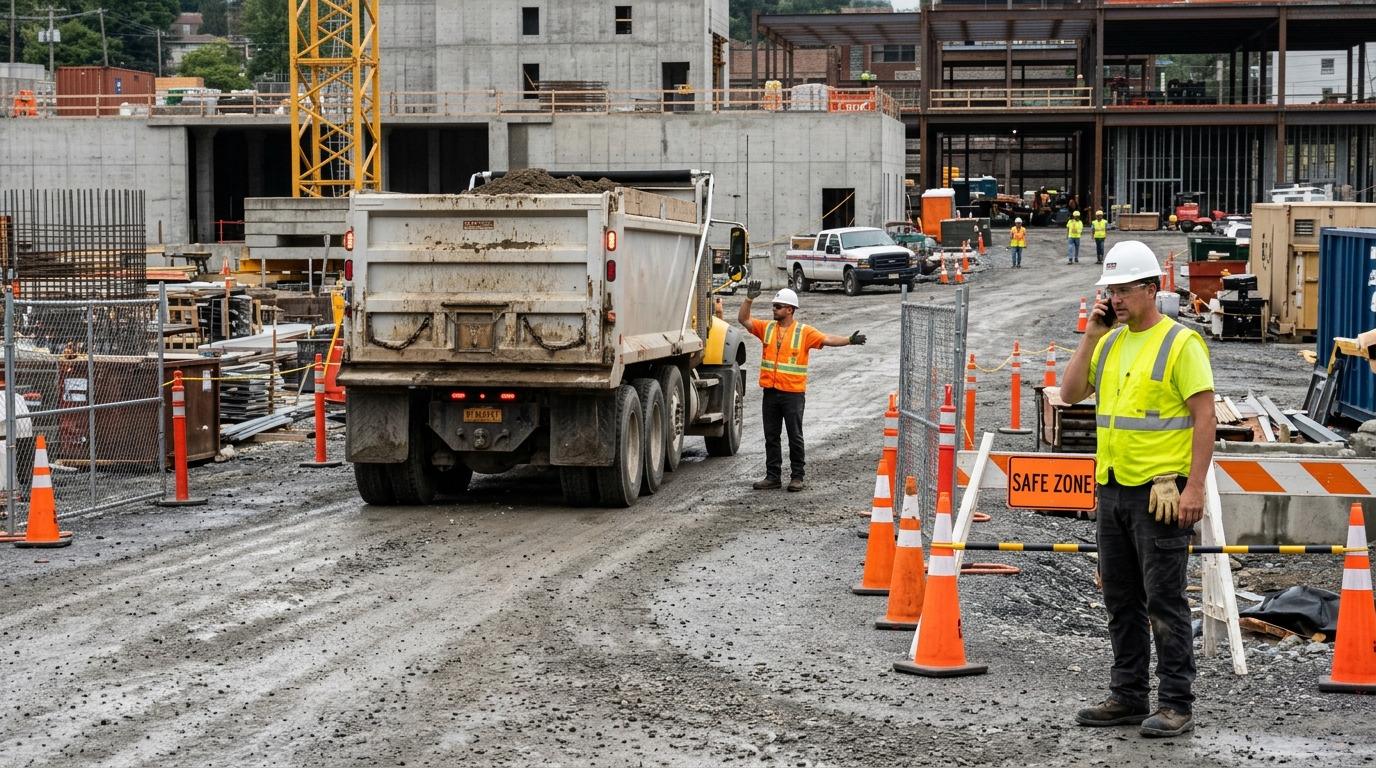
The morning after the party. The National Institute on Alcohol Abuse and Alcoholism (NIAAA) says hangover symptoms peak when blood alcohol returns to about zero and can impair attention, decision-making and coordination. A worker can be legally sober at 7 a.m. and at the worst point of the hangover. In NIAAA's words, "There is no cure for a hangover other than time."
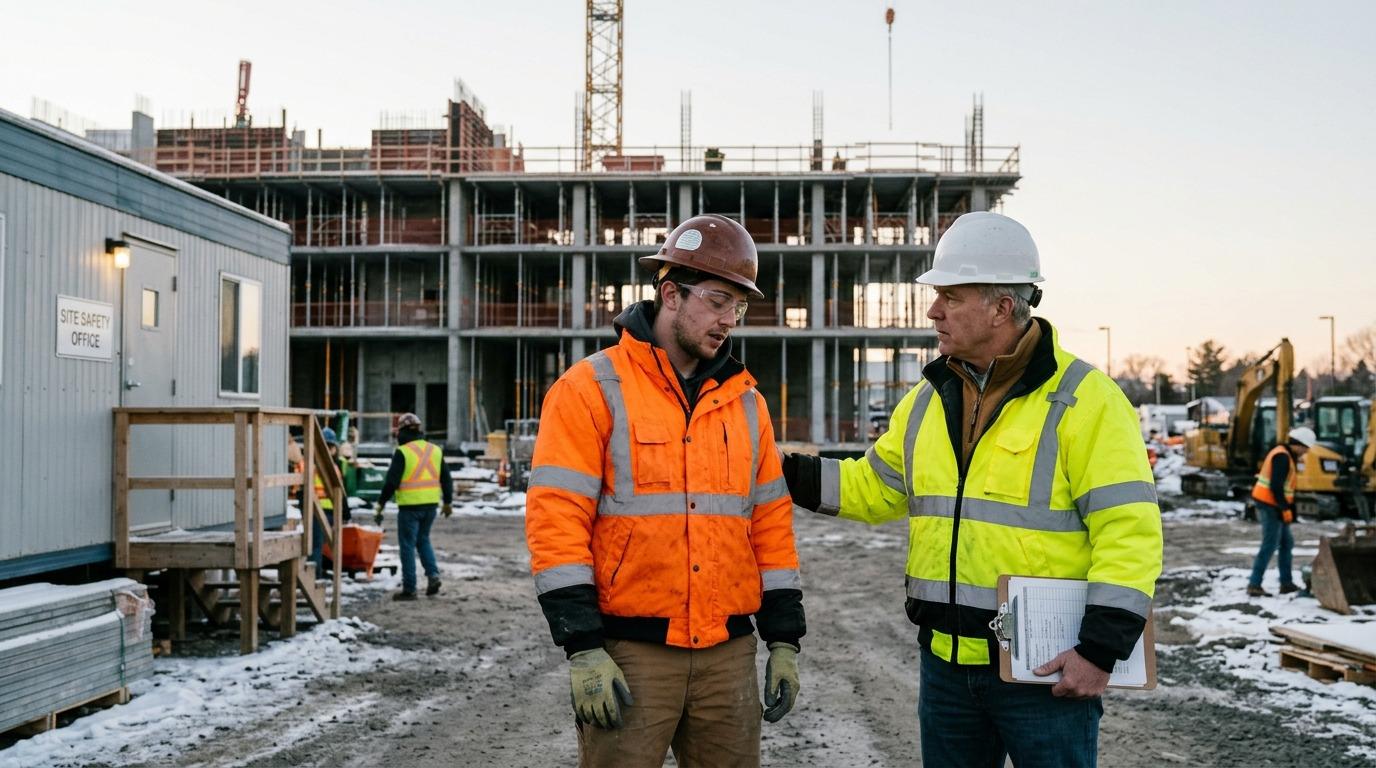
New and temporary faces. People take leave and seats get filled: a temp from an agency, somebody who "has run one before" on the loader. They do not know this site, and the regulars who would watch out for them are busy with the other four traps.
| Holiday trap | What it looks like on site | The control |
|---|---|---|
| Rushing before shutdown | Skipped steps; "we'll fix it in January" | Decide a week ahead what waits |
| Short daylight and fatigue | Work pushed into dusk; back-to-back long shifts | Critical work in daylight; cap the hours |
| Phones and stress | Phone out near moving equipment | Phones parked in the work zone |
| Morning after the party | Late, slow, clumsy hands | Speak up; no operating or heights until fit |
| New or temporary workers | An unfamiliar face on a machine | Orientation first; pair with a regular |
Holiday safety tips for employees#
Most holiday safety topics for the workplace are about home: lights, ladders, cooking. These are for the hours on site.
- Treat sleep like PPE. Protect it the night before any shift where you operate, climb or rig.
- Park the phone. Step out of the work zone, stop walking, then answer.
- Say it out loud. If your head is somewhere else — bad news, money, no sleep, last night — tell the foreman before the task, not after the near miss.
- Do not trade a step for ten minutes. The pre-use check, the tie-off and the lockout take the same time in December as in June.
- Watch the new person, and ask when the new person is you.
Securing the site before the holiday shutdown (and restarting safely after it)#
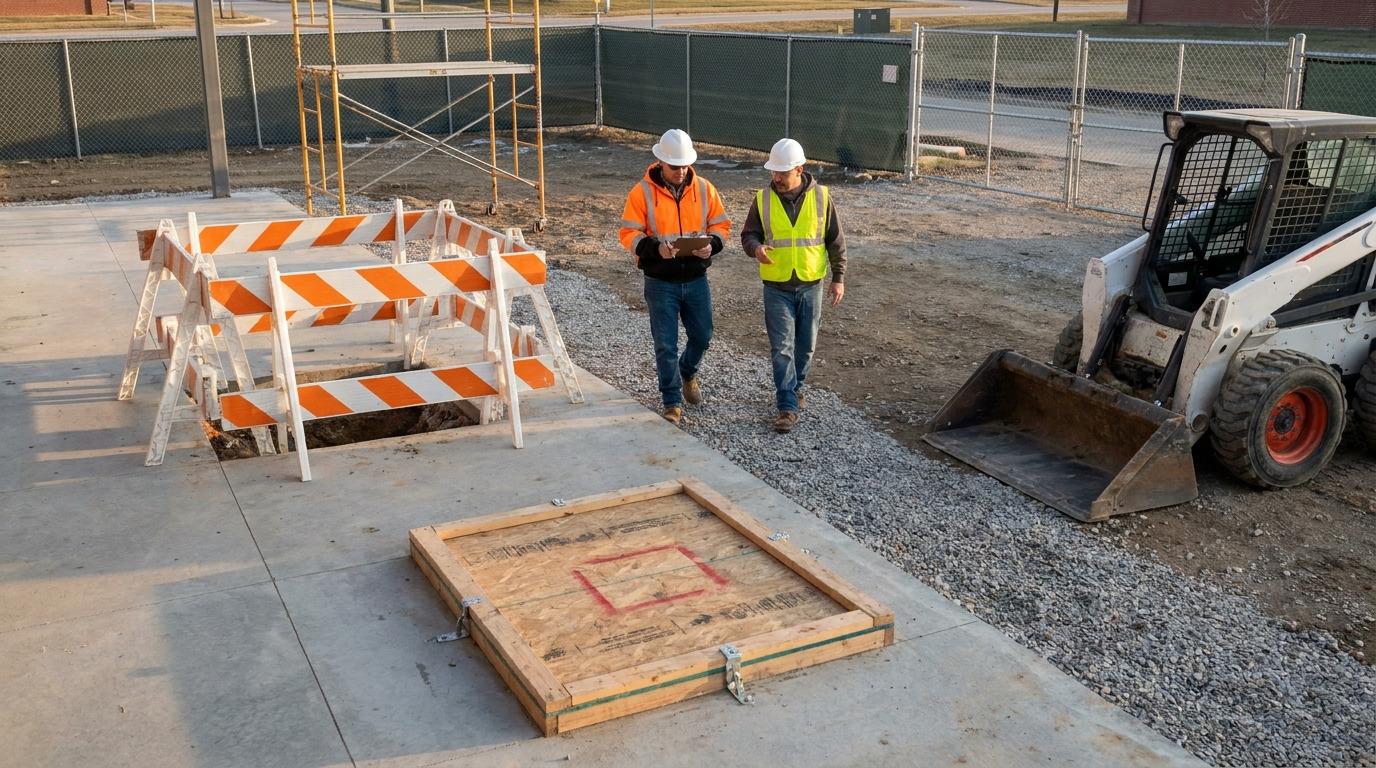
The last day before the break is the most rushed day of the year, and then the site sits for days with nobody watching it. Close it on a plan, not on the way to the truck: barricade, plate or backfill excavations; cover floor openings; tie down what the wind can move; block scaffold and ladder access; park equipment with keys out; shut off unneeded temporary power; stop hot work early; lock the gate and name who checks the site during the break.
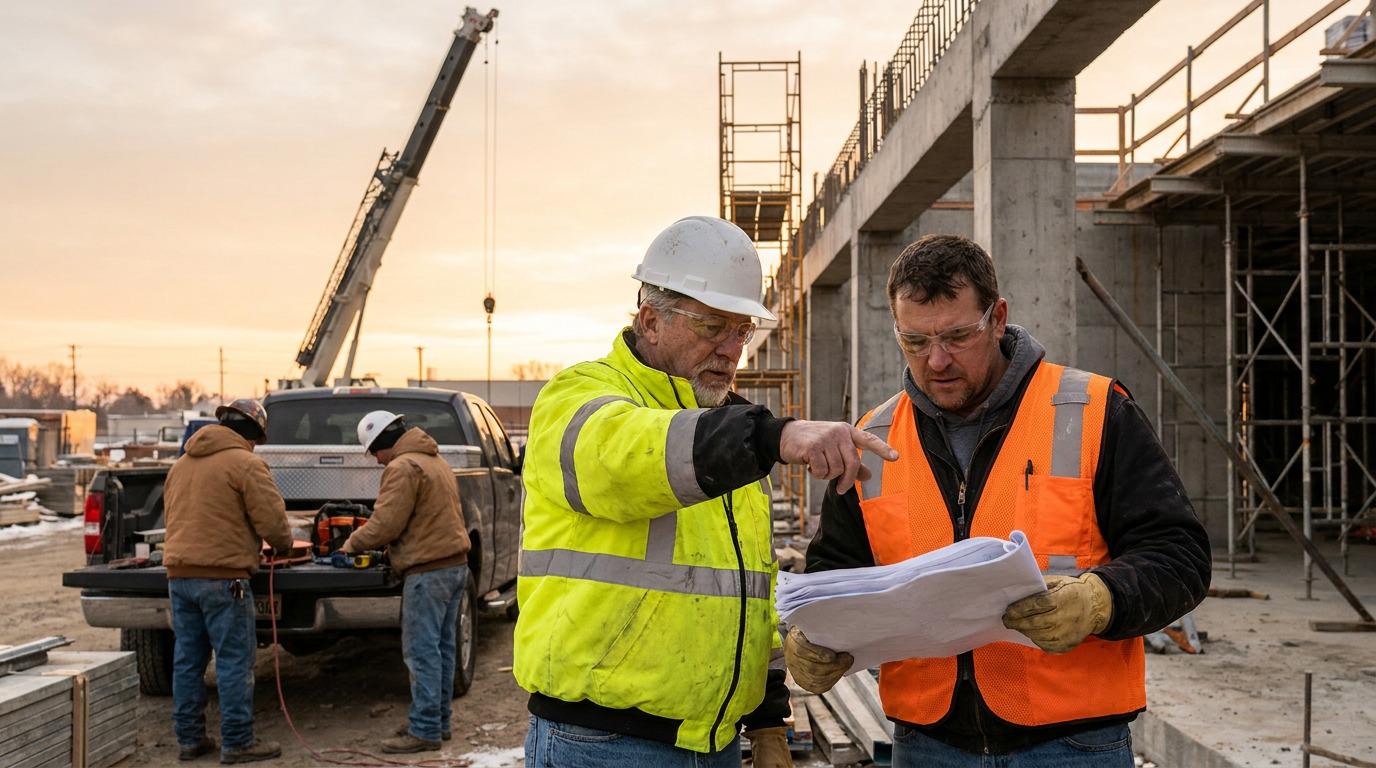
The first morning back is a new site. A competent person inspects every excavation before anyone enters — 1926.651(k)(1) requires it before the start of work and after every rainstorm or other hazard-increasing occurrence — and every scaffold before the shift under 1926.451(f)(3). For scaffolds, see the scaffolding talk. Run pre-use checks, hold a full huddle, and do not schedule the first day as if nobody had been away.
Driving home for the holidays#
The drive is where the holiday risk is best counted. NHTSA reports 934 people killed in alcohol-impaired-driving crashes in December 2024 alone. AAA forecast a record 81.8 million Thanksgiving travelers in 2025, at least 73 million by car. The AAA Foundation for Traffic Safety found drivers on four to five hours of sleep had 4.3 times the crash risk of drivers who slept seven hours or more. Sleep first, leave in daylight if you can, keep the phone out of reach, and never drive impaired. Snow and ice are covered in the winter driving talk.
Where the duty sits#
There is no OSHA standard for the holidays and none for distraction in general. Section 5(a)(1) of the OSH Act is the base: a workplace free of recognized hazards likely to cause death or serious physical harm. 1926.21(b)(2) requires the employer to instruct each employee in the "recognition and avoidance of unsafe conditions." 1926.20(b)(2) calls for regular inspections by competent persons, and 1926.20(b)(4) lets only employees "qualified by training or experience" run equipment. 1926.1417(d) is the one place the construction rules name the phone: a crane operator must not use a cell phone while operating, except for signals. The schedule and the decision on what waits belong to the employer; the sleep, the phone and the honest word about fitness belong to the worker.
What can go wrong?#
- A crew pulls the trench box and backfills in the dark on the last afternoon, skipping the inspection because the trucks are waiting.
- An operator reads a text about a canceled flight while backing; the spotter is on his own phone.
- A carpenter who left the party at midnight is on a ladder at 7 a.m., feeling "fine."
- A temp who arrived December 22 is handed a grinder with no orientation.
- The site is left with an unbarricaded excavation; the neighborhood kids find it.
- On the first morning back, a crew climbs a scaffold that took a week of wind and ice.
How do we manage this properly?#
- Decide what waits — a week before shutdown, the superintendent names what will not be finished.
- Freeze the last day — no new high-risk starts on the final shift.
- Cap the hours, use the daylight — critical work in daylight; lit work areas and walkways.
- Park the phones — a safe spot for calls; never at the controls or while spotting.
- Fit for duty, no penalty for saying so — a tired, hung-over or distracted worker is moved off critical tasks.
- Orient every new face — orientation before work, a regular as partner, only qualified operators.
- Shut down and restart on a checklist — competent-person inspections and a full huddle before work resumes.
Before you start#
Ask yourself three things before the first task: how much did I sleep, where is my head, and what changed on this crew or this plan since yesterday? Put the phone away before you enter the work zone. If the person next to you is new, slow down for them.
Holiday safety moment for supervisors#
Use this as a holiday safety moment at the morning huddle, or send it as a holiday safety message to employees before the break. It takes about a minute.
We have [number] working days until the break, and nothing on this site is worth getting hurt for in that time. The trench, the lift and the saw are the same as they were in October. What is different is us: less sleep, more on our minds, and a date we all want to hit. So here is the deal. If a job cannot be done safely before the break, it waits until January, and I make that call, not you. Phones stay put away in the work zone. If you are tired, had a late night, or your head is somewhere else today, tell me and I will move you. Nobody gets in trouble for that. Watch the new people. Do every check you would do in June. Drive home rested and sober. I want every one of you at your own table this holiday, and back here in January.
Talk it over#
- What are we tempted to rush before the break, and what can wait until January?
- Where on this site is it safe to take a phone call?
- If you came in on three hours of sleep or after a late party, who would you tell?
- Who is new on this crew this week, and who is their partner?
- Who checks this site during the shutdown, and what gets inspected before we restart?
The bottom line#
The holidays do not change the site. They change the people on it. A fixed date, short sleep, a busy phone, a late party and a new face all pull attention from hazards that are as dangerous as they were in October. Going faster does not beat the date; it spends attention the crew does not have. Decide early what waits, protect sleep, park the phones, speak up when you are not right, and shut down and restart on a plan. The job will be here in January. Make sure the crew is too.
Frequently asked questions about this holiday safety toolbox talk#
Is there an OSHA standard for holiday safety?
No. OSHA has no holiday standard and no general rule on distraction. The duty comes from Section 5(a)(1) of the OSH Act, on recognized hazards, and from the training rule, 1926.21(b)(2).
What are good December safety topics?
Good December safety topics for the workplace follow what the month brings: holiday distraction (this talk), cold stress, winter driving, winter slips and working safely in cold weather.
Do more construction workers get hurt during the holidays?
National counts do not point to winter: in BLS data for all industries, 1992 through 2011, July had the most fatal work injuries and February the fewest. The holiday risk is a tired, hurried, distracted crew doing ordinary work.
Can I work the morning after a holiday party if I feel fine?
Feeling fine is not the test. NIAAA says hangover symptoms peak as blood alcohol returns to about zero and can last 24 hours or longer. Tell your foreman; operating equipment and work at height wait until you are fit.
What should we do before shutting the site down for the break?
Secure excavations and floor openings, tie down loose material, block scaffold and ladder access, lock equipment, shut off temporary power, stop hot work early, and name who checks the site.
Download the holiday safety toolbox talk PDF#
Download this holiday safety toolbox talk (Safety Talk / Tailgate Talk) as a PDF in English, Spanish, Portuguese and Turkish with a 14-day free trial of FieldSafetyTalk Pro, and run it after Thanksgiving and again in the last week before shutdown. Building a set of December holiday safety toolbox talks? The fatigue and winter driving talks below pair with this one.
Related toolbox talks#
- Fatigue Management
- Situational Awareness
- Common Unsafe Behaviors
- Winter Driving Safety
- Cold Stress
- Winter Slips
- Working Safely in Cold Weather (Construction)
Sources#
- Bureau of Labor Statistics, Fatal occupational injuries by day of week and month, 1992–2011 (July highest, February lowest): https://www.bls.gov/opub/ted/2014/ted_20141201.htm
- OSHA, Long Work Hours, Extended or Irregular Shifts, and Worker Fatigue — Hazards (18% evening, 30% night, 37% for 12-hour days): https://www.osha.gov/worker-fatigue/hazards
- American Psychological Association, press release, November 30, 2023 (89% and 58%): https://www.apa.org/news/press/releases/2023/11/holiday-season-stress
- NHTSA, Distracted Driving (five seconds at 55 mph): https://www.nhtsa.gov/risky-driving/distracted-driving
- NIAAA, Hangovers fact sheet (peak near zero blood alcohol; 24 hours or longer): https://www.niaaa.nih.gov/publications/brochures-and-fact-sheets/hangovers
- NHTSA Traffic Safety Marketing, Holiday Season: Drive Sober or Get Pulled Over (934 deaths, December 2024): https://www.trafficsafetymarketing.gov/get-materials/drunk-driving/holiday-season
- AAA, Thanksgiving Travel Forecast, November 17, 2025 (81.8 million travelers; 73 million by car): https://newsroom.aaa.com/2025/11/aaa-thanksgiving-travel-forecast-2025/
- AAA Foundation for Traffic Safety, Acute Sleep Deprivation and Risk of Motor Vehicle Crash Involvement, December 6, 2016 (4.3 times the crash risk): https://newsroom.aaa.com/2016/12/missing-1-2-hours-sleep-doubles-crash-risk/
- OSH Act, Section 5 — Duties: https://www.osha.gov/laws-regs/oshact/section5-duties
- OSHA, 29 CFR 1926.20(b)(2) and (b)(4): https://www.osha.gov/laws-regs/regulations/standardnumber/1926/1926.20
- OSHA, 29 CFR 1926.21(b)(2): https://www.osha.gov/laws-regs/regulations/standardnumber/1926/1926.21
- OSHA, 29 CFR 1926.1417(d): https://www.osha.gov/laws-regs/regulations/standardnumber/1926/1926.1417
- OSHA, 29 CFR 1926.651(k)(1): https://www.osha.gov/laws-regs/regulations/standardnumber/1926/1926.651
- OSHA, 29 CFR 1926.451(f)(3): https://www.osha.gov/laws-regs/regulations/standardnumber/1926/1926.451
Written by FieldSafetyTalk's safety professional — a CSP, ASP, CHST and OSHA Authorized Outreach Trainer with 14+ years of international construction safety experience across federal, heavy civil, and industrial projects.